



Assertion: Pentane and $2 - $ methyl pentane are homologues.
Reason: Pentane is a straight chain alkane, while $2 - $ methyl pentane is a branched chain alkane.
A.Both Assertion and Reason are correct and Reason is the correct explanation for Assertion.
B.Both Assertion and Reason are correct but Reason is not the correct explanation for Assertion.
C.Assertion is correct but Reason is incorrect.
D.Both Assertion and Reason are incorrect.
Answer
 Verified
540.6k+ views
Hint: To answer this question, we must know the molecular formula of pentane and $2 - $ methyl pentane. By knowing the formula, we will be able to draw their structures. It is necessary to understand the definition of homologues and find out whether the above given compounds are homologues or not.
Complete answer:
Pentane, as the name signifies, “pent” $ + $ "ane” ,is a five carbon alkane with the molecular formula ${C_5}{H_{12}}$ .Given below is the structure of pentane.
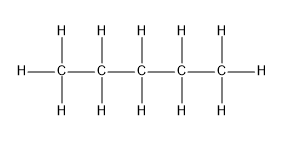
The above picture suggests that pentane is a straight chain alkane.
$2 - $ methyl pentane will have a methyl group attached to the second carbon of pentane and has the molecular formula ${C_6}{H_{14}}$ . The structure will be:
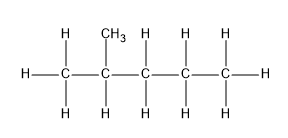
Here, we can notice a branching at the second carbon and therefore it is a branched chain alkane.
Now, we have to find whether both these compounds are homologues or not. A series of compounds with similar chemical properties and functional groups are called homologous series. They share the same general formula and show a gradual variation in their physical properties. The successive members of this series differ by a repeating unit - methylene $(C{H_2})$ group.
While considering the compounds pentane and $2 - $ methyl pentane , we can observe a difference of
$C{H_2}$ group in their molecular formulas and they have the same general formula $({C_n}{H_{2n + 2}})$ . Thus we can conclude that the given compounds are homologues and this is not because the former is a straight chain and the latter is a branched chain alkane.
Therefore, the right option is (B) Both Assertion and Reason are correct but Reason is not the correct explanation for Assertion.
Note:
Alkanes are hydrocarbons that have carbon-carbon and carbon-hydrogen single bonds. The general structural formula of alkanes is ${C_n}{H_{2n + 2}}$ where n represents the number of carbon atoms.
In the alkane family, methane $(C{H_4})$ is the first member of the homologous series followed by ethane $({C_2}{H_6})$ . They differ by a $({C_2}{H_6})$ group.
Complete answer:
Pentane, as the name signifies, “pent” $ + $ "ane” ,is a five carbon alkane with the molecular formula ${C_5}{H_{12}}$ .Given below is the structure of pentane.
The above picture suggests that pentane is a straight chain alkane.
$2 - $ methyl pentane will have a methyl group attached to the second carbon of pentane and has the molecular formula ${C_6}{H_{14}}$ . The structure will be:
Here, we can notice a branching at the second carbon and therefore it is a branched chain alkane.
Now, we have to find whether both these compounds are homologues or not. A series of compounds with similar chemical properties and functional groups are called homologous series. They share the same general formula and show a gradual variation in their physical properties. The successive members of this series differ by a repeating unit - methylene $(C{H_2})$ group.
While considering the compounds pentane and $2 - $ methyl pentane , we can observe a difference of
$C{H_2}$ group in their molecular formulas and they have the same general formula $({C_n}{H_{2n + 2}})$ . Thus we can conclude that the given compounds are homologues and this is not because the former is a straight chain and the latter is a branched chain alkane.
Therefore, the right option is (B) Both Assertion and Reason are correct but Reason is not the correct explanation for Assertion.
Note:
Alkanes are hydrocarbons that have carbon-carbon and carbon-hydrogen single bonds. The general structural formula of alkanes is ${C_n}{H_{2n + 2}}$ where n represents the number of carbon atoms.
In the alkane family, methane $(C{H_4})$ is the first member of the homologous series followed by ethane $({C_2}{H_6})$ . They differ by a $({C_2}{H_6})$ group.
Recently Updated Pages
Master Class 12 Business Studies: Engaging Questions & Answers for Success

Master Class 12 Chemistry: Engaging Questions & Answers for Success
Master Class 12 Biology: Engaging Questions & Answers for Success
Class 12 Question and Answer - Your Ultimate Solutions Guide
Master Class 11 English: Engaging Questions & Answers for Success
Master Class 11 Maths: Engaging Questions & Answers for Success
Trending doubts
Which is more stable and why class 12 chemistry CBSE
Which are the Top 10 Largest Countries of the World?
Draw a labelled sketch of the human eye class 12 physics CBSE
Differentiate between homogeneous and heterogeneous class 12 chemistry CBSE
What are the major means of transport Explain each class 12 social science CBSE
Sulphuric acid is known as the king of acids State class 12 chemistry CBSE