




Assertion: In the purely resistive element of a series LCR, AC circuit the maximum value of rms current increases with increase in the angular frequency of the applied e.m.f.
Reason: ${I_{\max }} = \dfrac{{{\varepsilon _{\max }}}}{z},z = \sqrt {{R^2} + {{\left( {\omega L - \dfrac{I}{{\omega C}}} \right)}^2}} $
Where ${I_{\max }}$ is the peak current in a cycle.
Answer
 Verified
574.8k+ views
Hint: Here, as we know that a LCR circuit is an electrical circuit. We will see the basics behind the LCR circuit and further study about the relation between the given current and impedance. This will help us get the required answer.
Complete answer:
Here, the given assertion is correct i.e., the value of current increases with increase in angular frequency of applied emf, as it makes the impedance of a circuit which gets reduced to only resistance of resistor.
Further, here the given reason is incorrect because the current becomes maximum when a decrease in impedance is observed. Here, we know that maximum current is inversely proportional to the impedance of the circuit. It is not due to the maximum of applied voltage.
Therefore, here the correct answer will be if the assertion is correct but reason is incorrect.
Additional information:
An LCR circuit also known as resonant circuit, tuned circuit or RLC circuit is an electrical circuit.
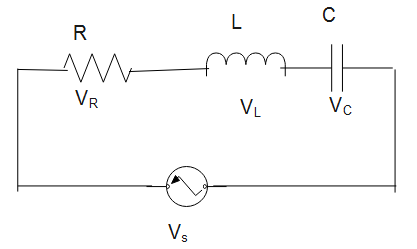
It consists of inductor L, capacitor C and resistor as shown is in the diagram.
The LCR circuit analysis is understood in terms of phasors.
Resistance, Inductance and Capacitance have very different phase relationships to each other when connected to a sinusoidal alternating supply.
A capacitor consists of two or more parallel conductive or metal plates. These plates are not connected or touching each other, but rather they are electrically separated either by air or by some form of a good insulating material like waxed paper, mica, ceramic, plastic or some form of a liquid gel as used in electrolytic capacitors. This insulating layer between capacitor’s plates is commonly called the Dielectric.
Note:
Here, we should note that capacitance is measured in Farad, or can be said as one coulomb per volt. Capacitance is dependent on the dielectric constant as well as on the distance between the two plates. The parallel plate capacitor is the simplest form of capacitor.
Complete answer:
Here, the given assertion is correct i.e., the value of current increases with increase in angular frequency of applied emf, as it makes the impedance of a circuit which gets reduced to only resistance of resistor.
Further, here the given reason is incorrect because the current becomes maximum when a decrease in impedance is observed. Here, we know that maximum current is inversely proportional to the impedance of the circuit. It is not due to the maximum of applied voltage.
Therefore, here the correct answer will be if the assertion is correct but reason is incorrect.
Additional information:
An LCR circuit also known as resonant circuit, tuned circuit or RLC circuit is an electrical circuit.
It consists of inductor L, capacitor C and resistor as shown is in the diagram.
The LCR circuit analysis is understood in terms of phasors.
Resistance, Inductance and Capacitance have very different phase relationships to each other when connected to a sinusoidal alternating supply.
A capacitor consists of two or more parallel conductive or metal plates. These plates are not connected or touching each other, but rather they are electrically separated either by air or by some form of a good insulating material like waxed paper, mica, ceramic, plastic or some form of a liquid gel as used in electrolytic capacitors. This insulating layer between capacitor’s plates is commonly called the Dielectric.
Note:
Here, we should note that capacitance is measured in Farad, or can be said as one coulomb per volt. Capacitance is dependent on the dielectric constant as well as on the distance between the two plates. The parallel plate capacitor is the simplest form of capacitor.
Recently Updated Pages
Master Class 12 Economics: Engaging Questions & Answers for Success

Master Class 12 Physics: Engaging Questions & Answers for Success
Master Class 12 English: Engaging Questions & Answers for Success
Master Class 12 Social Science: Engaging Questions & Answers for Success
Master Class 12 Maths: Engaging Questions & Answers for Success
Master Class 12 Business Studies: Engaging Questions & Answers for Success
Trending doubts
Which are the Top 10 Largest Countries of the World?
What are the major means of transport Explain each class 12 social science CBSE
Draw a labelled sketch of the human eye class 12 physics CBSE
Why cannot DNA pass through cell membranes class 12 biology CBSE
Differentiate between insitu conservation and exsitu class 12 biology CBSE
Draw a neat and well labeled diagram of TS of ovary class 12 biology CBSE