




Assertion: An electric bulb becomes dim when the electric heater in the parallel circuit is switched on.
Reason: Dimness decreases after some time.
A) Both assertion and reason are correct and the reason is the correct explanation for the assertion.
B) Both assertion and reason are correct but the reason is not the correct explanation for the assertion.
C) The assertion is correct but the reason is incorrect.
D) Both assertion and reason are incorrect.
Answer
 Verified
579.3k+ views
Hint: The resistance of the electric heater is lesser than the resistance of the electric bulb. So the electric heater when connected parallel to the electric bulb will draw more current than the bulb when it is switched on. As a result, the power consumed by the electric heater is more than that consumed by the electric bulb since power consumed is inversely proportional to the resistance.
Complete step by step answer:
Step 1: Sketching a schematic diagram depicting the parallel connection of the bulb and the heater.
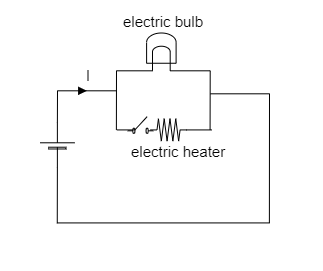
Step 2: Expressing a relation between the current drawn by each element in the sketched circuit.
Initially, the entire current in the circuit passes through the bulb alone.
We know that the resistance of a heater is lesser than that of a bulb i.e., ${R_{heater}} < {R_{bulb}}$.
When the heater is switched on, because of its lower resistance, more current will pass through it. This causes the current through the bulb to decrease and thereby resulting in the dimness of the bulb.
So the given assertion is true.
As more and more current passes through the heater, the coil in the heater heats up to a sufficient amount. Then its resistance increases and will be more than that of the bulb. Now more current will pass through the electric bulb thus causing its dimness to decrease.
So the given reason is also true.
But as mentioned above the reason is not the correct explanation of the given assertion. Hence the correct option is B.
Note:
It is according to Ohm’s law that we say more current passes through the electric heater when it is switched on. Ohm’s law gives the current to be inversely proportional to the resistance through which it passes provided the potential difference remains constant. As the electric bulb and the heater are connected to be parallel, the potential difference across the circuit remains constant. Resistance will change with a change in temperature.
Complete step by step answer:
Step 1: Sketching a schematic diagram depicting the parallel connection of the bulb and the heater.
Step 2: Expressing a relation between the current drawn by each element in the sketched circuit.
Initially, the entire current in the circuit passes through the bulb alone.
We know that the resistance of a heater is lesser than that of a bulb i.e., ${R_{heater}} < {R_{bulb}}$.
When the heater is switched on, because of its lower resistance, more current will pass through it. This causes the current through the bulb to decrease and thereby resulting in the dimness of the bulb.
So the given assertion is true.
As more and more current passes through the heater, the coil in the heater heats up to a sufficient amount. Then its resistance increases and will be more than that of the bulb. Now more current will pass through the electric bulb thus causing its dimness to decrease.
So the given reason is also true.
But as mentioned above the reason is not the correct explanation of the given assertion. Hence the correct option is B.
Note:
It is according to Ohm’s law that we say more current passes through the electric heater when it is switched on. Ohm’s law gives the current to be inversely proportional to the resistance through which it passes provided the potential difference remains constant. As the electric bulb and the heater are connected to be parallel, the potential difference across the circuit remains constant. Resistance will change with a change in temperature.
Recently Updated Pages
Master Class 12 Economics: Engaging Questions & Answers for Success

Master Class 12 Physics: Engaging Questions & Answers for Success
Master Class 12 English: Engaging Questions & Answers for Success
Master Class 12 Social Science: Engaging Questions & Answers for Success
Master Class 12 Maths: Engaging Questions & Answers for Success
Master Class 12 Business Studies: Engaging Questions & Answers for Success
Trending doubts
Which are the Top 10 Largest Countries of the World?
What are the major means of transport Explain each class 12 social science CBSE
Draw a labelled sketch of the human eye class 12 physics CBSE
Why cannot DNA pass through cell membranes class 12 biology CBSE
Differentiate between insitu conservation and exsitu class 12 biology CBSE
Draw a neat and well labeled diagram of TS of ovary class 12 biology CBSE