




Ashwini magnetised a piece of iron and using the stroking method as shown in the diagram below: Which part of the iron rod becomes the North-seeking pole?
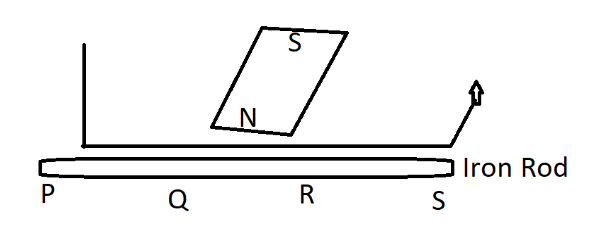
A. P
B. Q
C. R
D. S
Answer
 Verified
574.5k+ views
Hint:The magnetic impact on moving electric charges, electric currents, and magnetic materials is described by a magnetic field, which is a vector field. In a magnetic field, a moving charge experiences a force that is perpendicular to both its own velocity and the magnetic field.
Complete answer:
Magnetization is the vector field in classical electromagnetism that expresses the density of permanent or induced magnetic dipole moments in a magnetic substance. The direction of movement within this area is classified as either Axial or Diametric. The magnetic moments that cause magnetization can be caused by small electric currents caused by electron mobility in atoms, or by the spin of the electrons or nuclei. The response of a substance to an external magnetic field produces net magnetization.
Procedure:
-The steel bar is stroked in one direction from one end to the other with the same pole of the permanent magnet.
-Between strokes, the stroking magnet must be elevated sufficiently enough above the steel bar.
-Because the atomic magnets in the domain are attracted to the stroking pole, the steel bar will become a magnet with a pole formed at the end where the strokes cease, which is opposed to the stroking pole.
-When employing two magnets, the stroking poles of each magnet must be opposed, and the steel bar must be stroked in the opposite way.
-Stoking with two magnets is faster than with one magnet.
-The striking approach creates only weak magnets.
-As a result, Q becomes the North pole, and R becomes the South pole, where the rubbing magnet is raised.
Hence option B is correct.
Note:The term "demagnetization" refers to the process of reducing or eliminating magnetism. One method is to heat the item over its Curie temperature, at which point thermal fluctuations have sufficient energy to overcome exchange interactions, the source of ferromagnetic order, and destroy it. Another method is to pull it out of an electric coil that has alternating current running through it, creating fields that fight magnetization.
Complete answer:
Magnetization is the vector field in classical electromagnetism that expresses the density of permanent or induced magnetic dipole moments in a magnetic substance. The direction of movement within this area is classified as either Axial or Diametric. The magnetic moments that cause magnetization can be caused by small electric currents caused by electron mobility in atoms, or by the spin of the electrons or nuclei. The response of a substance to an external magnetic field produces net magnetization.
Procedure:
-The steel bar is stroked in one direction from one end to the other with the same pole of the permanent magnet.
-Between strokes, the stroking magnet must be elevated sufficiently enough above the steel bar.
-Because the atomic magnets in the domain are attracted to the stroking pole, the steel bar will become a magnet with a pole formed at the end where the strokes cease, which is opposed to the stroking pole.
-When employing two magnets, the stroking poles of each magnet must be opposed, and the steel bar must be stroked in the opposite way.
-Stoking with two magnets is faster than with one magnet.
-The striking approach creates only weak magnets.
-As a result, Q becomes the North pole, and R becomes the South pole, where the rubbing magnet is raised.
Hence option B is correct.
Note:The term "demagnetization" refers to the process of reducing or eliminating magnetism. One method is to heat the item over its Curie temperature, at which point thermal fluctuations have sufficient energy to overcome exchange interactions, the source of ferromagnetic order, and destroy it. Another method is to pull it out of an electric coil that has alternating current running through it, creating fields that fight magnetization.
Recently Updated Pages
Which of the following graphs shows the variation of class 12 physics CBSE

Draw a labelled diagram of the human male reproductive class 12 biology CBSE
Describe the experiment to compare the emf of two cells class 12 physics CBSE
What is standard hydrogen electrode
What is conventional current and electric current class 12 physics CBSE
2Bromopentane is treated with an alcoholic KOH solution class 12 chemistry CBSE
Trending doubts
Draw a labelled sketch of the human eye class 12 physics CBSE
Which are the Top 10 Largest Countries of the World?
Differentiate between homogeneous and heterogeneous class 12 chemistry CBSE
Draw ray diagrams each showing i myopic eye and ii class 12 physics CBSE
Which is the correct genotypic ratio of mendel dihybrid class 12 biology CBSE
What is the Full Form of PVC, PET, HDPE, LDPE, PP and PS ?