




As the glomerular filtrate courses the tubules, its composition and osmotic concentration changes, due to tubular reabsorption. Which of the following is an incorrect match regarding the segment of nephron and osmotic concentration of filtrate?
A. Segment of nephron – proximal convoluted tubule Osmotic concentration of filtrate isotonic to blood plasma
B. Segment of nephron – descending limb of Henle’s loop osmotic concentration of filtrate – Hypertonic
C. Segment of nephron – Ascending limb of Henle’s loop osmotic concentration of filtrate – Hypotonic
D. Segment of nephron – Bowman’s capsule osmotic concentration of filtrate – Hypotonic
Answer
 Verified
589.2k+ views
Hint: The first phase in the production of urine is glomerular filtration. It is the mechanism used by your kidneys to drain excess fluid and waste products from the blood into the urine that collects kidney tubules so that they can be extracted from the body.
Complete answer:
The descending limb of Henle's is water-permeable and noticeably less salt-permeable, thereby contributing only indirectly to the concentration of the interstitium. As the filtrate descends further into the renal medulla's hypertonic interstitium, water flows freely by osmosis out of the descending limb until the filtrate and interstitium equilibrate are tonic. Medulla hypertonicity (and thus urine concentration) is measured in part by the size of the Henle loops.
The thin ascending limb is impermeable to water, a vital aspect of the countercurrent exchange mechanism employed by the circle, unlike the descending limb. Sodium is constantly pumped out of the filtrate by the ascending limb, creating the hypertonic interstitium that drives countercurrent trade. As it has lost much of its sodium content, the filtrate grows hypotonic when passing through the ascending limb. In the renal cortex, this hypotonic filtrate is transferred to the distal convoluted tubule.
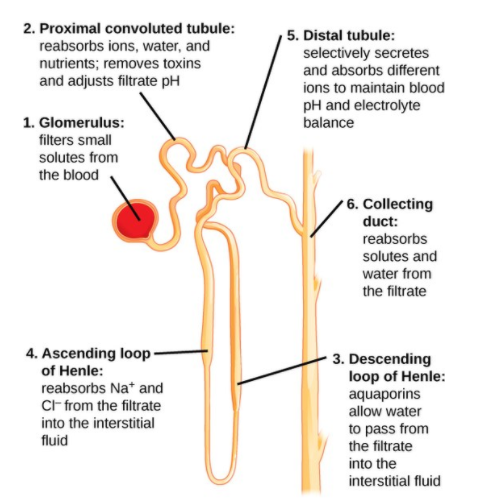
So, the incorrect statement is (A).
Note: Osmoregulation is the mechanism of manipulating body fluids and their structures. It retains blood osmotic pressure and assists in homeostasis. This is why drinking more water of around 2-3 liters is recommended, which allows the proper functioning of the kidneys. For example, during summers, we drink a lot of water, but still, we urinate fewer times in summers than in cold weather, and there is also more urine concentration.
Complete answer:
The descending limb of Henle's is water-permeable and noticeably less salt-permeable, thereby contributing only indirectly to the concentration of the interstitium. As the filtrate descends further into the renal medulla's hypertonic interstitium, water flows freely by osmosis out of the descending limb until the filtrate and interstitium equilibrate are tonic. Medulla hypertonicity (and thus urine concentration) is measured in part by the size of the Henle loops.
The thin ascending limb is impermeable to water, a vital aspect of the countercurrent exchange mechanism employed by the circle, unlike the descending limb. Sodium is constantly pumped out of the filtrate by the ascending limb, creating the hypertonic interstitium that drives countercurrent trade. As it has lost much of its sodium content, the filtrate grows hypotonic when passing through the ascending limb. In the renal cortex, this hypotonic filtrate is transferred to the distal convoluted tubule.
So, the incorrect statement is (A).
Note: Osmoregulation is the mechanism of manipulating body fluids and their structures. It retains blood osmotic pressure and assists in homeostasis. This is why drinking more water of around 2-3 liters is recommended, which allows the proper functioning of the kidneys. For example, during summers, we drink a lot of water, but still, we urinate fewer times in summers than in cold weather, and there is also more urine concentration.
Recently Updated Pages
Basicity of sulphurous acid and sulphuric acid are

Master Class 12 English: Engaging Questions & Answers for Success
Master Class 12 Social Science: Engaging Questions & Answers for Success
Master Class 12 Maths: Engaging Questions & Answers for Success
Master Class 12 Economics: Engaging Questions & Answers for Success
Master Class 12 Physics: Engaging Questions & Answers for Success
Trending doubts
Which are the Top 10 Largest Countries of the World?
Draw a labelled sketch of the human eye class 12 physics CBSE
Which state in the country is at the forefront in controlling class 12 social science CBSE
Where is the largest hydroelectric power station located class 12 biology CBSE
Which country did Danny Casey play for class 12 english CBSE
Coming together federation is practiced in A India class 12 social science CBSE