




Arrange the following in ascending order of their number per ${ mm }^{ 3 }$ present in the blood.
(a)Basophils
(b)Lymphocytes
(c)Eosinophils
(d)Neutrophils
(e)Monocytes
(A)$a\rightarrow c\rightarrow b\rightarrow d\rightarrow e$
(B)$c\rightarrow a\rightarrow d\rightarrow e\rightarrow b$
(C)$c\rightarrow a\rightarrow d\rightarrow b\rightarrow e$
(D)$a\rightarrow c\rightarrow e\rightarrow b\rightarrow d$
Answer
 Verified
587.4k+ views
Hint: It has a very characteristic nucleus. It is separated into 3-5 lobes which are associated by meager strands of chromatin. The number of lobes increases with cell age. Their nucleus usually has only two lobes. These cells are very variable in size.
Complete answer:
Neutrophils: 40% to 60%
Lymphocytes: 20% to 40%
Monocytes: 2% to 8%
Eosinophils: 1% to 4%
Basophils: 0.5% to 1%
Additional Information: Neutrophils play a central role in inflammatory processes. Neutrophils are the primary wave of cells invading infection sires. Receptors in their cell wall allow them to acknowledge foreign bodies, e.g. bacteria, and tissue debris, which they start to phagocytose and destroy. Neutrophils cannot replenish their store of granules. Their lifespan is only about one week.
The presence of antibody-antigen complexes stimulates the system. Eosinophils phagocytose these edifices, and this may keep the framework from "overreacting". Their granules also contain the enzyme’s histaminase and arylsulfatase. These enzymes break down histamine and leukotrienes, which again may dampen the consequences of their release by basophils or mast cells. MBP, which may also function as a cytotoxin, and its release by eosinophils could also be involved within the response of the body against parasitic infections, which are amid an increase in the number of eosinophils.
Heparin and histamine are vasoactive substances. They dilate the blood vessels, make vessel walls more permeable, and stop blood clotting. As a consequence, they facilitate the access of other lymphocytes and plasma-borne substances of importance for the immune response (e.g. antibodies) to, e.g., a site of infection. Antibodies produced by plasma cells (activated B-lymphocytes;) bind to Fc-receptors on the cell wall of basophils.
Once monocytes enter the animal tissue they differentiate into macrophages. The phagocytose microorganisms, tissue debris, and therefore the dead neutrophils. Monocytes also give rise to osteoclasts, which can dissolve bone. Osteoclasts are of importance in bone remodeling.
Most lymphocytes in the bloodstream belong to either the group of B-lymphocytes (~5%) or the group of T-lymphocytes (~90%). Unless they become activated, the 2 groups can't easily be distinguished using routine light or microscopy.
So the correct answer to the above question is ‘$a\rightarrow c\rightarrow e\rightarrow b\rightarrow d$’.
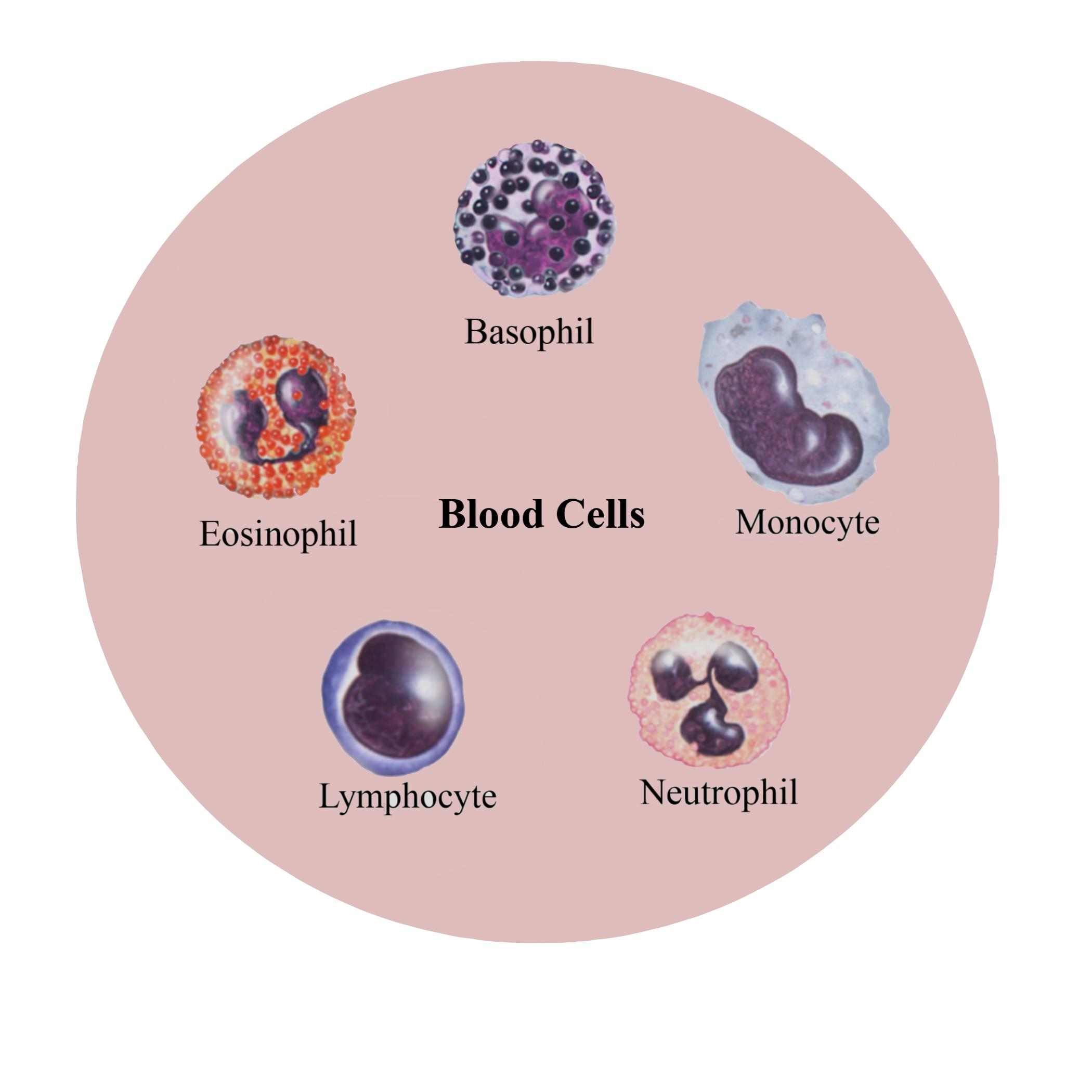
Note: Upon exposure to antigens by antigen-presenting cells (e.g. macrophages) and T-helper cells (one exceptional gathering of T-lymphocytes) B-lymphocytes separate into counteracting agents creating plasma cells. The number of cytoplasm increases and RER fills a large portion of the cytoplasm of plasma cells. T-lymphocytes represent the "cellular arm" of the immune reaction (cytotoxic T cells) and should attack foreign cells, cancer cells, and cells infected by, e.g., a virus.
Complete answer:
Neutrophils: 40% to 60%
Lymphocytes: 20% to 40%
Monocytes: 2% to 8%
Eosinophils: 1% to 4%
Basophils: 0.5% to 1%
Additional Information: Neutrophils play a central role in inflammatory processes. Neutrophils are the primary wave of cells invading infection sires. Receptors in their cell wall allow them to acknowledge foreign bodies, e.g. bacteria, and tissue debris, which they start to phagocytose and destroy. Neutrophils cannot replenish their store of granules. Their lifespan is only about one week.
The presence of antibody-antigen complexes stimulates the system. Eosinophils phagocytose these edifices, and this may keep the framework from "overreacting". Their granules also contain the enzyme’s histaminase and arylsulfatase. These enzymes break down histamine and leukotrienes, which again may dampen the consequences of their release by basophils or mast cells. MBP, which may also function as a cytotoxin, and its release by eosinophils could also be involved within the response of the body against parasitic infections, which are amid an increase in the number of eosinophils.
Heparin and histamine are vasoactive substances. They dilate the blood vessels, make vessel walls more permeable, and stop blood clotting. As a consequence, they facilitate the access of other lymphocytes and plasma-borne substances of importance for the immune response (e.g. antibodies) to, e.g., a site of infection. Antibodies produced by plasma cells (activated B-lymphocytes;) bind to Fc-receptors on the cell wall of basophils.
Once monocytes enter the animal tissue they differentiate into macrophages. The phagocytose microorganisms, tissue debris, and therefore the dead neutrophils. Monocytes also give rise to osteoclasts, which can dissolve bone. Osteoclasts are of importance in bone remodeling.
Most lymphocytes in the bloodstream belong to either the group of B-lymphocytes (~5%) or the group of T-lymphocytes (~90%). Unless they become activated, the 2 groups can't easily be distinguished using routine light or microscopy.
So the correct answer to the above question is ‘$a\rightarrow c\rightarrow e\rightarrow b\rightarrow d$’.
Note: Upon exposure to antigens by antigen-presenting cells (e.g. macrophages) and T-helper cells (one exceptional gathering of T-lymphocytes) B-lymphocytes separate into counteracting agents creating plasma cells. The number of cytoplasm increases and RER fills a large portion of the cytoplasm of plasma cells. T-lymphocytes represent the "cellular arm" of the immune reaction (cytotoxic T cells) and should attack foreign cells, cancer cells, and cells infected by, e.g., a virus.
Recently Updated Pages
Three beakers labelled as A B and C each containing 25 mL of water were taken A small amount of NaOH anhydrous CuSO4 and NaCl were added to the beakers A B and C respectively It was observed that there was an increase in the temperature of the solutions contained in beakers A and B whereas in case of beaker C the temperature of the solution falls Which one of the following statements isarecorrect i In beakers A and B exothermic process has occurred ii In beakers A and B endothermic process has occurred iii In beaker C exothermic process has occurred iv In beaker C endothermic process has occurred

Master Class 11 Social Science: Engaging Questions & Answers for Success
Master Class 11 Physics: Engaging Questions & Answers for Success
Master Class 11 Maths: Engaging Questions & Answers for Success
Master Class 11 Economics: Engaging Questions & Answers for Success
Master Class 11 Computer Science: Engaging Questions & Answers for Success
Three beakers labelled as A B and C each containing 25 mL of water were taken A small amount of NaOH anhydrous CuSO4 and NaCl were added to the beakers A B and C respectively It was observed that there was an increase in the temperature of the solutions contained in beakers A and B whereas in case of beaker C the temperature of the solution falls Which one of the following statements isarecorrect i In beakers A and B exothermic process has occurred ii In beakers A and B endothermic process has occurred iii In beaker C exothermic process has occurred iv In beaker C endothermic process has occurred
Master Class 11 Social Science: Engaging Questions & Answers for Success
Master Class 11 Physics: Engaging Questions & Answers for Success
Trending doubts
One Metric ton is equal to kg A 10000 B 1000 C 100 class 11 physics CBSE
There are 720 permutations of the digits 1 2 3 4 5 class 11 maths CBSE
State and prove Bernoullis theorem class 11 physics CBSE
Draw a diagram of a plant cell and label at least eight class 11 biology CBSE
Difference Between Prokaryotic Cells and Eukaryotic Cells
Discuss the various forms of bacteria class 11 biology CBSE