




Area of the region bounded by two parabolas $y={{x}^{2}}$ and $x={{y}^{2}}$ is.
(A) $\dfrac{1}{3}$
(B) $3$
(C) $\dfrac{1}{4}$
(D) $4$
Answer
 Verified
609k+ views
Hint: For answering this question we will obtain the simplified equation of the bounded region by the two parabolas $y={{x}^{2}}$ and $x={{y}^{2}}$ as follows \[{{x}^{2}}-\sqrt{x}\] and integrate it over the intersection points as the limits.
Complete answer:
Now considering from the questions we have two parabolas $y={{x}^{2}}$ and $x={{y}^{2}}$ .These curves can also be written as $y={{x}^{2}}$ and $y=\sqrt{x}$ .
To find the intersection point of both curves we will use \[{{x}^{2}}=\sqrt{x}\] which can be simply written as ${{x}^{4}}=x$ .
By further simplifying we will have ${{x}^{4}}-x=0\Rightarrow x\left( {{x}^{3}}-1 \right)=0$ .
Hence, $\left( 0,0 \right)$ and $\left( 1,1 \right)$ are the two points of intersection of the given parabolas.
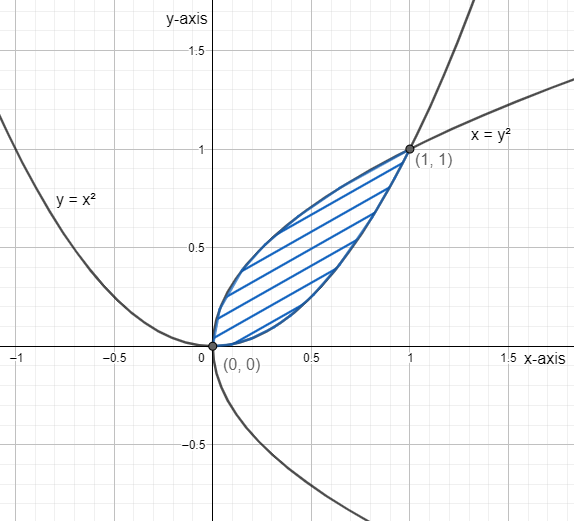
To find the area between the parabolas that is the area under the curve we need to subtract will the upper curve from the lower curve so we will have $\int_{0}^{1}{\left( \sqrt{x}-{{x}^{2}} \right)dx}$ .
As we know that $\int{{{x}^{n}}}dx=\dfrac{{{x}^{n+1}}}{n+1},n\ne -1$ by using this we will have $\int_{0}^{1}{\left( \sqrt{x}-{{x}^{2}} \right)dx}=\left( \dfrac{{{x}^{\dfrac{3}{2}}}}{\dfrac{3}{2}}-\dfrac{{{x}^{3}}}{3} \right)_{0}^{1}$ .
By further simplifying we will have $\dfrac{2}{3}-\dfrac{1}{3}=\dfrac{1}{3}$ .
Hence, we can conclude that the area of the region bounded by two parabolas $y={{x}^{2}}$ and $x={{y}^{2}}$ is given as $\dfrac{1}{3}$ .
Hence, option A is correct.
Note:
While answering this type of question we should note a point that area can never be negative so we need to apply modulus to the final result. The intersection points should be obtained exactly. This question can be answered in another way by integrating it over the y-limits as follows: $\int_{0}^{1}{\left( {{y}^{2}}-\sqrt{y} \right)dy}=\left( \dfrac{{{y}^{3}}}{3}-\dfrac{{{y}^{\dfrac{3}{2}}}}{\dfrac{3}{2}} \right)_{0}^{1}=-\dfrac{1}{3}$ the same answer.
Complete answer:
Now considering from the questions we have two parabolas $y={{x}^{2}}$ and $x={{y}^{2}}$ .These curves can also be written as $y={{x}^{2}}$ and $y=\sqrt{x}$ .
To find the intersection point of both curves we will use \[{{x}^{2}}=\sqrt{x}\] which can be simply written as ${{x}^{4}}=x$ .
By further simplifying we will have ${{x}^{4}}-x=0\Rightarrow x\left( {{x}^{3}}-1 \right)=0$ .
Hence, $\left( 0,0 \right)$ and $\left( 1,1 \right)$ are the two points of intersection of the given parabolas.
To find the area between the parabolas that is the area under the curve we need to subtract will the upper curve from the lower curve so we will have $\int_{0}^{1}{\left( \sqrt{x}-{{x}^{2}} \right)dx}$ .
As we know that $\int{{{x}^{n}}}dx=\dfrac{{{x}^{n+1}}}{n+1},n\ne -1$ by using this we will have $\int_{0}^{1}{\left( \sqrt{x}-{{x}^{2}} \right)dx}=\left( \dfrac{{{x}^{\dfrac{3}{2}}}}{\dfrac{3}{2}}-\dfrac{{{x}^{3}}}{3} \right)_{0}^{1}$ .
By further simplifying we will have $\dfrac{2}{3}-\dfrac{1}{3}=\dfrac{1}{3}$ .
Hence, we can conclude that the area of the region bounded by two parabolas $y={{x}^{2}}$ and $x={{y}^{2}}$ is given as $\dfrac{1}{3}$ .
Hence, option A is correct.
Note:
While answering this type of question we should note a point that area can never be negative so we need to apply modulus to the final result. The intersection points should be obtained exactly. This question can be answered in another way by integrating it over the y-limits as follows: $\int_{0}^{1}{\left( {{y}^{2}}-\sqrt{y} \right)dy}=\left( \dfrac{{{y}^{3}}}{3}-\dfrac{{{y}^{\dfrac{3}{2}}}}{\dfrac{3}{2}} \right)_{0}^{1}=-\dfrac{1}{3}$ the same answer.
Recently Updated Pages
Master Class 12 Business Studies: Engaging Questions & Answers for Success

Master Class 12 Chemistry: Engaging Questions & Answers for Success
Master Class 12 Biology: Engaging Questions & Answers for Success
Class 12 Question and Answer - Your Ultimate Solutions Guide
Master Class 11 English: Engaging Questions & Answers for Success
Master Class 11 Social Science: Engaging Questions & Answers for Success
Trending doubts
Which are the Top 10 Largest Countries of the World?
Draw a labelled sketch of the human eye class 12 physics CBSE
Differentiate between homogeneous and heterogeneous class 12 chemistry CBSE
Differentiate between Pyramid of energy and pyramid class 12 biology CBSE
Why is the cell called the structural and functional class 12 biology CBSE
Draw the diagram of the pyramid of energy Explain In class 12 biology CBSE