




Area of the region bounded by the curve $y=\dfrac{1}{x}+1$, the tangent at \[\left( 2,\dfrac{3}{2} \right)\] and the line $x=1$ is
A. $\dfrac{4}{5}+\ln 2$
B. $-\dfrac{5}{4}+\ln 3$
C. $-\dfrac{5}{8}+\ln 2$
D. $\ln 2-\dfrac{5}{8}$
Answer
 Verified
540k+ views
Hint: We first find the tangent of the curve $y=\dfrac{1}{x}+1$ at \[\left( 2,\dfrac{3}{2} \right)\]. We use the slope of the curve and find the three equations to place them in the graph. Then from the intersecting points we find the area and using integral form we find the solution.
Complete step by step answer:
The area is bounded by the curve $y=\dfrac{1}{x}+1$, the tangent at \[A=\left( 2,\dfrac{3}{2} \right)\] and the line $x=1$.
We first need to find the equation of the tangent. We find the slope $\dfrac{dy}{dx}$ for the curve $y=\dfrac{1}{x}+1$
Differentiating the equation $y=\dfrac{1}{x}+1$ with respect to $x$, we get
$\begin{align}
& y=\dfrac{1}{x}+1 \\
& \Rightarrow \dfrac{dy}{dx}=-\dfrac{1}{{{x}^{2}}} \\
\end{align}$
We find the slope value of the curve at \[\left( 2,\dfrac{3}{2} \right)\] which is ${{\left[ \dfrac{dy}{dx} \right]}_{\left( 2,\dfrac{3}{2} \right)}}={{\left[ -\dfrac{1}{{{x}^{2}}} \right]}_{\left( 2,\dfrac{3}{2} \right)}}=-\dfrac{1}{4}$.
The equation of tangent is $\left( y-b \right)={{\left[ \dfrac{dy}{dx} \right]}_{\left( a,b \right)}}\left( x-a \right)$ where \[\left( a,b \right)\equiv \left( 2,\dfrac{3}{2} \right)\].
$\begin{align}
& \left( y-\dfrac{3}{2} \right)=\left[ -\dfrac{1}{4} \right]\left( x-2 \right) \\
& \Rightarrow 4y-6=2-x \\
& \Rightarrow x+4y=8 \\
\end{align}$
Now we plot the graphs of $y=\dfrac{1}{x}+1$, $x+4y=8$ and $x=1$. The yellow marked area is the required one.
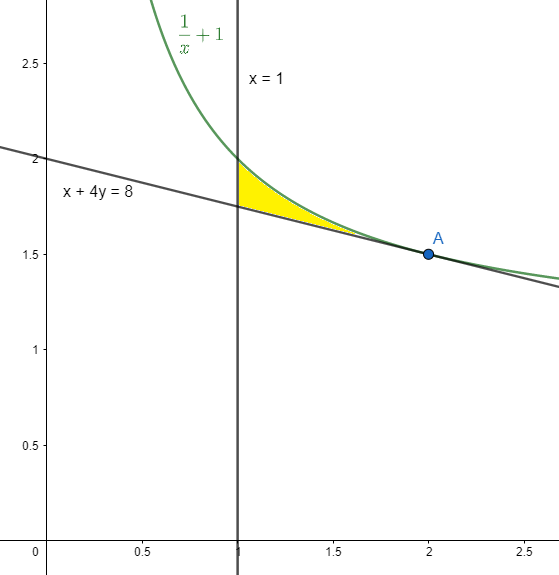
So, we subtract the area under the line $x+4y=8$ from the area under the curve $y=\dfrac{1}{x}+1$ to find the solution. The limit for the areas will be from $x=1$ to $x=2$.
We know that $x+4y=8$ which gives $y=\dfrac{8-x}{4}$
The integral form will be $\int\limits_{1}^{2}{\left( \dfrac{1}{x}+1 \right)dx}-\int\limits_{1}^{2}{\left( \dfrac{8-x}{4} \right)dx}=\int\limits_{1}^{2}{\left( \dfrac{1}{x}+1-\dfrac{8-x}{4} \right)dx}=\int\limits_{1}^{2}{\left( \dfrac{1}{x}-\dfrac{4-x}{4} \right)dx}$.
Integrating we get
$\begin{align}
& \int\limits_{1}^{2}{\left( \dfrac{1}{x}-\dfrac{4-x}{4} \right)dx} \\
& =\left[ \ln x-x+\dfrac{{{x}^{2}}}{8} \right]_{1}^{2} \\
& =\left[ \ln 2-2+\dfrac{4}{8} \right]-\left[ \log 1-1+\dfrac{1}{8} \right] \\
& =\ln 2-\dfrac{5}{8} \\
\end{align}$
The correct option is D.
Note: we need to remember that the required area is bounded on the left side by the line $x=1$. The intersecting point of the line $x=1$ and $x+4y=8$ is $\left( 1,\dfrac{7}{4} \right)$. The area under a curve between two points is found out by doing a definite integral between the two points.
Complete step by step answer:
The area is bounded by the curve $y=\dfrac{1}{x}+1$, the tangent at \[A=\left( 2,\dfrac{3}{2} \right)\] and the line $x=1$.
We first need to find the equation of the tangent. We find the slope $\dfrac{dy}{dx}$ for the curve $y=\dfrac{1}{x}+1$
Differentiating the equation $y=\dfrac{1}{x}+1$ with respect to $x$, we get
$\begin{align}
& y=\dfrac{1}{x}+1 \\
& \Rightarrow \dfrac{dy}{dx}=-\dfrac{1}{{{x}^{2}}} \\
\end{align}$
We find the slope value of the curve at \[\left( 2,\dfrac{3}{2} \right)\] which is ${{\left[ \dfrac{dy}{dx} \right]}_{\left( 2,\dfrac{3}{2} \right)}}={{\left[ -\dfrac{1}{{{x}^{2}}} \right]}_{\left( 2,\dfrac{3}{2} \right)}}=-\dfrac{1}{4}$.
The equation of tangent is $\left( y-b \right)={{\left[ \dfrac{dy}{dx} \right]}_{\left( a,b \right)}}\left( x-a \right)$ where \[\left( a,b \right)\equiv \left( 2,\dfrac{3}{2} \right)\].
$\begin{align}
& \left( y-\dfrac{3}{2} \right)=\left[ -\dfrac{1}{4} \right]\left( x-2 \right) \\
& \Rightarrow 4y-6=2-x \\
& \Rightarrow x+4y=8 \\
\end{align}$
Now we plot the graphs of $y=\dfrac{1}{x}+1$, $x+4y=8$ and $x=1$. The yellow marked area is the required one.
So, we subtract the area under the line $x+4y=8$ from the area under the curve $y=\dfrac{1}{x}+1$ to find the solution. The limit for the areas will be from $x=1$ to $x=2$.
We know that $x+4y=8$ which gives $y=\dfrac{8-x}{4}$
The integral form will be $\int\limits_{1}^{2}{\left( \dfrac{1}{x}+1 \right)dx}-\int\limits_{1}^{2}{\left( \dfrac{8-x}{4} \right)dx}=\int\limits_{1}^{2}{\left( \dfrac{1}{x}+1-\dfrac{8-x}{4} \right)dx}=\int\limits_{1}^{2}{\left( \dfrac{1}{x}-\dfrac{4-x}{4} \right)dx}$.
Integrating we get
$\begin{align}
& \int\limits_{1}^{2}{\left( \dfrac{1}{x}-\dfrac{4-x}{4} \right)dx} \\
& =\left[ \ln x-x+\dfrac{{{x}^{2}}}{8} \right]_{1}^{2} \\
& =\left[ \ln 2-2+\dfrac{4}{8} \right]-\left[ \log 1-1+\dfrac{1}{8} \right] \\
& =\ln 2-\dfrac{5}{8} \\
\end{align}$
The correct option is D.
Note: we need to remember that the required area is bounded on the left side by the line $x=1$. The intersecting point of the line $x=1$ and $x+4y=8$ is $\left( 1,\dfrac{7}{4} \right)$. The area under a curve between two points is found out by doing a definite integral between the two points.
Recently Updated Pages
Master Class 12 Economics: Engaging Questions & Answers for Success

Master Class 12 Physics: Engaging Questions & Answers for Success
Master Class 12 English: Engaging Questions & Answers for Success
Master Class 12 Social Science: Engaging Questions & Answers for Success
Master Class 12 Maths: Engaging Questions & Answers for Success
Master Class 12 Business Studies: Engaging Questions & Answers for Success
Trending doubts
Which are the Top 10 Largest Countries of the World?
What are the major means of transport Explain each class 12 social science CBSE
Draw a labelled sketch of the human eye class 12 physics CBSE
Why cannot DNA pass through cell membranes class 12 biology CBSE
Differentiate between insitu conservation and exsitu class 12 biology CBSE
Draw a neat and well labeled diagram of TS of ovary class 12 biology CBSE