




What are the types of Sori classified based on the pattern of Maturation of Sporangia?
Answer
 Verified
531.3k+ views
Hint: Sori or Sorus is a Cluster of Sporangia, it contains the spores in plants like Pteridophytes (Fern) and fungi. Pteridophytes do not have seeds or flowers, they reproduce by Spores. Usually they are located on the lower surface of fern leaves.
Complete ANSWER:
INTRODUCTION :
Sori or Sorus is a Group of spores (sporangia) that are produced on the adaxial (upper surface) or abaxial (lower surface) of Pteridophytes plant leaves (ferns). In ferns these form a yellowish or brownish mass on the edge or underside of leaves and Some species of ferns, sours are protected by Scale or Film of tissue called indusium. In lichens and fungi, the sorus is surrounded by an external layer.
There are three types of Sori based on Maturation of Sporangia :
1. Simple Sorus :
In simple Sori, the maturation of spores occurs at the same stage of development. They are also referred to as Simplices. They mature and develop at the same stage.
2. The Gradate or Basipetal Sorus :
In Gradate Sorus, the spores are occupied in the Middle position with oblique annulus. In this, internal spaces within the radial sorus overlap and are filled by sporangia. In this spores shows Basipetal or Acropetal arrangement.
3. The Mixed sorus :
Mixed sorus is one in which there is irregular ripening of later sporangia among earlier ones, which is regarded as advanced.This sorus is present in vertical fashion. The aggregation of sorus occurs in old and young sporangia that are mixed and show no regular arrangement. In Mixed sorus, the Old and Young sporangia are indiscriminately mixed.
NOTE :
The Spore producing structures are called Sporangia, They are generally referred to as Sori or sorus. Reproductive unit of the plant is the spore that is used for dispersal and survival of the plant in unfavourable conditions.
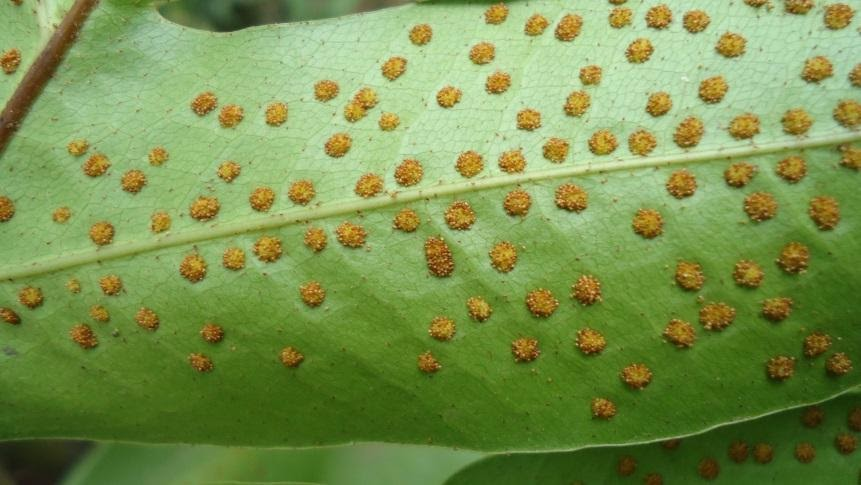
Fig : Sporangia is located at the lower surface (abaxial) of fern leaves.
Complete ANSWER:
INTRODUCTION :
Sori or Sorus is a Group of spores (sporangia) that are produced on the adaxial (upper surface) or abaxial (lower surface) of Pteridophytes plant leaves (ferns). In ferns these form a yellowish or brownish mass on the edge or underside of leaves and Some species of ferns, sours are protected by Scale or Film of tissue called indusium. In lichens and fungi, the sorus is surrounded by an external layer.
There are three types of Sori based on Maturation of Sporangia :
1. Simple Sorus :
In simple Sori, the maturation of spores occurs at the same stage of development. They are also referred to as Simplices. They mature and develop at the same stage.
2. The Gradate or Basipetal Sorus :
In Gradate Sorus, the spores are occupied in the Middle position with oblique annulus. In this, internal spaces within the radial sorus overlap and are filled by sporangia. In this spores shows Basipetal or Acropetal arrangement.
3. The Mixed sorus :
Mixed sorus is one in which there is irregular ripening of later sporangia among earlier ones, which is regarded as advanced.This sorus is present in vertical fashion. The aggregation of sorus occurs in old and young sporangia that are mixed and show no regular arrangement. In Mixed sorus, the Old and Young sporangia are indiscriminately mixed.
NOTE :
The Spore producing structures are called Sporangia, They are generally referred to as Sori or sorus. Reproductive unit of the plant is the spore that is used for dispersal and survival of the plant in unfavourable conditions.
Fig : Sporangia is located at the lower surface (abaxial) of fern leaves.
Recently Updated Pages
Master Class 12 Economics: Engaging Questions & Answers for Success

Master Class 12 English: Engaging Questions & Answers for Success
Master Class 12 Social Science: Engaging Questions & Answers for Success
Master Class 12 Maths: Engaging Questions & Answers for Success
Master Class 12 Physics: Engaging Questions & Answers for Success
Master Class 11 Social Science: Engaging Questions & Answers for Success
Trending doubts
One Metric ton is equal to kg A 10000 B 1000 C 100 class 11 physics CBSE
Difference Between Prokaryotic Cells and Eukaryotic Cells
Two of the body parts which do not appear in MRI are class 11 biology CBSE
1 ton equals to A 100 kg B 1000 kg C 10 kg D 10000 class 11 physics CBSE
Draw a diagram of nephron and explain its structur class 11 biology CBSE
10 examples of friction in our daily life