




What are the total number of stereoisomers of $ 2,3 - $ dichlorobutane?
Answer
 Verified
555.3k+ views
Hint: Isomerism is the property of chemical compounds in which compounds can exist in two different forms but having the same molecular formula. Stereochemistry is a type of isomer in which the position of substituents changes in three-dimensional orientation.
Complete answer:
Stereoisomerism of particular compounds have the same chemical formula, same number of atoms but only spatial arrangements differ. Therefore, stereoisomerism is also known as spatial isomerism.
$ 2,3 - $ dichlorobutane molecule do not give any geometric isomers because geometric isomerism is shown by the compounds having double bonds.
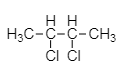
As we see, the $ 2,3 - $ dichlorobutane molecule is symmetrical in nature due to the presence of the same substituent in the end.
$ 2,3 - $ dichlorobutane molecule has a two chiral center hence capable of rotating plane polarized light into right and left direction.
The mathematical formula which is used to calculate the total number of stereoisomers for an even number of chiral centers is;
$ S = {2^{n - 1}} + {2^{n/2 - 1}} $
Where $ S = $ total number of stereoisomers
$ n = $ Total number of chiral centers present in a molecule
As we noticed from the structure there are two chiral centers so the value of $ \left( n \right) $ is $ 2 $ .
Now put the value of $ \left( n \right) $ in the above formula-
$ S = {2^{2 - 1}} + {2^{\dfrac{2}{2} - 1}} $
After solving this equation, we get
$ S = {2^1} + {2^0} $
$ S = 2 + 1 $
Hence, the value of $ S $ after calculation is $ 3 $ .
Hence according to the formula there are a total of three stereoisomers possible for $ 2,3 - $ dichlorobutane.


As we see from the above structure, figure $ \left( {III} \right) $ shows the presence of symmetry of a molecule and hence it is mesomeres. As we know mesomeres have net zero optical rotation therefore they are considered as an optically inactive isomer.
Hence the total number of stereoisomers of $ 2,3 - $ dichlorobutane is $ 3 $ .
Note:
Enantiomers or optical isomers are two forms of stereoisomers which are mirror images of each other and are non-superimposable in nature. Diastereomers are two forms of stereoisomers which are non-mirror images of each other and are non-superimposable in nature.
Complete answer:
Stereoisomerism of particular compounds have the same chemical formula, same number of atoms but only spatial arrangements differ. Therefore, stereoisomerism is also known as spatial isomerism.
$ 2,3 - $ dichlorobutane molecule do not give any geometric isomers because geometric isomerism is shown by the compounds having double bonds.
As we see, the $ 2,3 - $ dichlorobutane molecule is symmetrical in nature due to the presence of the same substituent in the end.
$ 2,3 - $ dichlorobutane molecule has a two chiral center hence capable of rotating plane polarized light into right and left direction.
The mathematical formula which is used to calculate the total number of stereoisomers for an even number of chiral centers is;
$ S = {2^{n - 1}} + {2^{n/2 - 1}} $
Where $ S = $ total number of stereoisomers
$ n = $ Total number of chiral centers present in a molecule
As we noticed from the structure there are two chiral centers so the value of $ \left( n \right) $ is $ 2 $ .
Now put the value of $ \left( n \right) $ in the above formula-
$ S = {2^{2 - 1}} + {2^{\dfrac{2}{2} - 1}} $
After solving this equation, we get
$ S = {2^1} + {2^0} $
$ S = 2 + 1 $
Hence, the value of $ S $ after calculation is $ 3 $ .
Hence according to the formula there are a total of three stereoisomers possible for $ 2,3 - $ dichlorobutane.
As we see from the above structure, figure $ \left( {III} \right) $ shows the presence of symmetry of a molecule and hence it is mesomeres. As we know mesomeres have net zero optical rotation therefore they are considered as an optically inactive isomer.
Hence the total number of stereoisomers of $ 2,3 - $ dichlorobutane is $ 3 $ .
Note:
Enantiomers or optical isomers are two forms of stereoisomers which are mirror images of each other and are non-superimposable in nature. Diastereomers are two forms of stereoisomers which are non-mirror images of each other and are non-superimposable in nature.
Recently Updated Pages
Which will be the least stable resonating structure class 11 chemistry CBSE

How many 5 digit telephone numbers can be construc-class-11-maths-CBSE
How do you find the angle of the resultant vector class 11 physics CBSE
Draw labelled diagram of the following i Gram seed class 11 biology CBSE
What is the need and importance of classification class 11 biology CBSE
The way in which the sparrows expressed their sorrow class 11 english CBSE
Trending doubts
One Metric ton is equal to kg A 10000 B 1000 C 100 class 11 physics CBSE
Find the value of the expression given below sin 30circ class 11 maths CBSE
1 Quintal is equal to a 110 kg b 10 kg c 100kg d 1000 class 11 physics CBSE
Draw a diagram of nephron and explain its structur class 11 biology CBSE
10 examples of friction in our daily life
Proton was discovered by A Thomson B Rutherford C Chadwick class 11 chemistry CBSE