




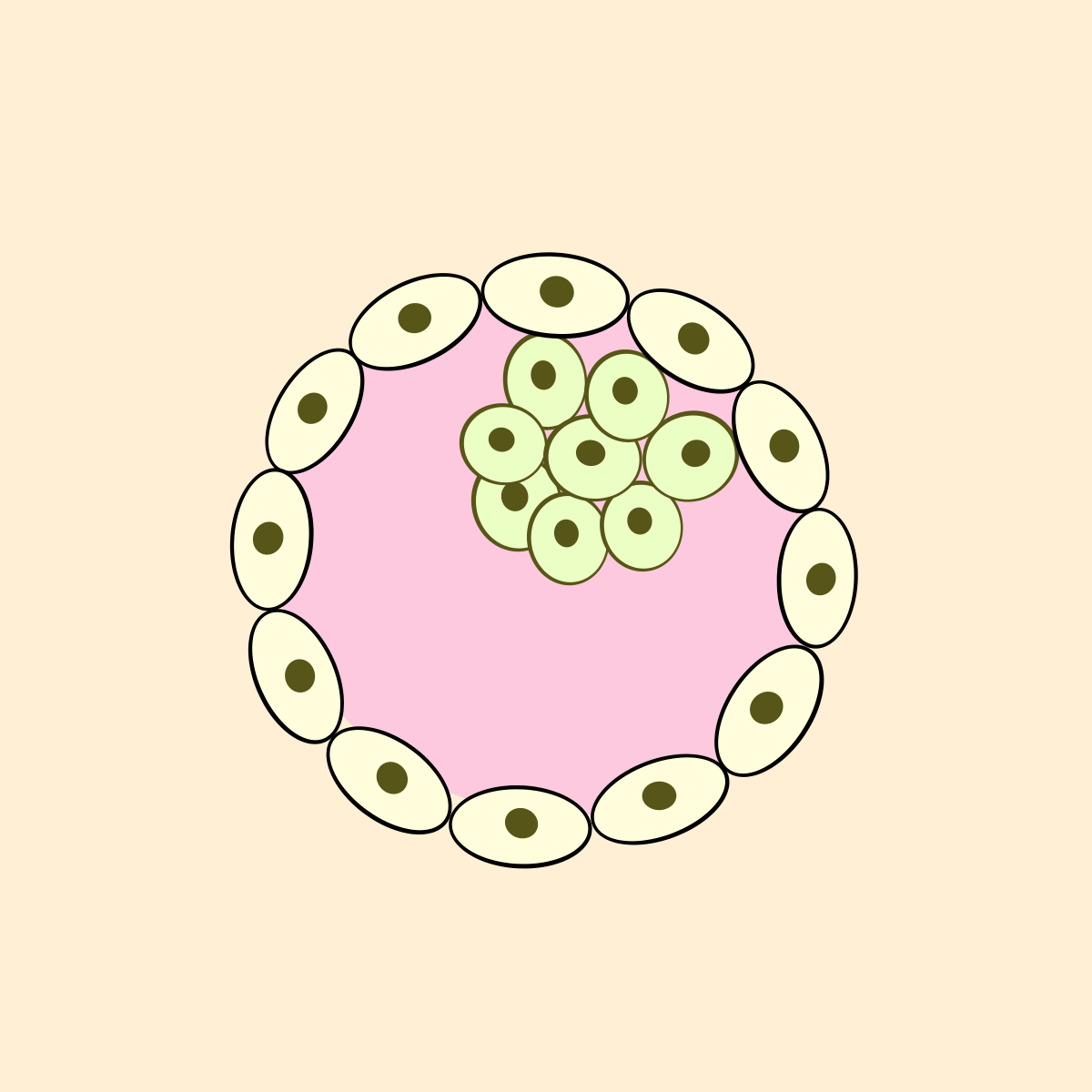
Where are the stem cells located in this embryo?
Answer
 Verified
609.9k+ views
Hint: Embryonic stem cells (ES cells or ESCs) are pluripotent in nature. They are derived from the inner cell mass of a blastocyst. The human embryos reach the blastocyst stage around 4–5 days post fertilization, at which period they comprise nearly 50–150 cells. A blastocyst is an early-stage pre-implantation embryo.
Complete step by step answer:
- Pluripotency is the ability to differentiate to generate primitive ectoderm, which differentiates during gastrulation into all derivatives of the three primary germ layers: ectoderm, endoderm, and mesoderm.
- These germ layers in turn generate each of the more than 220 cell types in the human body.
- The stem cells initially form precursor cells that differentiate into the desired cell types.
- Due to the plasticity of these stem cells and the unlimited capacity to self- renew, embryonic stem cell therapies have been proposed for regenerative medicine and tissue replacement after injury or disease.
- Pluripotent stem cells have shown promise in treating a number of varying conditions.
- Corrections of disorders with loss of normal cells- diabetes, Alzheimer’s disease, Parkinson’s disease can be achieved through appropriate cell therapy.
- Engineering and replacement of various tissues can also be achieved via embryonic stem cells.
- Stem cells are nowadays engaged for the discovery of new drugs and for testing the safety of drugs.
- Human developmental studies are done through stem cell experiments.
Note:
- There are various serious ethical, legal, and political issues surrounding human ES cell research.
- There are enormous technical difficulties in stem cell research.
- The lack of tissue- specific differentiation markers may be a characteristic feature of stem cells.
Complete step by step answer:
- Pluripotency is the ability to differentiate to generate primitive ectoderm, which differentiates during gastrulation into all derivatives of the three primary germ layers: ectoderm, endoderm, and mesoderm.
- These germ layers in turn generate each of the more than 220 cell types in the human body.
- The stem cells initially form precursor cells that differentiate into the desired cell types.
- Due to the plasticity of these stem cells and the unlimited capacity to self- renew, embryonic stem cell therapies have been proposed for regenerative medicine and tissue replacement after injury or disease.
- Pluripotent stem cells have shown promise in treating a number of varying conditions.
- Corrections of disorders with loss of normal cells- diabetes, Alzheimer’s disease, Parkinson’s disease can be achieved through appropriate cell therapy.
- Engineering and replacement of various tissues can also be achieved via embryonic stem cells.
- Stem cells are nowadays engaged for the discovery of new drugs and for testing the safety of drugs.
- Human developmental studies are done through stem cell experiments.
Note:
- There are various serious ethical, legal, and political issues surrounding human ES cell research.
- There are enormous technical difficulties in stem cell research.
- The lack of tissue- specific differentiation markers may be a characteristic feature of stem cells.
Recently Updated Pages
Master Class 9 General Knowledge: Engaging Questions & Answers for Success

Master Class 9 Maths: Engaging Questions & Answers for Success
Master Class 9 Science: Engaging Questions & Answers for Success
Master Class 9 English: Engaging Questions & Answers for Success
Master Class 9 Social Science: Engaging Questions & Answers for Success
Class 9 Question and Answer - Your Ultimate Solutions Guide
Trending doubts
Which are the Top 10 Largest Countries of the World?
Draw a labelled sketch of the human eye class 12 physics CBSE
Differentiate between homogeneous and heterogeneous class 12 chemistry CBSE
Sulphuric acid is known as the king of acids State class 12 chemistry CBSE
Why is the cell called the structural and functional class 12 biology CBSE
A dentist uses a small mirror that gives a magnification class 12 physics CBSE