




What are the reaction sequences of glucosazone formation?
Answer
 Verified
665.4k+ views
Hint – You can start by describing glucose and its uses. Then move on to describe phenylhydrazine and its uses. Then describe the reaction between glucose and phenylhydrazine. Then finally describe glucosazone and its properties.
Complete step by step solution:
Glucose is a six carbon compound made by plants during the process of photosynthesis. During photosynthesis plants use carbon dioxide and water and with the help of sunlight in a complicated process produce glucose. Glucose is a monosaccharide that is found in abundance in nature. Glucose can be found anywhere from the sweetener used in your food to the cellulose in the plant cell wall.
Phenylhydrazine is a chemical compound having the molecular formula
 Phenylhydrazine is in an oily form at room temperature. When it comes in contact with air, their color changes from yellow color to dark red color. Phenylhydrazine is produced by the following reactions. The first reaction is between sodium nitrite with aniline in the presence of hydrogen chloride. The former reaction produces diazonium salt which is further reduced using sodium sulfite with sodium hydroxide and thus phenylhydrazine is formed. Phenylhydrazine under Fischer indole synthesis produces indoles.
The reaction of glucosazone formation are –
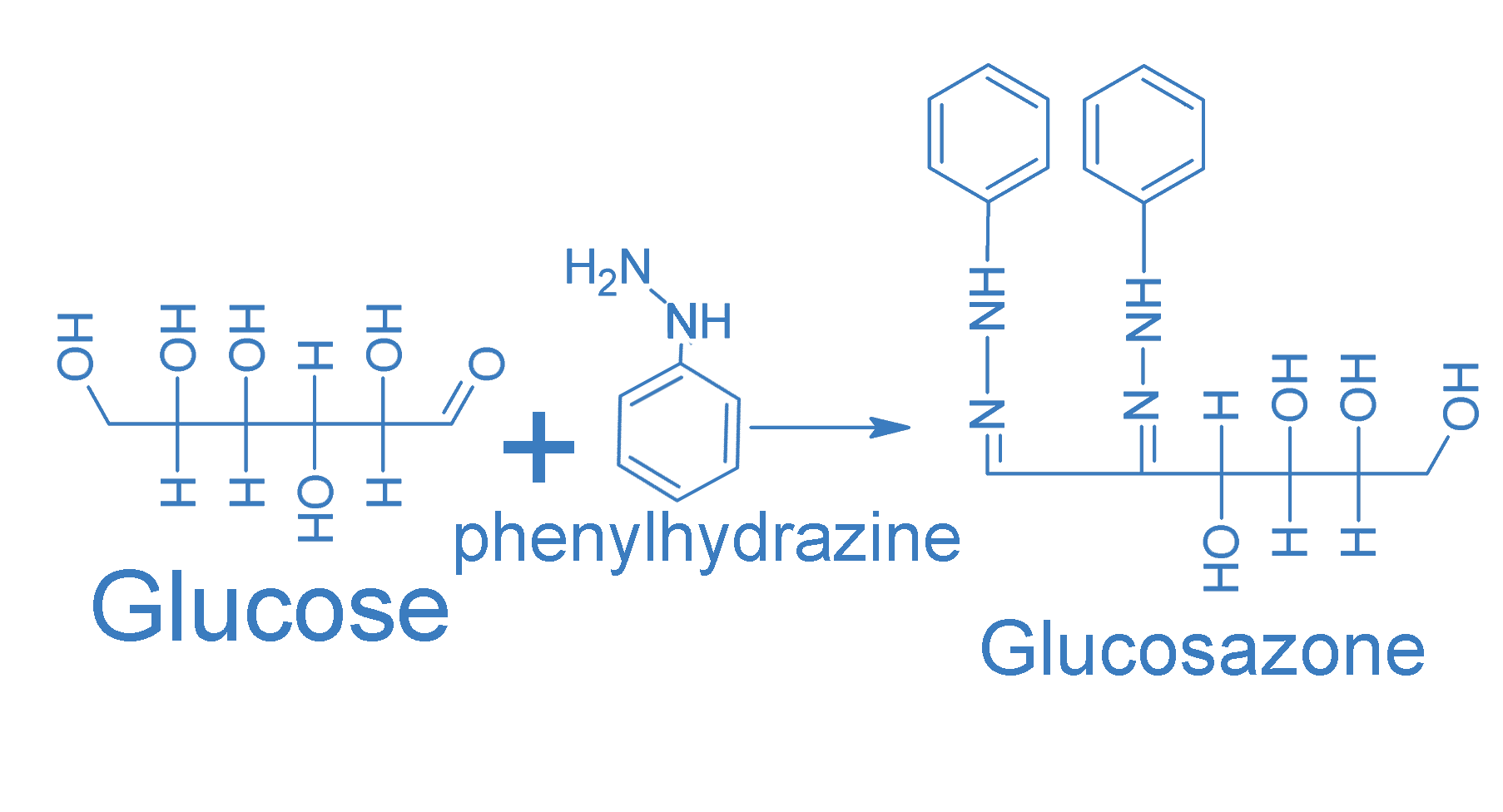
In this reaction one molecule of glucose reacts with two molecules of phenyl hydrazine to create glucosazone.
Glucosazone is a yellow crystalline substance that is often used to identify the presence of glucose. It's chemically very similar to fructosazone and mannosazone
Note - Glucosazone is an example of osazone.Osazones are a class of carbohydrates formed by the reaction of reducing sugars with phenylhydrazine. Ozone are colored compounds with crystalline in nature (remember than glucosazone is a yellow crystalline substance). Fructosazone and mannosazone are some more examples of osazone.
Complete step by step solution:
Glucose is a six carbon compound made by plants during the process of photosynthesis. During photosynthesis plants use carbon dioxide and water and with the help of sunlight in a complicated process produce glucose. Glucose is a monosaccharide that is found in abundance in nature. Glucose can be found anywhere from the sweetener used in your food to the cellulose in the plant cell wall.
Phenylhydrazine is a chemical compound having the molecular formula
The reaction of glucosazone formation are –
In this reaction one molecule of glucose reacts with two molecules of phenyl hydrazine to create glucosazone.
Glucosazone is a yellow crystalline substance that is often used to identify the presence of glucose. It's chemically very similar to fructosazone and mannosazone
Note - Glucosazone is an example of osazone.Osazones are a class of carbohydrates formed by the reaction of reducing sugars with phenylhydrazine. Ozone are colored compounds with crystalline in nature (remember than glucosazone is a yellow crystalline substance). Fructosazone and mannosazone are some more examples of osazone.
Recently Updated Pages
Which of the following graphs shows the variation of class 12 physics CBSE

Draw a labelled diagram of the human male reproductive class 12 biology CBSE
Describe the experiment to compare the emf of two cells class 12 physics CBSE
What is standard hydrogen electrode
What is conventional current and electric current class 12 physics CBSE
2Bromopentane is treated with an alcoholic KOH solution class 12 chemistry CBSE
Trending doubts
Draw a labelled sketch of the human eye class 12 physics CBSE
Which are the Top 10 Largest Countries of the World?
A member of Simon commission later became Prime Minister class 12 social science CBSE
Differentiate between homogeneous and heterogeneous class 12 chemistry CBSE
Draw ray diagrams each showing i myopic eye and ii class 12 physics CBSE
Which is the correct genotypic ratio of mendel dihybrid class 12 biology CBSE