




What are the main constituents of dettol?
Answer
 Verified
673.2k+ views
Hint: There are two main constituents of dettol and one of them is a terpenoid compound. The terpenoid compound that is present has two isomers namely \[\alpha \] and \[\beta \]. The other compound is slightly acidic in nature and will give a positive Beilstein test.
Complete Step-by-Step Solution:
The main constituents of Dettol are Terpineol and Chloroxylenol. The structure of both the constituents is as shown below.
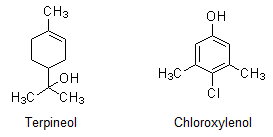
Terpineol is an terpenoid type of compound and Chloroxylenol is an aromatic compound.
Additional Information:
- Dettol is used as an antiseptic. Let’s see what does the term antiseptic mean.
- Antiseptics are the compounds or mixtures that either kill or control the growth of several microorganisms like bacteria, fungi ,etc…
- Disinfectant also has the same definition as anticeptics but the only difference between them is the place we apply them on.
- If we apply the compound on living tissues like wounds, skin or cuts, then it is known as antiseptic while if we apply the compound on non-living items like floor or instruments, then they are called disinfectants.
- Furacine , Soframycin, Tincture iodine and dettol are examples of antiseptics.
- Very dilute solutions of Chlorine and sulphur dioxide are examples of disinfectants.
Note: You just need to remember the fact that these two compounds when combined have disinfectant properties and are good enough for daily use for mankind. Do not choose other disinfectants like iodine, Biothionol, Soframicine, Furacine as the constituents of dettol as they are also disinfectants.
Complete Step-by-Step Solution:
The main constituents of Dettol are Terpineol and Chloroxylenol. The structure of both the constituents is as shown below.
Terpineol is an terpenoid type of compound and Chloroxylenol is an aromatic compound.
Additional Information:
- Dettol is used as an antiseptic. Let’s see what does the term antiseptic mean.
- Antiseptics are the compounds or mixtures that either kill or control the growth of several microorganisms like bacteria, fungi ,etc…
- Disinfectant also has the same definition as anticeptics but the only difference between them is the place we apply them on.
- If we apply the compound on living tissues like wounds, skin or cuts, then it is known as antiseptic while if we apply the compound on non-living items like floor or instruments, then they are called disinfectants.
- Furacine , Soframycin, Tincture iodine and dettol are examples of antiseptics.
- Very dilute solutions of Chlorine and sulphur dioxide are examples of disinfectants.
Note: You just need to remember the fact that these two compounds when combined have disinfectant properties and are good enough for daily use for mankind. Do not choose other disinfectants like iodine, Biothionol, Soframicine, Furacine as the constituents of dettol as they are also disinfectants.
Recently Updated Pages
Explain the structure of megasporangium class 12 biology CBSE

Why is chloroform kept in dark coloured bottles class 12 chemistry CBSE
Derive the balancing condition of a Wheatstone bri class 12 physics CBSE
Draw VI characteristics of a pn junction diode Explain class 12 physics CBSE
Is it possible to carry pride in ones language too class 12 english CBSE
In a population at Hardy Weinberg equilibrium the allele class 12 biology CBSE
Trending doubts
Draw a labelled sketch of the human eye class 12 physics CBSE
Which are the Top 10 Largest Countries of the World?
Draw ray diagrams each showing i myopic eye and ii class 12 physics CBSE
One megawatt is equal to how many units of electri class 12 physics CBSE
Which is the correct genotypic ratio of mendel dihybrid class 12 biology CBSE
Give 10 examples of unisexual and bisexual flowers