




What are the first 100 digits of $\pi $ ?
Answer
 Verified
603.9k+ views
Hint: $\pi $ is a non-repeating non-terminating irrational number. For calculation purposes we just need the value 3.141 but $\pi $ has been a very attractive number for mathematicians for many decades. Currently, the best method we have to find its value is by using the Binomial theorem.
Complete step by step solution:
The very first attempts to calculate the value of $\pi $ were made by drawing a hexagon inside the circle, and a square outside the circle. This was just sufficient to tell us that $3<\pi <4$ .
This hexagon was further bisected into the dodecagon (12 sides) to get a more precise value. This process was repeated for many years.
Then, amidst a pandemic, came the ground-breaking work of famous mathematician and physicist Sir Isaac Newton.
He used Binomial theorem to calculate $\pi $ . This is how he did it.
We know that according to Binomial theorem,
$\begin{align}
& {{\left( x+y \right)}^{n}}=\sum\limits_{r=0}^{n}{{}^{n}{{C}_{r}}{{x}^{n-r}}{{y}^{r}}} \\
& \text{where }n\in N\text{ and }x,y\in R. \\
\end{align}$
The expansion of this Binomial theorem for any index n, such that, n is a rational number, x is a real number and |x| < 1, gives the following result
${{\left( 1+x \right)}^{n}}=1+nx+\dfrac{n\left( n-1 \right)}{2!}{{x}^{2}}+\dfrac{n\left( n-1 \right)\left( n-2 \right)}{3!}{{x}^{3}}+...+\dfrac{n\left( n-1 \right)\left( n-2 \right)...\left( n-r-1 \right)}{r!}{{x}^{r}}+...\infty $
For $n=\dfrac{1}{2}$ , we have
${{\left( 1+x \right)}^{\dfrac{1}{2}}}=1+\dfrac{1}{2}x+\dfrac{\dfrac{1}{2}\left( \dfrac{1}{2}-1 \right)}{2!}{{x}^{2}}+\dfrac{\dfrac{1}{2}\left( \dfrac{1}{2}-1 \right)\left( \dfrac{1}{2}-2 \right)}{3!}{{x}^{3}}+...+\dfrac{\dfrac{1}{2}\left( \dfrac{1}{2}-1 \right)\left( \dfrac{1}{2}-2 \right)...\left( \dfrac{1}{2}-r-1 \right)}{r!}{{x}^{r}}+...\infty $
\[\Rightarrow {{\left( 1+x \right)}^{\dfrac{1}{2}}}=1+\dfrac{1}{2}x-\dfrac{1}{8}{{x}^{2}}+\dfrac{1}{16}{{x}^{3}}-\dfrac{5}{128}{{x}^{4}}+...\infty \text{ }...\left( i \right)\]
Let us assume a unit circle with centre at (0,0). Equation of this circle is ${{x}^{2}}+{{y}^{2}}=1$ . We can solve this equation further as,
${{y}^{2}}=1-{{x}^{2}}$
For positive values of y, we have
$y=\sqrt{1-{{x}^{2}}}$
We can expand the RHS using equation (i) to get
$y=1-\dfrac{1}{2}{{x}^{2}}-\dfrac{1}{8}{{x}^{4}}-\dfrac{1}{16}{{x}^{6}}-\dfrac{5}{128}{{x}^{8}}+...\infty $
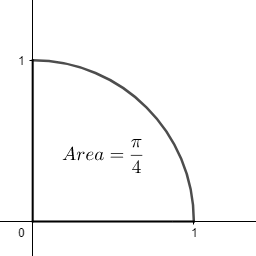
If we now integrate y from 0 to 1, we get the following area,
Thus, we can write,
$\int\limits_{x=0}^{x=1}{ydx}=\int\limits_{x=0}^{x=1}{\left( 1-\dfrac{1}{2}{{x}^{2}}-\dfrac{1}{8}{{x}^{4}}-\dfrac{1}{16}{{x}^{6}}-\dfrac{5}{128}{{x}^{8}}+...\infty \right)}dx$
$\Rightarrow \dfrac{\pi }{4}=\left( x-\dfrac{1}{2}\dfrac{{{x}^{3}}}{3}-\dfrac{1}{8}\dfrac{{{x}^{5}}}{5}-\dfrac{1}{16}\dfrac{{{x}^{7}}}{7}-\dfrac{5}{128}\dfrac{{{x}^{9}}}{9}+...\infty \right)_{x=0}^{x=1}$
$\Rightarrow \dfrac{\pi }{4}=\left( 1-\dfrac{1}{6}-\dfrac{1}{40}-\dfrac{1}{112}-\dfrac{5}{1152}-...\infty \right)$
$\Rightarrow \pi =4\left( 1-\dfrac{1}{6}-\dfrac{1}{40}-\dfrac{1}{112}-\dfrac{5}{1152}-...\infty \right)$
We can use this arithmetic expression to evaluate the value of $\pi $ with great precision.
We need the first 100 digits of $\pi $ , which will take at least a few days for us to solve. But ultimately, we can get our value of $\pi $ with hundred digits, and it will look exactly like this,
$\begin{align}
& \pi =3.1415926535\text{ }8979323846\text{ }2643383279\text{ }5028841971\text{ }6939937510\text{ } \\
& 5820974944\text{ }5923078164\text{ }0628620899\text{ }8628034825\text{ }342117067 \\
\end{align}$
Note: We must remember that $\pi $ is a non-repeating non-terminating irrational number. Therefore, it is impossible to list, or even find all digits of the number $\pi $ . We must not ignore the fact that the traditional Binomial theorem is applicable only when n is a natural number.
Complete step by step solution:
The very first attempts to calculate the value of $\pi $ were made by drawing a hexagon inside the circle, and a square outside the circle. This was just sufficient to tell us that $3<\pi <4$ .
This hexagon was further bisected into the dodecagon (12 sides) to get a more precise value. This process was repeated for many years.
Then, amidst a pandemic, came the ground-breaking work of famous mathematician and physicist Sir Isaac Newton.
He used Binomial theorem to calculate $\pi $ . This is how he did it.
We know that according to Binomial theorem,
$\begin{align}
& {{\left( x+y \right)}^{n}}=\sum\limits_{r=0}^{n}{{}^{n}{{C}_{r}}{{x}^{n-r}}{{y}^{r}}} \\
& \text{where }n\in N\text{ and }x,y\in R. \\
\end{align}$
The expansion of this Binomial theorem for any index n, such that, n is a rational number, x is a real number and |x| < 1, gives the following result
${{\left( 1+x \right)}^{n}}=1+nx+\dfrac{n\left( n-1 \right)}{2!}{{x}^{2}}+\dfrac{n\left( n-1 \right)\left( n-2 \right)}{3!}{{x}^{3}}+...+\dfrac{n\left( n-1 \right)\left( n-2 \right)...\left( n-r-1 \right)}{r!}{{x}^{r}}+...\infty $
For $n=\dfrac{1}{2}$ , we have
${{\left( 1+x \right)}^{\dfrac{1}{2}}}=1+\dfrac{1}{2}x+\dfrac{\dfrac{1}{2}\left( \dfrac{1}{2}-1 \right)}{2!}{{x}^{2}}+\dfrac{\dfrac{1}{2}\left( \dfrac{1}{2}-1 \right)\left( \dfrac{1}{2}-2 \right)}{3!}{{x}^{3}}+...+\dfrac{\dfrac{1}{2}\left( \dfrac{1}{2}-1 \right)\left( \dfrac{1}{2}-2 \right)...\left( \dfrac{1}{2}-r-1 \right)}{r!}{{x}^{r}}+...\infty $
\[\Rightarrow {{\left( 1+x \right)}^{\dfrac{1}{2}}}=1+\dfrac{1}{2}x-\dfrac{1}{8}{{x}^{2}}+\dfrac{1}{16}{{x}^{3}}-\dfrac{5}{128}{{x}^{4}}+...\infty \text{ }...\left( i \right)\]
Let us assume a unit circle with centre at (0,0). Equation of this circle is ${{x}^{2}}+{{y}^{2}}=1$ . We can solve this equation further as,
${{y}^{2}}=1-{{x}^{2}}$
For positive values of y, we have
$y=\sqrt{1-{{x}^{2}}}$
We can expand the RHS using equation (i) to get
$y=1-\dfrac{1}{2}{{x}^{2}}-\dfrac{1}{8}{{x}^{4}}-\dfrac{1}{16}{{x}^{6}}-\dfrac{5}{128}{{x}^{8}}+...\infty $
If we now integrate y from 0 to 1, we get the following area,
Thus, we can write,
$\int\limits_{x=0}^{x=1}{ydx}=\int\limits_{x=0}^{x=1}{\left( 1-\dfrac{1}{2}{{x}^{2}}-\dfrac{1}{8}{{x}^{4}}-\dfrac{1}{16}{{x}^{6}}-\dfrac{5}{128}{{x}^{8}}+...\infty \right)}dx$
$\Rightarrow \dfrac{\pi }{4}=\left( x-\dfrac{1}{2}\dfrac{{{x}^{3}}}{3}-\dfrac{1}{8}\dfrac{{{x}^{5}}}{5}-\dfrac{1}{16}\dfrac{{{x}^{7}}}{7}-\dfrac{5}{128}\dfrac{{{x}^{9}}}{9}+...\infty \right)_{x=0}^{x=1}$
$\Rightarrow \dfrac{\pi }{4}=\left( 1-\dfrac{1}{6}-\dfrac{1}{40}-\dfrac{1}{112}-\dfrac{5}{1152}-...\infty \right)$
$\Rightarrow \pi =4\left( 1-\dfrac{1}{6}-\dfrac{1}{40}-\dfrac{1}{112}-\dfrac{5}{1152}-...\infty \right)$
We can use this arithmetic expression to evaluate the value of $\pi $ with great precision.
We need the first 100 digits of $\pi $ , which will take at least a few days for us to solve. But ultimately, we can get our value of $\pi $ with hundred digits, and it will look exactly like this,
$\begin{align}
& \pi =3.1415926535\text{ }8979323846\text{ }2643383279\text{ }5028841971\text{ }6939937510\text{ } \\
& 5820974944\text{ }5923078164\text{ }0628620899\text{ }8628034825\text{ }342117067 \\
\end{align}$
Note: We must remember that $\pi $ is a non-repeating non-terminating irrational number. Therefore, it is impossible to list, or even find all digits of the number $\pi $ . We must not ignore the fact that the traditional Binomial theorem is applicable only when n is a natural number.
Recently Updated Pages
Which of the following graphs shows the variation of class 12 physics CBSE

Draw a labelled diagram of the human male reproductive class 12 biology CBSE
Describe the experiment to compare the emf of two cells class 12 physics CBSE
What is standard hydrogen electrode
What is conventional current and electric current class 12 physics CBSE
2Bromopentane is treated with an alcoholic KOH solution class 12 chemistry CBSE
Trending doubts
Draw a labelled sketch of the human eye class 12 physics CBSE
Which are the Top 10 Largest Countries of the World?
Differentiate between homogeneous and heterogeneous class 12 chemistry CBSE
Draw ray diagrams each showing i myopic eye and ii class 12 physics CBSE
Which is the correct genotypic ratio of mendel dihybrid class 12 biology CBSE
What is the Full Form of PVC, PET, HDPE, LDPE, PP and PS ?