




Where are the field lines most concentrated around a bar magnet
A) At the North Pole
B) At the center
C) At both poles
D) At the South pole
Answer
 Verified
578.7k+ views
Hint: The field lines come out of N (North Pole) and go into S (South Pole). Magnetic field lines form concentric circles around a cylindrical current-carrying conductor, such as a length of wire. The direction of such a field can be determined using the "right-hand grip rule”.
Complete step by step solution:
The magnetic field lines cannot be seen. They fill the space around a magnet where the magnetic forces work and where they can attract or repel magnetic materials. Follow the diagrammatic representation given below:
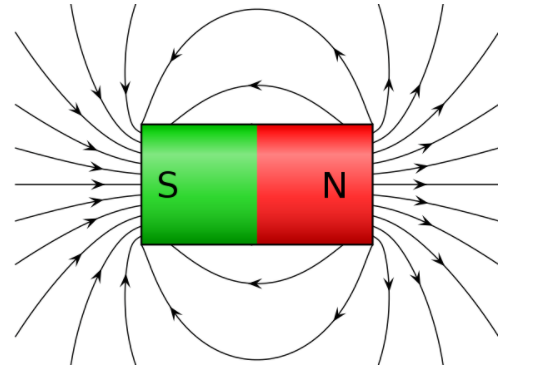
Here N and S represent North and South poles respectively. The magnetic field lines are said to originate from the North Pole and end towards the South Pole (it is taken as convention). As the magnetic field originates and terminates at the poles, they are more crowded at the poles itself. It is also evident from the diagram also.
Hence Option (C) is the correct option.
Additional Information: We cannot see these magnetic fields but we can detect them using iron filings. When we drop tiny pieces of iron over and around the magnet the same magnetic field line is observed. The magnetic field lines are parallel inside the magnet. When two or more magnetic field lines are parallel to each other then such magnetic field is said to be a Uniform magnetic field.
Note: When drawing the magnetic field lines always draw the arrows too. Starting from the North Pole and Ending at the South Pole. Magnets are normally made up of magnetic metals such as iron, nickel and cobalt. These are the only pure metals that can be turned into a permanent magnet. Steel is an alloy of iron and so can also be made into a magnet. But it is to be noted that Steel being an alloy will also produce the same pattern of magnetic field lines.
Complete step by step solution:
The magnetic field lines cannot be seen. They fill the space around a magnet where the magnetic forces work and where they can attract or repel magnetic materials. Follow the diagrammatic representation given below:
Here N and S represent North and South poles respectively. The magnetic field lines are said to originate from the North Pole and end towards the South Pole (it is taken as convention). As the magnetic field originates and terminates at the poles, they are more crowded at the poles itself. It is also evident from the diagram also.
Hence Option (C) is the correct option.
Additional Information: We cannot see these magnetic fields but we can detect them using iron filings. When we drop tiny pieces of iron over and around the magnet the same magnetic field line is observed. The magnetic field lines are parallel inside the magnet. When two or more magnetic field lines are parallel to each other then such magnetic field is said to be a Uniform magnetic field.
Note: When drawing the magnetic field lines always draw the arrows too. Starting from the North Pole and Ending at the South Pole. Magnets are normally made up of magnetic metals such as iron, nickel and cobalt. These are the only pure metals that can be turned into a permanent magnet. Steel is an alloy of iron and so can also be made into a magnet. But it is to be noted that Steel being an alloy will also produce the same pattern of magnetic field lines.
Recently Updated Pages
Master Class 12 Economics: Engaging Questions & Answers for Success

Master Class 12 Physics: Engaging Questions & Answers for Success
Master Class 12 English: Engaging Questions & Answers for Success
Master Class 12 Social Science: Engaging Questions & Answers for Success
Master Class 12 Maths: Engaging Questions & Answers for Success
Master Class 12 Business Studies: Engaging Questions & Answers for Success
Trending doubts
Which are the Top 10 Largest Countries of the World?
What are the major means of transport Explain each class 12 social science CBSE
Draw a labelled sketch of the human eye class 12 physics CBSE
Why cannot DNA pass through cell membranes class 12 biology CBSE
Differentiate between insitu conservation and exsitu class 12 biology CBSE
Draw a neat and well labeled diagram of TS of ovary class 12 biology CBSE