




What are the crystal field splitting energy and the spin only moment in Bohr magneton for the complex ${K_3}\left[ {Fe{{\left( {CN} \right)}_6}} \right]$?
Answer
 Verified
493.5k+ views
Hint: The crystal field theory describes the conversion of five $d - $ orbitals of metal ions which are already in generated form into the different sets of orbitals which are having variation in energies in the presence of electric field applied by the ligands.
Complete answer:
In the octahedral complexes, where central metal has $6$ ligands, all the $5$ orbitals of $d - $ orbitals do not have the same energy level. Two of these orbitals namely $d{z^2},d{x^2} - {y^2}$ possess high negative charge and have higher energy levels known as $\left( {eg} \right)$.
Remaining three orbital $dxy,dyz,dzx$ have less negative energy and experience low repulsion energy from the ligands and have a low energy state known as $\left( {{t_{2g}}} \right)$.
Electronic configuration of $\left( {Fe} \right)$ is $1{s^2}2{s^2}2{p^6}3{s^2}3{d^6}4{s^2}$. After removal of three electron iron atom get converted into its ionic form $\left( {F{e^{ + 3}}} \right)$ and electronic configuration will become $1{s^2}2{s^2}2{p^6}3{s^2}3{d^5}4{s^0}$.
As we see $d - $ orbitals of $\left( {F{e^{ + 3}}} \right)$ have a total of $5$ electrons they get arranged into orbitals depending upon the energy. Cyanide causes splitting of crystal field upto large extent and hence it comes under the category of strong field ligand.
As the complex contains cyanide ion which acts as a strong ligand it promotes pairing of electrons in $d - $ orbitals of $\left( {F{e^{ + 3}}} \right)$.
Hence, in starting three electrons fill into $dxy,dyz,dzx$ and in the second round remaining two electrons also fill into these orbitals due to cyanide ligand.
Therefore, all the electrons of $\left( {F{e^{ + 3}}} \right)$ are present at $\left( {{t_{2g}}} \right)$ energy state.
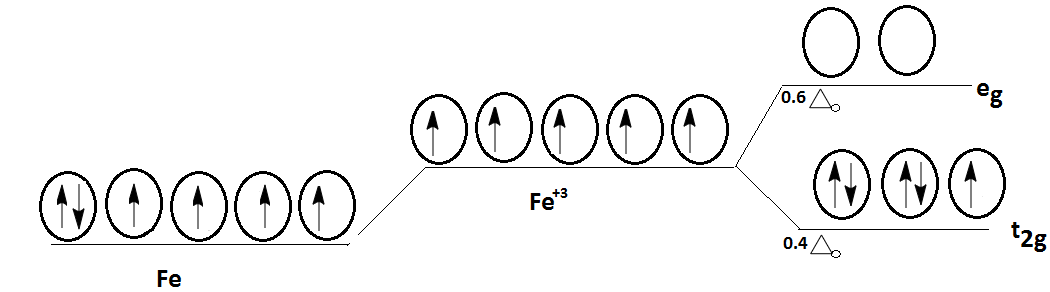
Due to pairing of electrons in $d - $ orbitals, this complex has low spin.
Note:
Weak ligands do not promote pairing and therefore they form high spin complexes. Other examples of strong field ligands include $\left( {N{O_2}^ - ,CO} \right)$. The ligands which cause splitting of crystal field only upto small extent are known as weak field ligands like $\left( {{I^ - },C{l^ - }} \right)$.
Complete answer:
In the octahedral complexes, where central metal has $6$ ligands, all the $5$ orbitals of $d - $ orbitals do not have the same energy level. Two of these orbitals namely $d{z^2},d{x^2} - {y^2}$ possess high negative charge and have higher energy levels known as $\left( {eg} \right)$.
Remaining three orbital $dxy,dyz,dzx$ have less negative energy and experience low repulsion energy from the ligands and have a low energy state known as $\left( {{t_{2g}}} \right)$.
Electronic configuration of $\left( {Fe} \right)$ is $1{s^2}2{s^2}2{p^6}3{s^2}3{d^6}4{s^2}$. After removal of three electron iron atom get converted into its ionic form $\left( {F{e^{ + 3}}} \right)$ and electronic configuration will become $1{s^2}2{s^2}2{p^6}3{s^2}3{d^5}4{s^0}$.
As we see $d - $ orbitals of $\left( {F{e^{ + 3}}} \right)$ have a total of $5$ electrons they get arranged into orbitals depending upon the energy. Cyanide causes splitting of crystal field upto large extent and hence it comes under the category of strong field ligand.
As the complex contains cyanide ion which acts as a strong ligand it promotes pairing of electrons in $d - $ orbitals of $\left( {F{e^{ + 3}}} \right)$.
Hence, in starting three electrons fill into $dxy,dyz,dzx$ and in the second round remaining two electrons also fill into these orbitals due to cyanide ligand.
Therefore, all the electrons of $\left( {F{e^{ + 3}}} \right)$ are present at $\left( {{t_{2g}}} \right)$ energy state.
Due to pairing of electrons in $d - $ orbitals, this complex has low spin.
Note:
Weak ligands do not promote pairing and therefore they form high spin complexes. Other examples of strong field ligands include $\left( {N{O_2}^ - ,CO} \right)$. The ligands which cause splitting of crystal field only upto small extent are known as weak field ligands like $\left( {{I^ - },C{l^ - }} \right)$.
Recently Updated Pages
Master Class 12 Economics: Engaging Questions & Answers for Success

Master Class 12 Physics: Engaging Questions & Answers for Success
Master Class 12 English: Engaging Questions & Answers for Success
Master Class 12 Social Science: Engaging Questions & Answers for Success
Master Class 12 Maths: Engaging Questions & Answers for Success
Master Class 12 Business Studies: Engaging Questions & Answers for Success
Trending doubts
Why cannot DNA pass through cell membranes class 12 biology CBSE
Draw a neat and well labeled diagram of TS of ovary class 12 biology CBSE
In a human foetus the limbs and digits develop after class 12 biology CBSE
AABbCc genotype forms how many types of gametes a 4 class 12 biology CBSE
Differentiate between homogeneous and heterogeneous class 12 chemistry CBSE
The correct structure of ethylenediaminetetraacetic class 12 chemistry CBSE