




How are sound waves different from electromagnetic waves?
Answer
 Verified
591.6k+ views
Hint: In order to answer this question, you could recall the characteristics of each of the given waves in the question, that is, the sound waves and electromagnetic waves. You could discuss how they propagate and different properties shown by them. You could also find differences in the requirement of medium for propagation.
Complete Step by step solution:
In the question, we are asked to find how electromagnetic waves and sound waves are different from each other. In order to answer this question, we could understand exactly what these sound waves and electromagnetic waves are.
Electromagnetic waves:
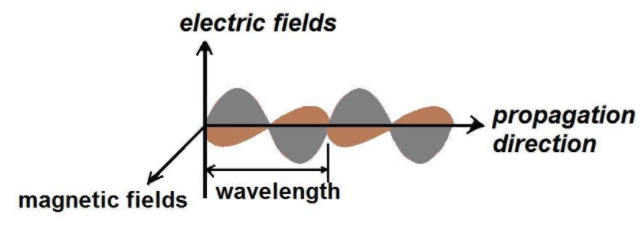
They’re generated as the result of coupling of electric and magnetic fields which are perpendicular to each other and the wave propagation is found to be perpendicular to both. Electromagnetic waves are transverse in nature and their property of polarization is well known. It is found that they also propagate in the absence of a medium. Electromagnetic waves are found to travel with a speed of universal velocity of light in vacuum. They are known to exhibit interference as well as diffraction.
Sound waves:
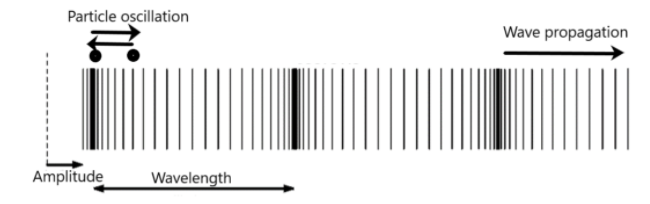
They are mechanical waves that are known to require a medium for propagation. If you recall the bell jar experiment done in your lower classes, then you may know that they don’t propagate through vacuum. In the case of sound waves, particles are seen to oscillate about their mean positions in the wave's direction of propagation.
So we could conclude that:
In sound waves, particles vibrate in the direction of propagation while particles in EM waves propagate perpendicular to it. The sound waves propagate in the form of compressions and rarefactions and EM waves use crests and troughs.
Note:
You may know that sound waves are an example for mechanical waves and the electromagnetic waves have light waves as an example. Sound waves definitely require a medium for propagation as they propagate with the help of pressure variation. Both of them are seen to exhibit the property of Doppler shift and diffraction.
Complete Step by step solution:
In the question, we are asked to find how electromagnetic waves and sound waves are different from each other. In order to answer this question, we could understand exactly what these sound waves and electromagnetic waves are.
Electromagnetic waves:
They’re generated as the result of coupling of electric and magnetic fields which are perpendicular to each other and the wave propagation is found to be perpendicular to both. Electromagnetic waves are transverse in nature and their property of polarization is well known. It is found that they also propagate in the absence of a medium. Electromagnetic waves are found to travel with a speed of universal velocity of light in vacuum. They are known to exhibit interference as well as diffraction.
Sound waves:
They are mechanical waves that are known to require a medium for propagation. If you recall the bell jar experiment done in your lower classes, then you may know that they don’t propagate through vacuum. In the case of sound waves, particles are seen to oscillate about their mean positions in the wave's direction of propagation.
So we could conclude that:
In sound waves, particles vibrate in the direction of propagation while particles in EM waves propagate perpendicular to it. The sound waves propagate in the form of compressions and rarefactions and EM waves use crests and troughs.
Note:
You may know that sound waves are an example for mechanical waves and the electromagnetic waves have light waves as an example. Sound waves definitely require a medium for propagation as they propagate with the help of pressure variation. Both of them are seen to exhibit the property of Doppler shift and diffraction.
Recently Updated Pages
Master Class 12 Economics: Engaging Questions & Answers for Success

Master Class 12 English: Engaging Questions & Answers for Success
Master Class 12 Social Science: Engaging Questions & Answers for Success
Master Class 12 Maths: Engaging Questions & Answers for Success
Master Class 12 Physics: Engaging Questions & Answers for Success
Master Class 12 Business Studies: Engaging Questions & Answers for Success
Trending doubts
Which are the Top 10 Largest Countries of the World?
Draw a labelled sketch of the human eye class 12 physics CBSE
Differentiate between homogeneous and heterogeneous class 12 chemistry CBSE
Why is the cell called the structural and functional class 12 biology CBSE
Draw ray diagrams each showing i myopic eye and ii class 12 physics CBSE
Which is the correct genotypic ratio of mendel dihybrid class 12 biology CBSE