




Are human eggs Haploid or Diploid?
Answer
 Verified
520.2k+ views
Hint: Human eggs or ovum is the major part of the female reproductive system. As puberty hits, Females do not show any specifications in voice changes but other changes can be seen physically. Apart from internal changes in the body, external changes also can be seen. At the age of puberty, changes are frequently being seen in both male and female bodies.
Complete answer:
Female puberty shows at slightly earlier than boys or male that is $12 - 14$age. Females start to develop feminine characters like- development of breasts, hip region becomes broader due to pelvic bones broaden. These are some of the significant features the female body goes through while attaining puberty.
Now, coming to the internal part of sexual development human females produce millions of eggs or ovum in their lifetime, half of the number remain when they are in the womb. But at time of birth ova become lesser in number counting to thousands. Because most of the eggs deploys in the womb only.
The fact that a female child is born with eggs from birth and male starts attaining sperm at the time of puberty. This is the most distinctive character in both sexes. Hence, eggs in female are haploid reason behind it is eggs are termed as sex cells along with sperms. Being called as sex cells they are haploid in nature as in sexual organisms all other cells except sex cells count for diploid.
Sex cells which are ova and sperms are haploid so that during fertilization they fuse into each other and develop into an offspring which is diploid in nature. This phenomenon occurs mostly in mammals and organisms which are involved in sexual reproduction.
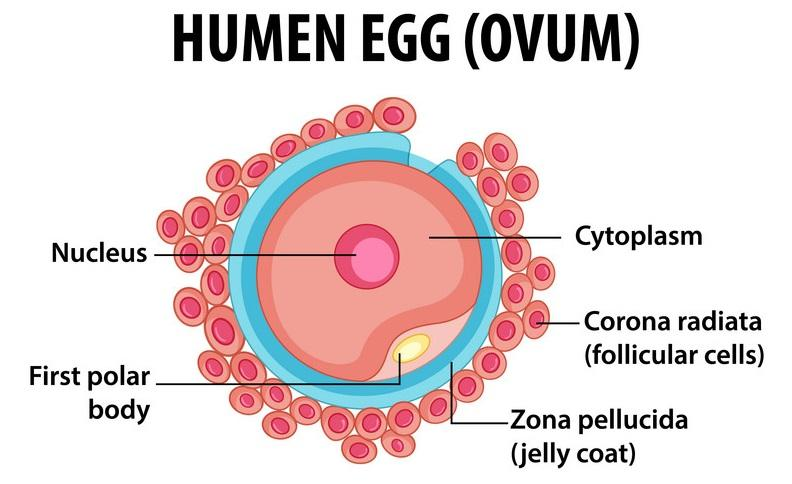
Therefore the correct answer is sex cells are haploid in nature.
Note:
Voice box or larynx is present in both the male and female body but they do not showcase any particular changes during puberty in a girl. Adam’s apple is the extension of the voice box bulged out into the outside. It can be seen through naked eye. And about presenting in both male and female bodies. No, it is only present in male body. It is a part of male secondary sexual character.
Complete answer:
Female puberty shows at slightly earlier than boys or male that is $12 - 14$age. Females start to develop feminine characters like- development of breasts, hip region becomes broader due to pelvic bones broaden. These are some of the significant features the female body goes through while attaining puberty.
Now, coming to the internal part of sexual development human females produce millions of eggs or ovum in their lifetime, half of the number remain when they are in the womb. But at time of birth ova become lesser in number counting to thousands. Because most of the eggs deploys in the womb only.
The fact that a female child is born with eggs from birth and male starts attaining sperm at the time of puberty. This is the most distinctive character in both sexes. Hence, eggs in female are haploid reason behind it is eggs are termed as sex cells along with sperms. Being called as sex cells they are haploid in nature as in sexual organisms all other cells except sex cells count for diploid.
Sex cells which are ova and sperms are haploid so that during fertilization they fuse into each other and develop into an offspring which is diploid in nature. This phenomenon occurs mostly in mammals and organisms which are involved in sexual reproduction.
Therefore the correct answer is sex cells are haploid in nature.
Note:
Voice box or larynx is present in both the male and female body but they do not showcase any particular changes during puberty in a girl. Adam’s apple is the extension of the voice box bulged out into the outside. It can be seen through naked eye. And about presenting in both male and female bodies. No, it is only present in male body. It is a part of male secondary sexual character.
Recently Updated Pages
Master Class 11 Social Science: Engaging Questions & Answers for Success

Master Class 11 Physics: Engaging Questions & Answers for Success
Master Class 11 Maths: Engaging Questions & Answers for Success
Master Class 11 Economics: Engaging Questions & Answers for Success
Master Class 11 Computer Science: Engaging Questions & Answers for Success
Master Class 11 Chemistry: Engaging Questions & Answers for Success
Trending doubts
There are 720 permutations of the digits 1 2 3 4 5 class 11 maths CBSE
1 Quintal is equal to a 110 kg b 10 kg c 100kg d 1000 class 11 physics CBSE
Which among the following are examples of coming together class 11 social science CBSE
Discuss the various forms of bacteria class 11 biology CBSE
What organs are located on the left side of your body class 11 biology CBSE
Draw a labelled diagram showing structure of LS of class 11 biology CBSE