




How are electric vector (\[\overrightarrow E \]), magnetic vector ($\overrightarrow B $) velocity vector ($\overrightarrow c $) oriented in an electromagnetic wave?
Answer
 Verified
623.7k+ views
Hint Electromagnetic waves are transverse in nature. Oscillations of the electric vector and magnetic vectors are perpendicular to the direction of the wave or path of propagation.
Complete step-by-step solution
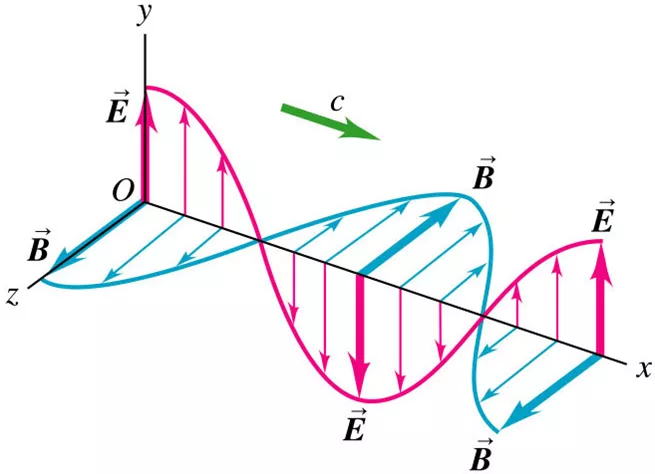
For a transverse wave like electromagnetic waves the electric vector and magnetic vector are always perpendicular to each other and perpendicular to the direction of propagation. Since electromagnetic waves propagate with speed of light, both electric vector and magnetic vector oscillates perpendicular to the velocity vector.
The direction of propagation of electromagnetic waves is the direction of $\overrightarrow {E \times B} $. If an electromagnetic wave is travelling in the positive x-axis then the direction of the electric vector is along the y-axis and the magnetic vector is along the z-axis direction.
Note Electromagnetic waves can travel through empty space. Electromagnetic waves can be produced by oscillating charges or by transition of electrons from different energy levels of the atom.
Examples of electromagnetic waves are: Radio waves, microwaves, infrared, ultraviolet rays, x-rays, gamma rays and visible light.
Complete step-by-step solution
For a transverse wave like electromagnetic waves the electric vector and magnetic vector are always perpendicular to each other and perpendicular to the direction of propagation. Since electromagnetic waves propagate with speed of light, both electric vector and magnetic vector oscillates perpendicular to the velocity vector.
The direction of propagation of electromagnetic waves is the direction of $\overrightarrow {E \times B} $. If an electromagnetic wave is travelling in the positive x-axis then the direction of the electric vector is along the y-axis and the magnetic vector is along the z-axis direction.
Note Electromagnetic waves can travel through empty space. Electromagnetic waves can be produced by oscillating charges or by transition of electrons from different energy levels of the atom.
Examples of electromagnetic waves are: Radio waves, microwaves, infrared, ultraviolet rays, x-rays, gamma rays and visible light.
Recently Updated Pages
Master Class 12 Business Studies: Engaging Questions & Answers for Success

Master Class 12 Biology: Engaging Questions & Answers for Success
Master Class 12 Chemistry: Engaging Questions & Answers for Success
Class 12 Question and Answer - Your Ultimate Solutions Guide
Master Class 11 English: Engaging Questions & Answers for Success
Master Class 11 Social Science: Engaging Questions & Answers for Success
Trending doubts
Which are the Top 10 Largest Countries of the World?
Draw a labelled sketch of the human eye class 12 physics CBSE
Differentiate between homogeneous and heterogeneous class 12 chemistry CBSE
Why is the cell called the structural and functional class 12 biology CBSE
Draw ray diagrams each showing i myopic eye and ii class 12 physics CBSE
Which is the correct genotypic ratio of mendel dihybrid class 12 biology CBSE