




What are electric lines of forces? State the properties of lines of forces.
Answer
 Verified
579.5k+ views
Hint: Electric lines of force are the field lines. They are produced when a test charge experiences a force due to a unit positive charge at a particular distance and then an electric field is produced and so the electric lines of forces or electric field lines.
Complete step-by-step answer:
An electric line of force is an imaginary curve drawn in such a way that tangent to this curve at any point gives the direction of the electric field at that point.
It can be a path with maybe a curve or a straight line.
Properties of lines of forces:
1. Electric lines of forces start from a positive charge and end in negative charge.
It is shown in the following figure, the electric lines of forces are originating from the positive charge. In another figure, electric lines of forces are converging towards the negative charge.
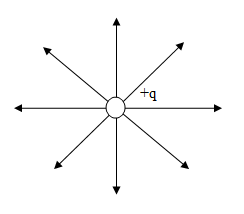
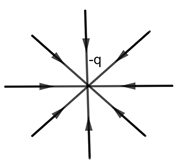
2. Since tangents of electric lines of force represent the direction of the electric field and at a particular point the electric field does not have direction more than one. So, two electric lines of forces cannot intersect or cross each other.
3. Electric lines of forces are continuous curves if there is no conductor. And the lines of forces are discontinuous for the conductor.
4. Electric lines of force can only contract longitudinally and expand laterally.
5. The electric lines of force in the same direction repel each other and vice versa.
6. Electric lines of forces are always perpendicular or normal to the surface of a charged body.
7. Inside the body, there is no existence of electric lines of forces.
Note: Electric lines of forces and electric field lines both are the same. These lines start from the positive and end in negative charge. We can relate this concept with magnetic lines of force where field lines originate from the North pole and end in a South pole.
Complete step-by-step answer:
An electric line of force is an imaginary curve drawn in such a way that tangent to this curve at any point gives the direction of the electric field at that point.
It can be a path with maybe a curve or a straight line.
Properties of lines of forces:
1. Electric lines of forces start from a positive charge and end in negative charge.
It is shown in the following figure, the electric lines of forces are originating from the positive charge. In another figure, electric lines of forces are converging towards the negative charge.
2. Since tangents of electric lines of force represent the direction of the electric field and at a particular point the electric field does not have direction more than one. So, two electric lines of forces cannot intersect or cross each other.
3. Electric lines of forces are continuous curves if there is no conductor. And the lines of forces are discontinuous for the conductor.
4. Electric lines of force can only contract longitudinally and expand laterally.
5. The electric lines of force in the same direction repel each other and vice versa.
6. Electric lines of forces are always perpendicular or normal to the surface of a charged body.
7. Inside the body, there is no existence of electric lines of forces.
Note: Electric lines of forces and electric field lines both are the same. These lines start from the positive and end in negative charge. We can relate this concept with magnetic lines of force where field lines originate from the North pole and end in a South pole.
Recently Updated Pages
Explain the structure of megasporangium class 12 biology CBSE

Why is chloroform kept in dark coloured bottles class 12 chemistry CBSE
Derive the balancing condition of a Wheatstone bri class 12 physics CBSE
Draw VI characteristics of a pn junction diode Explain class 12 physics CBSE
Is it possible to carry pride in ones language too class 12 english CBSE
In a population at Hardy Weinberg equilibrium the allele class 12 biology CBSE
Trending doubts
Draw a labelled sketch of the human eye class 12 physics CBSE
Which are the Top 10 Largest Countries of the World?
Draw ray diagrams each showing i myopic eye and ii class 12 physics CBSE
Which is the correct genotypic ratio of mendel dihybrid class 12 biology CBSE
Differentiate between homogeneous and heterogeneous class 12 chemistry CBSE
Which animal never drinks water in its entire life class 12 biology CBSE