




What are collisions? Explain the possible types of collisions. Develop the theory of one-dimensional elastic collision.
Answer
 Verified
568.8k+ views
Hint: Collisions – define it in terms of the laws of conservations they follow. Explain the types of collision based on the conservation laws they followed. Use the law of conservation of momentum and the law of conservation of kinetic energy in an elastic collision to develop the theory of one-dimensional elastic collision.
Complete step-by-step answer:
Collision can be defined as the event in which two moving bodies or one moving body and one at rest collide with each other.
Collision is of two types –
1. Elastic collision
2. Inelastic collision
Elastic collision can be defined as a collision where the total kinetic energy of the system is conserved. In an elastic collision both the total kinetic energy and the total linear momentum of the system remains constant.
In an elastic collision the total kinetic energy of the system will not be conserved. The total kinetic energy before the collision and after the collision will be different.
Consider two bodies, one with mass ${{m}_{1}}$ moving with velocity ${{v}_{1}}$ in the positive x-direction and another body of mass ${{m}_{2}}$at rest.
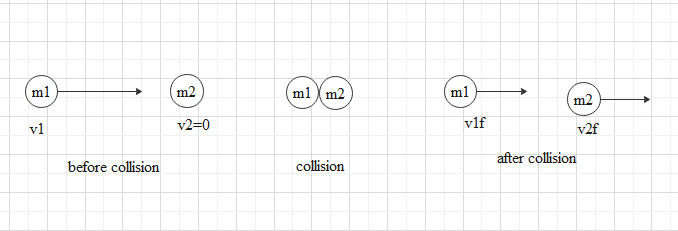
Let, after a time t the two bodies collide. After the collision the velocity of the body with mass ${{m}_{1}}$ becomes ${{v}_{1f}}$ and the velocity of the body of mass ${{m}_{2}}$becomes ${{v}_{2f}}$.
Now, in an elastic collision the linear momentum is conserved,
$\begin{align}
& {{m}_{1}}{{v}_{1}}+{{m}_{2}}{{v}_{2}}={{m}_{1}}{{v}_{1f}}+{{m}_{2}}{{v}_{2f}} \\
& {{m}_{1}}{{v}_{1}}={{m}_{2}}{{v}_{1f}}+{{m}_{2}}{{v}_{2f}}\to 1 \\
& {{m}_{1}}({{v}_{1}}-{{v}_{1f}})={{m}_{2}}{{v}_{2f}}\to 2 \\
\end{align}$
Again, total kinetic energy is also conserved,
$\begin{align}
& \dfrac{1}{2}{{m}_{1}}{{v}_{1}}^{2}+\dfrac{1}{2}{{m}_{2}}{{v}_{2}}^{2}=\dfrac{1}{2}{{m}_{1}}{{v}_{1f}}^{2}+\dfrac{1}{2}{{m}_{2}}{{v}_{2f}}^{2} \\
& \dfrac{1}{2}{{m}_{1}}{{v}_{1}}^{2}=\dfrac{1}{2}{{m}_{1}}{{v}_{1f}}^{2}+\dfrac{1}{2}{{m}_{2}}{{v}_{2f}}^{2} \\
& {{m}_{1}}({{v}_{1}}^{2}-{{v}_{1f}}^{2})={{m}_{2}}{{v}_{2f}}^{2} \\
& {{m}_{1}}({{v}_{1}}-{{v}_{1f}})({{v}_{1}}+{{v}_{1f}})={{m}_{2}}{{v}_{2f}}^{2}\to 3 \\
\end{align}$
Dividing equation 3 by equation 2,
$\begin{align}
& {{v}_{1}}+{{v}_{1f}}={{v}_{2f}} \\
& {{v}_{1f}}={{v}_{2f}}-{{v}_{1}}\to 4 \\
\end{align}$
Putting this value on equation 1, we get
\[\begin{align}
& {{m}_{1}}{{v}_{1}}={{m}_{2}}({{v}_{2f}}-{{v}_{1}})+{{m}_{2}}{{v}_{2f}} \\
& ({{m}_{1}}+{{m}_{2}}){{v}_{1}}=2{{m}_{2}}{{v}_{2f}} \\
& {{v}_{2f}}=\dfrac{({{m}_{1}}+{{m}_{2}})}{2{{m}_{2}}}{{v}_{1}} \\
\end{align}\]
Putting this value on equation 4,
$\begin{align}
& {{v}_{1f}}={{v}_{2f}}-{{v}_{1}} \\
& {{v}_{1f}}=\dfrac{({{m}_{1}}+{{m}_{2}})}{2{{m}_{2}}}{{v}_{1}}-{{v}_{1}} \\
& {{v}_{1f}}=\dfrac{({{m}_{1}}+{{m}_{2}}-2{{m}_{2}})}{2{{m}_{2}}}{{v}_{1}} \\
& {{v}_{1f}}=\dfrac{({{m}_{1}}-{{m}_{2}})}{2{{m}_{2}}}{{v}_{1}} \\
\end{align}$
This way we can find out the final velocities of the two particles from the conservation of momentum and energies.
Note: Most of the collisions in our day to day life are inelastic collisions. We have a special case of inelastic collision which is called the perfectly inelastic collision. In this type of inelastic collision, the two objects will stick together.
Complete step-by-step answer:
Collision can be defined as the event in which two moving bodies or one moving body and one at rest collide with each other.
Collision is of two types –
1. Elastic collision
2. Inelastic collision
Elastic collision can be defined as a collision where the total kinetic energy of the system is conserved. In an elastic collision both the total kinetic energy and the total linear momentum of the system remains constant.
In an elastic collision the total kinetic energy of the system will not be conserved. The total kinetic energy before the collision and after the collision will be different.
Consider two bodies, one with mass ${{m}_{1}}$ moving with velocity ${{v}_{1}}$ in the positive x-direction and another body of mass ${{m}_{2}}$at rest.
Let, after a time t the two bodies collide. After the collision the velocity of the body with mass ${{m}_{1}}$ becomes ${{v}_{1f}}$ and the velocity of the body of mass ${{m}_{2}}$becomes ${{v}_{2f}}$.
Now, in an elastic collision the linear momentum is conserved,
$\begin{align}
& {{m}_{1}}{{v}_{1}}+{{m}_{2}}{{v}_{2}}={{m}_{1}}{{v}_{1f}}+{{m}_{2}}{{v}_{2f}} \\
& {{m}_{1}}{{v}_{1}}={{m}_{2}}{{v}_{1f}}+{{m}_{2}}{{v}_{2f}}\to 1 \\
& {{m}_{1}}({{v}_{1}}-{{v}_{1f}})={{m}_{2}}{{v}_{2f}}\to 2 \\
\end{align}$
Again, total kinetic energy is also conserved,
$\begin{align}
& \dfrac{1}{2}{{m}_{1}}{{v}_{1}}^{2}+\dfrac{1}{2}{{m}_{2}}{{v}_{2}}^{2}=\dfrac{1}{2}{{m}_{1}}{{v}_{1f}}^{2}+\dfrac{1}{2}{{m}_{2}}{{v}_{2f}}^{2} \\
& \dfrac{1}{2}{{m}_{1}}{{v}_{1}}^{2}=\dfrac{1}{2}{{m}_{1}}{{v}_{1f}}^{2}+\dfrac{1}{2}{{m}_{2}}{{v}_{2f}}^{2} \\
& {{m}_{1}}({{v}_{1}}^{2}-{{v}_{1f}}^{2})={{m}_{2}}{{v}_{2f}}^{2} \\
& {{m}_{1}}({{v}_{1}}-{{v}_{1f}})({{v}_{1}}+{{v}_{1f}})={{m}_{2}}{{v}_{2f}}^{2}\to 3 \\
\end{align}$
Dividing equation 3 by equation 2,
$\begin{align}
& {{v}_{1}}+{{v}_{1f}}={{v}_{2f}} \\
& {{v}_{1f}}={{v}_{2f}}-{{v}_{1}}\to 4 \\
\end{align}$
Putting this value on equation 1, we get
\[\begin{align}
& {{m}_{1}}{{v}_{1}}={{m}_{2}}({{v}_{2f}}-{{v}_{1}})+{{m}_{2}}{{v}_{2f}} \\
& ({{m}_{1}}+{{m}_{2}}){{v}_{1}}=2{{m}_{2}}{{v}_{2f}} \\
& {{v}_{2f}}=\dfrac{({{m}_{1}}+{{m}_{2}})}{2{{m}_{2}}}{{v}_{1}} \\
\end{align}\]
Putting this value on equation 4,
$\begin{align}
& {{v}_{1f}}={{v}_{2f}}-{{v}_{1}} \\
& {{v}_{1f}}=\dfrac{({{m}_{1}}+{{m}_{2}})}{2{{m}_{2}}}{{v}_{1}}-{{v}_{1}} \\
& {{v}_{1f}}=\dfrac{({{m}_{1}}+{{m}_{2}}-2{{m}_{2}})}{2{{m}_{2}}}{{v}_{1}} \\
& {{v}_{1f}}=\dfrac{({{m}_{1}}-{{m}_{2}})}{2{{m}_{2}}}{{v}_{1}} \\
\end{align}$
This way we can find out the final velocities of the two particles from the conservation of momentum and energies.
Note: Most of the collisions in our day to day life are inelastic collisions. We have a special case of inelastic collision which is called the perfectly inelastic collision. In this type of inelastic collision, the two objects will stick together.
Recently Updated Pages
Master Class 10 Computer Science: Engaging Questions & Answers for Success

Master Class 10 Social Science: Engaging Questions & Answers for Success
Master Class 10 Science: Engaging Questions & Answers for Success
Class 10 Question and Answer - Your Ultimate Solutions Guide
Master Class 10 Maths: Engaging Questions & Answers for Success
Master Class 10 English: Engaging Questions & Answers for Success
Trending doubts
Two of the body parts which do not appear in MRI are class 11 biology CBSE
Draw a diagram of nephron and explain its structur class 11 biology CBSE
One Metric ton is equal to kg A 10000 B 1000 C 100 class 11 physics CBSE
Draw a diagram of a plant cell and label at least eight class 11 biology CBSE
The actual molecular mass of chlorine is A 5893 times class 11 chemistry CBSE
What is the specific heat capacity of ice water and class 11 physics CBSE