




Application of a forward bias to a p-n junction:
A. Increases the number of donors on the n-side.
B. Increases the electric field in the depletion zone.
C. Increases the potential difference across the depletion zone.
D. Widens the depletion zone.
Answer
 Verified
657.9k+ views
Hint: p-n junction is an active element of the circuit, which is used where we want the flow of current in one direction and not in both. It is called a p-n junction because it is built using a p-type and a n-type semiconductor. When this diode is forward biased, only in that case it allows the current to flow through it.
Complete answer:
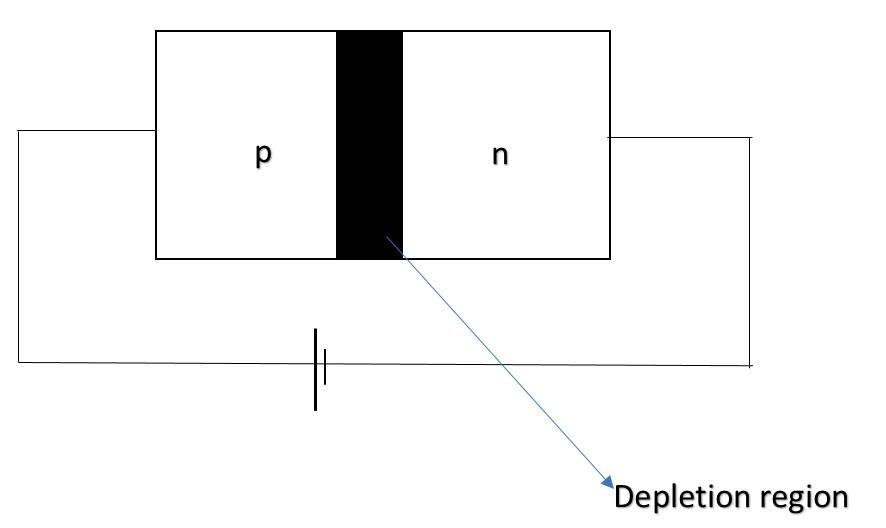
The above diagram shows a forward biased p-n junction. We can identify the forward or reverse bias of a p-n junction by knowing its connection with the battery. If the positive terminal of the battery is connected with p type semiconductor and negative terminal to the n type semiconductor, then the p-n junction will be forward biased and otherwise it is reverse biased and no current will flow through it in that case.
Now, in the forward biased condition, the negative terminal of the battery pushes the electrons in the n type region. The holes present in the depletion region hence get filled up and the width of depletion region reduces. This means that the concentration of electrons on the n side of the junction gets increased thereby reducing the width of the depletion region.
So, the correct answer is “Option A”.
Note:
Depletion region is the region of meeting of p and n type material. In forward biased conditions, its width is minimal. Hence it allows the passage of electrons very easily. One must also note that all other options are very true, but for reverse biased conditions. In short we can say the battery pushes more electrons (donors) into the n-type material side.
Complete answer:
The above diagram shows a forward biased p-n junction. We can identify the forward or reverse bias of a p-n junction by knowing its connection with the battery. If the positive terminal of the battery is connected with p type semiconductor and negative terminal to the n type semiconductor, then the p-n junction will be forward biased and otherwise it is reverse biased and no current will flow through it in that case.
Now, in the forward biased condition, the negative terminal of the battery pushes the electrons in the n type region. The holes present in the depletion region hence get filled up and the width of depletion region reduces. This means that the concentration of electrons on the n side of the junction gets increased thereby reducing the width of the depletion region.
So, the correct answer is “Option A”.
Note:
Depletion region is the region of meeting of p and n type material. In forward biased conditions, its width is minimal. Hence it allows the passage of electrons very easily. One must also note that all other options are very true, but for reverse biased conditions. In short we can say the battery pushes more electrons (donors) into the n-type material side.
Recently Updated Pages
What is BLO What is the full form of BLO class 8 social science CBSE

Explain the Treaty of Vienna of 1815 class 10 social science CBSE
10 examples of friction in our daily life
Draw a diagram of nephron and explain its structur class 11 biology CBSE
Write structures of the following compounds i 2 Chloro3methylpentane class 11 chemistry CBSE
A Paragraph on Pollution in about 100-150 Words
Trending doubts
Draw a labelled sketch of the human eye class 12 physics CBSE
Which are the Top 10 Largest Countries of the World?
Differentiate between homogeneous and heterogeneous class 12 chemistry CBSE
Draw ray diagrams each showing i myopic eye and ii class 12 physics CBSE
Materials which do not allow an electric current to class 12 physics CBSE
Which is the correct genotypic ratio of mendel dihybrid class 12 biology CBSE