




Antigenic determinants are
A. Large and complex molecules that are different from those of an organism/host
B. Proteins or carbohydrates
C. Recognizable sites over antigens
D. Specific protein pathogen
Answer
 Verified
583.8k+ views
Hint:
An antigen is a substance when introduced into a body evokes an immune response to produce a specific antibody with which it reacts.
Types of antigens are as follows:
-Complete Antigen: These are substances that can induce antibody formation by themselves and can react specifically with these antibodies.
-Haptens: Haptens are substances unable to induce antibody formation on their own but can become immunogenic (capable of inducing antibodies) when covalently linked to proteins, called carrier proteins. These antibodies are produced not only against the hapten but also against the carrier protein
Complete answer:
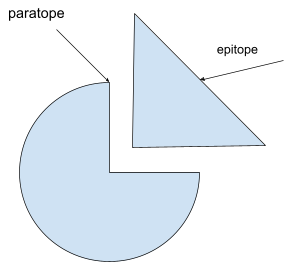
An antigenic determinant in an antigen is “Epitope”. It is the smallest unit of antigenicity. Antigen possesses a number of these determinants. While the corresponding site of antibodies to which is corresponding to the epitope is called a paratope. This paratope binds to an epitope.
Additional information:
The exact basis of antigenicity is not clear but a number of factors have been implicated which make a substance antigenic. These factors are:
-Foreignness
-Size
-Chemical nature
-Susceptibility to tissue enzymes
-Antigenic specificity
Note: Antigen combines with its specific antibody in an observable manner and the reaction between antigen and antibody is specific. These antigen-antibody reactions when conducted in vitro are known as serological tests. These serological tests provide various diagnoses of infectious diseases and for non-infectious agents such as enzymes. These antigen-antibodies may lead to tissue injury in some hypersensitivity reactions and autoimmune diseases.
An antigen is a substance when introduced into a body evokes an immune response to produce a specific antibody with which it reacts.
Types of antigens are as follows:
-Complete Antigen: These are substances that can induce antibody formation by themselves and can react specifically with these antibodies.
-Haptens: Haptens are substances unable to induce antibody formation on their own but can become immunogenic (capable of inducing antibodies) when covalently linked to proteins, called carrier proteins. These antibodies are produced not only against the hapten but also against the carrier protein
Complete answer:
An antigenic determinant in an antigen is “Epitope”. It is the smallest unit of antigenicity. Antigen possesses a number of these determinants. While the corresponding site of antibodies to which is corresponding to the epitope is called a paratope. This paratope binds to an epitope.
Additional information:
The exact basis of antigenicity is not clear but a number of factors have been implicated which make a substance antigenic. These factors are:
-Foreignness
-Size
-Chemical nature
-Susceptibility to tissue enzymes
-Antigenic specificity
Note: Antigen combines with its specific antibody in an observable manner and the reaction between antigen and antibody is specific. These antigen-antibody reactions when conducted in vitro are known as serological tests. These serological tests provide various diagnoses of infectious diseases and for non-infectious agents such as enzymes. These antigen-antibodies may lead to tissue injury in some hypersensitivity reactions and autoimmune diseases.
Recently Updated Pages
Master Class 11 Economics: Engaging Questions & Answers for Success

Master Class 11 English: Engaging Questions & Answers for Success
Master Class 11 Maths: Engaging Questions & Answers for Success
Class 11 Question and Answer - Your Ultimate Solutions Guide
Master Class 11 Social Science: Engaging Questions & Answers for Success
Master Class 11 Business Studies: Engaging Questions & Answers for Success
Trending doubts
Differentiate between an exothermic and an endothermic class 11 chemistry CBSE
One Metric ton is equal to kg A 10000 B 1000 C 100 class 11 physics CBSE
There are 720 permutations of the digits 1 2 3 4 5 class 11 maths CBSE
In what year Guru Nanak Dev ji was born A15 April 1469 class 11 social science CBSE
Difference Between Prokaryotic Cells and Eukaryotic Cells
Draw a diagram of a plant cell and label at least eight class 11 biology CBSE