




Anther and filament are the parts of-
a. Style
b. Stigma
c. Stamen
d. Ovary
Answer
 Verified
628.2k+ views
Hint: While the anthers of most angiosperms release pollen through a rupture along one side of each sac, the anthers belonging to members of the common family liberate pollen through small pores at the anther tip.
Complete answer:
- The style is the element of the pistil which leads to the development of the pollen tube.
- Stigma is the part of the pistil which clasps the pollen.
- Stamen is the male reproductive component of the flower which is composed of two parts the filament which is a stalk that attaches to another bilobed structure that forms pollen grains.
- The ovary is the major female part that leads to the formation of an ovum.
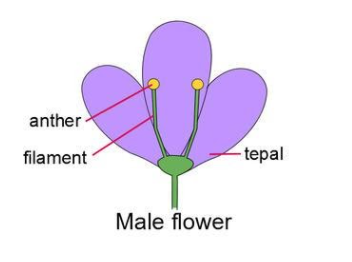
Hence, the correct answer is option (C).
Additional information:
The number and pact of stamens, along with the way in which the anthers release pollen, are important taxonomic features for many flowering plants. The number of stamens is frequently the same as the number of petals. The presence of many stamens is ordinary in many plant families (e.g., Cactaceae, Ranunculaceae, and Rosaceae); most orchids own only one stamen.
In plants with imperfect (unisexual) flowers, the staminate flowers may be borne individually, as in most squash species, or arranged in elongated clusters known as catkins, as is a feature of oaks and willows. Some flowers construct sterile stamens, known as staminodes, which may be flashy or subtle.
Note: The anther is composed of four saclike structures (microsporangia) that create pollen for pollination. Small secretory structures, called nectaries, are habitually found at the base of the stamens; they give food rewards for insect and bird pollinators. All stamens of a flower are together called the androecium.
Complete answer:
- The style is the element of the pistil which leads to the development of the pollen tube.
- Stigma is the part of the pistil which clasps the pollen.
- Stamen is the male reproductive component of the flower which is composed of two parts the filament which is a stalk that attaches to another bilobed structure that forms pollen grains.
- The ovary is the major female part that leads to the formation of an ovum.
Hence, the correct answer is option (C).
Additional information:
The number and pact of stamens, along with the way in which the anthers release pollen, are important taxonomic features for many flowering plants. The number of stamens is frequently the same as the number of petals. The presence of many stamens is ordinary in many plant families (e.g., Cactaceae, Ranunculaceae, and Rosaceae); most orchids own only one stamen.
In plants with imperfect (unisexual) flowers, the staminate flowers may be borne individually, as in most squash species, or arranged in elongated clusters known as catkins, as is a feature of oaks and willows. Some flowers construct sterile stamens, known as staminodes, which may be flashy or subtle.
Note: The anther is composed of four saclike structures (microsporangia) that create pollen for pollination. Small secretory structures, called nectaries, are habitually found at the base of the stamens; they give food rewards for insect and bird pollinators. All stamens of a flower are together called the androecium.
Recently Updated Pages
Master Class 12 Business Studies: Engaging Questions & Answers for Success

Master Class 12 Chemistry: Engaging Questions & Answers for Success
Master Class 12 Biology: Engaging Questions & Answers for Success
Class 12 Question and Answer - Your Ultimate Solutions Guide
Master Class 11 English: Engaging Questions & Answers for Success
Master Class 11 Social Science: Engaging Questions & Answers for Success
Trending doubts
Which are the Top 10 Largest Countries of the World?
Draw a labelled sketch of the human eye class 12 physics CBSE
The end of compass needle which points towards north class 12 physics CBSE
Differentiate between homogeneous and heterogeneous class 12 chemistry CBSE
In order to find out the different types of gametes class 12 biology NEET_UG
Why is the cell called the structural and functional class 12 biology CBSE