




Annaya wanted to isolate and study organelles involved in packaging and transporting of proteins to various locations in a cell. Her colleague had carried out the following experiment: She grounded a piece of spinach leaves and carried out differential centrifugation. A scheme of the protocol she followed along with the centrifugation speed (in g) at every step is given. The fraction that would give Ananya the purified fraction of the organelle of her interest would be?
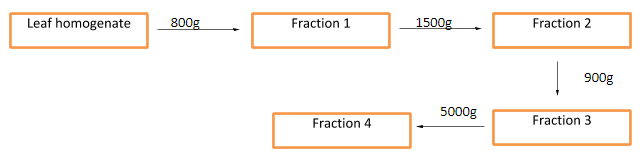
A. 1
B. 2
C. 3
D. 4
Answer
 Verified
561.3k+ views
Hint: A common technique used in biochemistry and cell biology is differential centrifugation, also known as differential velocity centrifugation. Based on its sedimentation rate, it is used to distinguish organelles and other subcellular particles. The cell can be divided into its working organelles and macromolecules just like tissue can be separated into its living constituent cell forms. Each cell is composed of cell organelles such as nuclei, mitochondria, ER, lysosomes and many more.
Complete answer: The centrifugation is a mechanical method that involves the use of centrifugal force according to its size, form, density, medium viscosity and rotor speed. A centrifuge works by using the theory of sedimentation; substances separate under the influence of gravitational force according to their mass (g-force). Various separation forms are known, including isopycnic, ultrafiltration, density gradient, phase separation, and pelleting. Centrifugation is used, depending on size and density, to separate subcellular components. The higher the density, the faster it goes. Differential centrifugation uses various velocities in order to isolate different subcellular components from the homogenate. Although biochemical analysis involves cell anatomy destruction, gentle fractionation methods have been designed to isolate the different components of the cell while maintaining their individual functions.
Therefore, option A is the correct answer.
Note: The order of sedimentation is usually (from most to least dense) with regard to the major components present in cells; nuclei, mitochondria, lysosomes, plasma membrane, endoplasmic reticulum and contractile vacuoles. Animal tissues are homogenized more readily than plant tissues since there are no cell walls.
Complete answer: The centrifugation is a mechanical method that involves the use of centrifugal force according to its size, form, density, medium viscosity and rotor speed. A centrifuge works by using the theory of sedimentation; substances separate under the influence of gravitational force according to their mass (g-force). Various separation forms are known, including isopycnic, ultrafiltration, density gradient, phase separation, and pelleting. Centrifugation is used, depending on size and density, to separate subcellular components. The higher the density, the faster it goes. Differential centrifugation uses various velocities in order to isolate different subcellular components from the homogenate. Although biochemical analysis involves cell anatomy destruction, gentle fractionation methods have been designed to isolate the different components of the cell while maintaining their individual functions.
Therefore, option A is the correct answer.
Note: The order of sedimentation is usually (from most to least dense) with regard to the major components present in cells; nuclei, mitochondria, lysosomes, plasma membrane, endoplasmic reticulum and contractile vacuoles. Animal tissues are homogenized more readily than plant tissues since there are no cell walls.
Recently Updated Pages
Master Class 12 Economics: Engaging Questions & Answers for Success

Master Class 12 Physics: Engaging Questions & Answers for Success
Master Class 12 English: Engaging Questions & Answers for Success
Master Class 12 Social Science: Engaging Questions & Answers for Success
Master Class 12 Maths: Engaging Questions & Answers for Success
Master Class 12 Business Studies: Engaging Questions & Answers for Success
Trending doubts
Which are the Top 10 Largest Countries of the World?
What are the major means of transport Explain each class 12 social science CBSE
Draw a labelled sketch of the human eye class 12 physics CBSE
Why cannot DNA pass through cell membranes class 12 biology CBSE
Differentiate between insitu conservation and exsitu class 12 biology CBSE
Draw a neat and well labeled diagram of TS of ovary class 12 biology CBSE