




How many angles are formed by two intersecting lines?
A) 2
B) 4
C) 8
D) None of these
Answer
 Verified
611.1k+ views
Hint:
Here, we have to use the basic concepts of geometry. In geometry two intersecting lines always intersect each other at a point and that point is called a point of intersection. We will draw a figure of two intersecting lines. Then we will analyze at the point of intersection to find out the number of angles formed by the intersection of two lines.
Complete step by step solution:
Firstly we will draw a figure of two intersecting lines
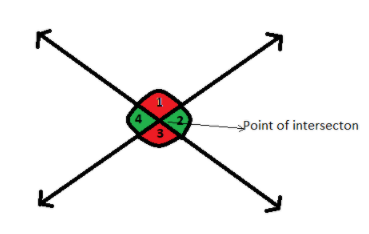
Here, from the diagram we can see that, when two lines intersect, at a point of intersection, four angles are formed. We can say that \[\angle 1 = \angle 3\] and \[\angle 2 = \angle 4\] because these are vertical opposite angles (vertical angles).
Thus, we can conclude that there are four angles formed by two intersecting lines.
So, option B is correct.
Note:
At a single point of intersection, more than two lines can intersect.
Here are some properties of intersecting lines:
The intersecting lines meet only at one point always even if they are more than 2 lines.
The lines can intersect with each other at any angle. This angle formed is always greater than \[0^\circ \] and less than \[180^\circ \].
Here are some real life examples of intersecting lines are railway tracks, crossroads, hour hand and minute hand in a clock, scissors etc
Vertically Opposite Angles (vertical angles) are the angles opposite each other when two lines intersect or cross each other and pairs of vertically opposite angles (vertical angles) are always equal to each other.
Here, we have to use the basic concepts of geometry. In geometry two intersecting lines always intersect each other at a point and that point is called a point of intersection. We will draw a figure of two intersecting lines. Then we will analyze at the point of intersection to find out the number of angles formed by the intersection of two lines.
Complete step by step solution:
Firstly we will draw a figure of two intersecting lines
Here, from the diagram we can see that, when two lines intersect, at a point of intersection, four angles are formed. We can say that \[\angle 1 = \angle 3\] and \[\angle 2 = \angle 4\] because these are vertical opposite angles (vertical angles).
Thus, we can conclude that there are four angles formed by two intersecting lines.
So, option B is correct.
Note:
At a single point of intersection, more than two lines can intersect.
Here are some properties of intersecting lines:
The intersecting lines meet only at one point always even if they are more than 2 lines.
The lines can intersect with each other at any angle. This angle formed is always greater than \[0^\circ \] and less than \[180^\circ \].
Here are some real life examples of intersecting lines are railway tracks, crossroads, hour hand and minute hand in a clock, scissors etc
Vertically Opposite Angles (vertical angles) are the angles opposite each other when two lines intersect or cross each other and pairs of vertically opposite angles (vertical angles) are always equal to each other.
Recently Updated Pages
Master Class 9 General Knowledge: Engaging Questions & Answers for Success

Master Class 9 Maths: Engaging Questions & Answers for Success
Master Class 9 Science: Engaging Questions & Answers for Success
Master Class 9 English: Engaging Questions & Answers for Success
Master Class 9 Social Science: Engaging Questions & Answers for Success
Class 9 Question and Answer - Your Ultimate Solutions Guide
Trending doubts
Find the sum of series 1 + 2 + 3 + 4 + 5 + + 100 class 9 maths CBSE
Difference Between Plant Cell and Animal Cell
Fill the blanks with the suitable prepositions 1 The class 9 english CBSE
What is pollution? How many types of pollution? Define it
What is the Full Form of ICSE / ISC ?
Name 10 Living and Non living things class 9 biology CBSE