




How will the angle of incidence relate to the angle of reflection?
Answer
 Verified
653.1k+ views
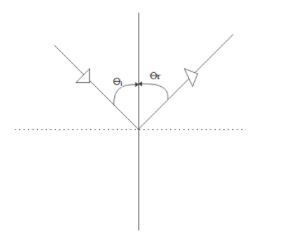
Hint: The incident angle can be defined as the angle between a ray incident on a surface and the line perpendicular to the surface of incidence which is called the normal. The angle of reflection is described as the angle between a ray reflected from a surface and the line perpendicular to it, the normal.
Complete step-by-step answer:
When light is reflected from a specific surface, the angle of incidence is always the same as the angle of reflection, where the both angles are calculated from the path of the light to the normal to the surface at the point at which light strikes the surface. This equality is called the law of reflection.
That is,
Angle of incidence is equivalent to angle of reflection
$\angle i=\angle r$
Where i is the angle of incidence and the r is the angle of reflection.
Hence the answer for the question is obtained.
Note: Fermat's principle, also called as the principle of least time, is the link in between ray optics and the wave optics. Fermat's principle states that the path occupied by a ray between two particular points is the same as the path that can be traversed in the least time. The Snell’s law states that, a ray which is being hit on the interface of the two media, the sine of the angle of incidence times the index of refraction of the first medium is equivalent to the sine of the angle of refraction times the index of refraction of the another medium. These laws are useful in calculating the angle of incidence and refraction.
Complete step-by-step answer:
When light is reflected from a specific surface, the angle of incidence is always the same as the angle of reflection, where the both angles are calculated from the path of the light to the normal to the surface at the point at which light strikes the surface. This equality is called the law of reflection.
That is,
Angle of incidence is equivalent to angle of reflection
$\angle i=\angle r$
Where i is the angle of incidence and the r is the angle of reflection.
Hence the answer for the question is obtained.
Note: Fermat's principle, also called as the principle of least time, is the link in between ray optics and the wave optics. Fermat's principle states that the path occupied by a ray between two particular points is the same as the path that can be traversed in the least time. The Snell’s law states that, a ray which is being hit on the interface of the two media, the sine of the angle of incidence times the index of refraction of the first medium is equivalent to the sine of the angle of refraction times the index of refraction of the another medium. These laws are useful in calculating the angle of incidence and refraction.
Recently Updated Pages
Master Class 12 Economics: Engaging Questions & Answers for Success

Master Class 12 Social Science: Engaging Questions & Answers for Success
Master Class 12 English: Engaging Questions & Answers for Success
Master Class 12 Maths: Engaging Questions & Answers for Success
Master Class 12 Physics: Engaging Questions & Answers for Success
Master Class 12 Biology: Engaging Questions & Answers for Success
Trending doubts
What is the Full Form of PVC, PET, HDPE, LDPE, PP and PS ?
Draw a ray diagram of compound microscope when the class 12 physics CBSE
Derive an expression for the electric field intensity class 12 physics CBSE
Ethylidene chloride and ethylene dichloride are A Chain class 12 chemistry CBSE
Calculate the equivalent resistance between a and b class 12 physics CBSE
Derive an expression of the magnetic field at the center class 12 physics CBSE