




Angle of deviation is between:
(A) Real and virtual image
(B) Incident and emergent ray
(C) Plane of reflection and plane of incidence
(D) None of the above
Answer
 Verified
571.5k+ views
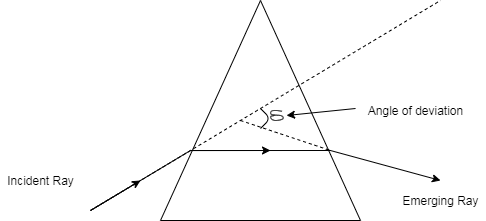
Hint : In this question, we are required to find the position of angle of deviation, and in order to find that we will consider a prism in which we will pass an incident ray and we will get refracted ray and emerging ray. Then through observation, we will get the angle of deviation.
Complete step by step answer:
Definition of Angle of deviation: The angle which the emergent ray makes with the direction of the incident ray, When a ray passes from one medium to another medium it creates an angle between the direction of refracted ray and the direction of the incident ray.
In other words, we can say that angle of deviation is the angle of deviation defined as the angle which is obtained from the difference between the angle of incidence and the angle of refraction created by the ray of light traveling from one medium to another that has a different refractive index.
Example: A plane wavefront is incident at an angle of ${{40}^{o}}$ on the surface of the glass. Calculate the angle of deviation if the angle of refraction is${{15}^{o}}$.
$\Rightarrow $Angle of incidence, $i={{40}^{o}}$
Angle of refraction, $r={{15}^{o}}$
Angle of deviation, $\delta =i-r={{40}^{o}}-{{15}^{o}}={{25}^{^{o}}}$
Diagram:
The angle of deviation of the prism depends on the following factors:
(A) Angle of prism
(B) Angle of incidence
(C) Wavelength of the light
(D) Refractive index of the optical material, that is prism.
So the angle of deviation is between the incident and emergent ray. Hence option B. is correct.
Note: In order to solve this kind of question, we should have knowledge about ray optics and its principle. To better understand the angle of deviation, we can observe the diagram shown above in the solution.
Complete step by step answer:
Definition of Angle of deviation: The angle which the emergent ray makes with the direction of the incident ray, When a ray passes from one medium to another medium it creates an angle between the direction of refracted ray and the direction of the incident ray.
In other words, we can say that angle of deviation is the angle of deviation defined as the angle which is obtained from the difference between the angle of incidence and the angle of refraction created by the ray of light traveling from one medium to another that has a different refractive index.
Example: A plane wavefront is incident at an angle of ${{40}^{o}}$ on the surface of the glass. Calculate the angle of deviation if the angle of refraction is${{15}^{o}}$.
$\Rightarrow $Angle of incidence, $i={{40}^{o}}$
Angle of refraction, $r={{15}^{o}}$
Angle of deviation, $\delta =i-r={{40}^{o}}-{{15}^{o}}={{25}^{^{o}}}$
Diagram:
The angle of deviation of the prism depends on the following factors:
(A) Angle of prism
(B) Angle of incidence
(C) Wavelength of the light
(D) Refractive index of the optical material, that is prism.
So the angle of deviation is between the incident and emergent ray. Hence option B. is correct.
Note: In order to solve this kind of question, we should have knowledge about ray optics and its principle. To better understand the angle of deviation, we can observe the diagram shown above in the solution.
Recently Updated Pages
Three beakers labelled as A B and C each containing 25 mL of water were taken A small amount of NaOH anhydrous CuSO4 and NaCl were added to the beakers A B and C respectively It was observed that there was an increase in the temperature of the solutions contained in beakers A and B whereas in case of beaker C the temperature of the solution falls Which one of the following statements isarecorrect i In beakers A and B exothermic process has occurred ii In beakers A and B endothermic process has occurred iii In beaker C exothermic process has occurred iv In beaker C endothermic process has occurred

Master Class 12 Social Science: Engaging Questions & Answers for Success
Master Class 12 Physics: Engaging Questions & Answers for Success
Master Class 12 Maths: Engaging Questions & Answers for Success
Master Class 12 Economics: Engaging Questions & Answers for Success
Master Class 12 Chemistry: Engaging Questions & Answers for Success
Three beakers labelled as A B and C each containing 25 mL of water were taken A small amount of NaOH anhydrous CuSO4 and NaCl were added to the beakers A B and C respectively It was observed that there was an increase in the temperature of the solutions contained in beakers A and B whereas in case of beaker C the temperature of the solution falls Which one of the following statements isarecorrect i In beakers A and B exothermic process has occurred ii In beakers A and B endothermic process has occurred iii In beaker C exothermic process has occurred iv In beaker C endothermic process has occurred
Master Class 12 Social Science: Engaging Questions & Answers for Success
Master Class 12 Physics: Engaging Questions & Answers for Success
Trending doubts
Which are the Top 10 Largest Countries of the World?
Draw a labelled sketch of the human eye class 12 physics CBSE
Differentiate between homogeneous and heterogeneous class 12 chemistry CBSE
What are the major means of transport Explain each class 12 social science CBSE
Sulphuric acid is known as the king of acids State class 12 chemistry CBSE
Why should a magnesium ribbon be cleaned before burning class 12 chemistry CBSE