




An urn contains one black ball and one green ball. A second urn contains one white and one green ball. One ball is drawn from each urn. What is the probability that both balls are of the same color?
(A) \[\dfrac{1}{2}\]
(B) \[\dfrac{1}{3}\]
(C) \[\dfrac{1}{4}\]
(D) \[\dfrac{2}{3}\]
Answer
 Verified
633k+ views
Hint: In urn A, we have the number of black balls and green balls is 1. We know that sample space is the total number of possible outcomes. The total number of balls is the summation of the number of black balls and the number of the green ball. In urn B, we have the number of white balls and green balls is 1. We know that sample space is the total number of possible outcomes. The total number of balls is the summation of the number of the white ball and the number of the green ball. To get both balls of the same color we have to draw only green balls from each urn. Now, use the formula, \[\text{Probability=}\dfrac{\text{Number of favorable outcomes}}{\text{Sample space}}\] and calculate the probability of green balls in urn A and urn B. The probability that both balls are green is equal to the product of the probability of green balls in urn A and probability of green balls in urn B.
Complete step-by-step answer:
According to the question, we have two urns A and B. In urn A, we have one black ball and one green ball. In urn B, we have one white and one green ball.
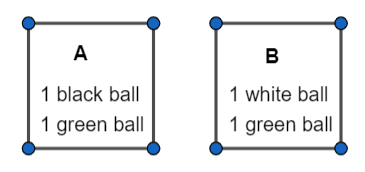
We have to draw one ball from each urn. We have to find the probability that both balls are of the same color. In the urn A and B, we only have green colors in common. So, in order to get both balls of the same color, we have to draw only green balls from each urn.
In urn A, we have
The number of black balls = 1.
The number of green balls = 1 ………………………(1)
The total number of balls = The number of black balls + The number of green balls = 1 + 1 = 2 …………………………….(2)
We know the formula, \[\text{Probability=}\dfrac{\text{Number of favorable outcomes}}{\text{Sample space}}\] …………………………(3)
From equation (1), we have the number of favorable outcomes for green balls.
The sample space is the total number of possible outcomes. From equation (2), we have the total number of possible outcomes.
Now, from equation (1), equation (2), and equation (3), we get
The probability of green balls in urn A = \[\dfrac{1}{2}\] ……………………(4)
In urn B, we have
The number of white balls = 1.
The number of green balls = 1 ………………………(5)
The total number of balls = The number of white balls + The number of green balls = 1 + 1 = 2 …………………………….(6)
We know the formula, \[\text{Probability=}\dfrac{\text{Number of favorable outcomes}}{\text{Sample space}}\] …………………………(7)
From equation (5), we have the number of favorable outcomes for green balls.
The sample space is the total number of possible outcomes. From equation (6), we have the total number of possible outcomes.
Now, from equation (5), equation (6), and equation (7), we get
The probability of green balls in urn B = \[\dfrac{1}{2}\] ……………………(8)
The probability that both balls are green =
\[\left( \text{Probability of green balls in urn A} \right)\times \left( \text{Probability of green balls in urn B} \right)\] ……………….(9)
From equation (4) and equation (8), we have the probability of green balls in urn A and B respectively.
Now, from equation (4), equation (8), and equation (9), we get,
The probability that both balls are green = \[\dfrac{1}{2}\times \dfrac{1}{2}=\dfrac{1}{4}\] .
Hence, the correct option is (C).
Note: In this question, one might calculate the probability that both balls are green as the summation of the probability of green balls in urn A and the probability of green balls in urn B. This is wrong because it is a case of ‘and’. We have to find the probability that both balls are of the same color. In the urn A and B, we only have green colors in common. So, in order to get both balls of the same color, we have to draw only green balls from each urn. In other words, we can say that we have to find the probability of green balls in urn A and urn B. In the case of ‘and’ the probability is the multiplication of two cases. So, here the probability that both balls are green is equal to
\[\left( \text{Probability of green balls in urn A} \right)\times \left( \text{Probability of green balls in urn B} \right)\] .
Complete step-by-step answer:
According to the question, we have two urns A and B. In urn A, we have one black ball and one green ball. In urn B, we have one white and one green ball.
We have to draw one ball from each urn. We have to find the probability that both balls are of the same color. In the urn A and B, we only have green colors in common. So, in order to get both balls of the same color, we have to draw only green balls from each urn.
In urn A, we have
The number of black balls = 1.
The number of green balls = 1 ………………………(1)
The total number of balls = The number of black balls + The number of green balls = 1 + 1 = 2 …………………………….(2)
We know the formula, \[\text{Probability=}\dfrac{\text{Number of favorable outcomes}}{\text{Sample space}}\] …………………………(3)
From equation (1), we have the number of favorable outcomes for green balls.
The sample space is the total number of possible outcomes. From equation (2), we have the total number of possible outcomes.
Now, from equation (1), equation (2), and equation (3), we get
The probability of green balls in urn A = \[\dfrac{1}{2}\] ……………………(4)
In urn B, we have
The number of white balls = 1.
The number of green balls = 1 ………………………(5)
The total number of balls = The number of white balls + The number of green balls = 1 + 1 = 2 …………………………….(6)
We know the formula, \[\text{Probability=}\dfrac{\text{Number of favorable outcomes}}{\text{Sample space}}\] …………………………(7)
From equation (5), we have the number of favorable outcomes for green balls.
The sample space is the total number of possible outcomes. From equation (6), we have the total number of possible outcomes.
Now, from equation (5), equation (6), and equation (7), we get
The probability of green balls in urn B = \[\dfrac{1}{2}\] ……………………(8)
The probability that both balls are green =
\[\left( \text{Probability of green balls in urn A} \right)\times \left( \text{Probability of green balls in urn B} \right)\] ……………….(9)
From equation (4) and equation (8), we have the probability of green balls in urn A and B respectively.
Now, from equation (4), equation (8), and equation (9), we get,
The probability that both balls are green = \[\dfrac{1}{2}\times \dfrac{1}{2}=\dfrac{1}{4}\] .
Hence, the correct option is (C).
Note: In this question, one might calculate the probability that both balls are green as the summation of the probability of green balls in urn A and the probability of green balls in urn B. This is wrong because it is a case of ‘and’. We have to find the probability that both balls are of the same color. In the urn A and B, we only have green colors in common. So, in order to get both balls of the same color, we have to draw only green balls from each urn. In other words, we can say that we have to find the probability of green balls in urn A and urn B. In the case of ‘and’ the probability is the multiplication of two cases. So, here the probability that both balls are green is equal to
\[\left( \text{Probability of green balls in urn A} \right)\times \left( \text{Probability of green balls in urn B} \right)\] .
Recently Updated Pages
Master Class 12 Economics: Engaging Questions & Answers for Success

Master Class 12 English: Engaging Questions & Answers for Success
Master Class 12 Social Science: Engaging Questions & Answers for Success
Master Class 12 Maths: Engaging Questions & Answers for Success
Master Class 12 Physics: Engaging Questions & Answers for Success
Master Class 9 General Knowledge: Engaging Questions & Answers for Success
Trending doubts
Which are the Top 10 Largest Countries of the World?
Draw a labelled sketch of the human eye class 12 physics CBSE
Differentiate between homogeneous and heterogeneous class 12 chemistry CBSE
Why is the cell called the structural and functional class 12 biology CBSE
Draw ray diagrams each showing i myopic eye and ii class 12 physics CBSE
Which is the correct genotypic ratio of mendel dihybrid class 12 biology CBSE