




An urn contains $m$ white and $n$ black balls. Balls are drawn one by one till all the balls are drawn. Probability that the second drawn ball is white is
(a) $\dfrac{m}{m+n}$
(b) $\dfrac{m\left( n-1 \right)}{\left( m+n \right)\left( m+n-1 \right)}$
(c) $\dfrac{m\left( m-1 \right)}{\left( m+n \right)\left( m+n-1 \right)}$
(d) $\dfrac{mn}{\left( m+n \right)\left( m+n-1 \right)}$
Answer
 Verified
584.7k+ views
Hint: The first ball that is chosen can be either white or black. We will find the probability of the first ball being white, then we will find the probability of the first ball being back. Then we will consider the event to be drawing the second ball, which is white. We will find the probability for this event. Then the final probability will take into account the probability that the first ball and second ball is white, and the probability that the first ball is black and the second ball is white.
Complete step by step answer:
Let us draw a diagram to understand the events.
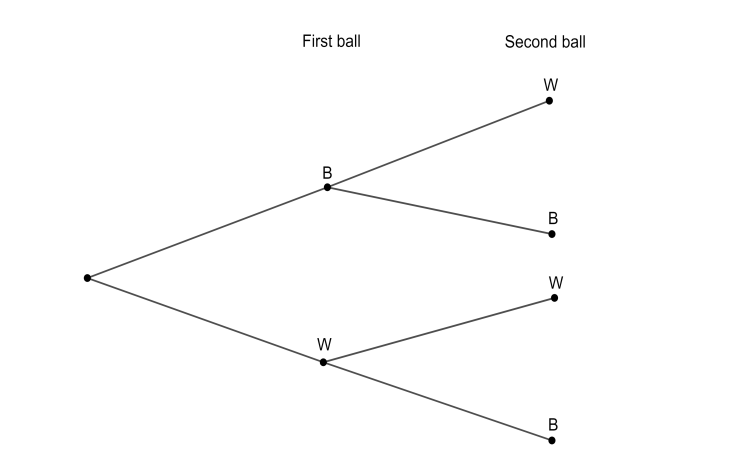
Now, the probability that the first ball is white is $\dfrac{m}{m+n}$, since there are $m$ white balls and $m+n$ total balls in the urn. Similarly, the probability that the first ball is black is $\dfrac{n}{m+n}$, as there are $n$ white balls and $m+n$ total balls.
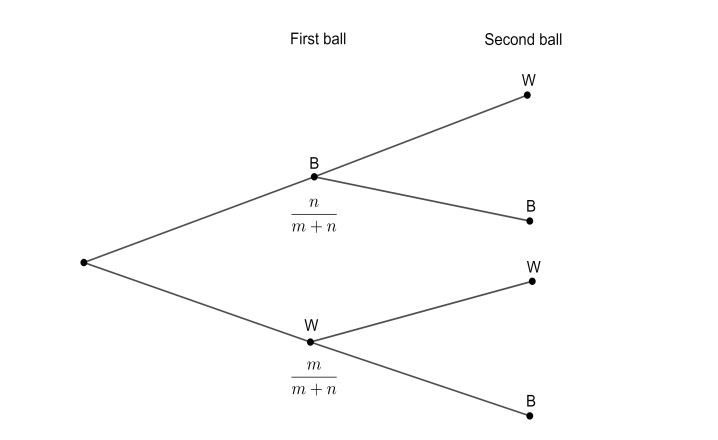
Next we will come to the second ball. The total number of balls left in the urn after drawing the first ball is $m+n-1$. Let us fix the first ball to be black. Now, the probability that the second ball is white is $P\left( BW \right)=\dfrac{n}{m+n}\times \dfrac{m}{m+n-1}$. The probability that the second ball is black is $P\left( BB \right)=\dfrac{n}{m+n}\times \dfrac{n-1}{m+n-1}$.
Now we will fix the first ball to be white. So, the probability that the second ball is white is $P\left( WW \right)=\dfrac{m}{m+n}\times \dfrac{m-1}{m+n-1}$. And the probability that the second ball is black is $P\left( WB \right)=\dfrac{m}{m+n}\times \dfrac{n}{m+n-1}$.
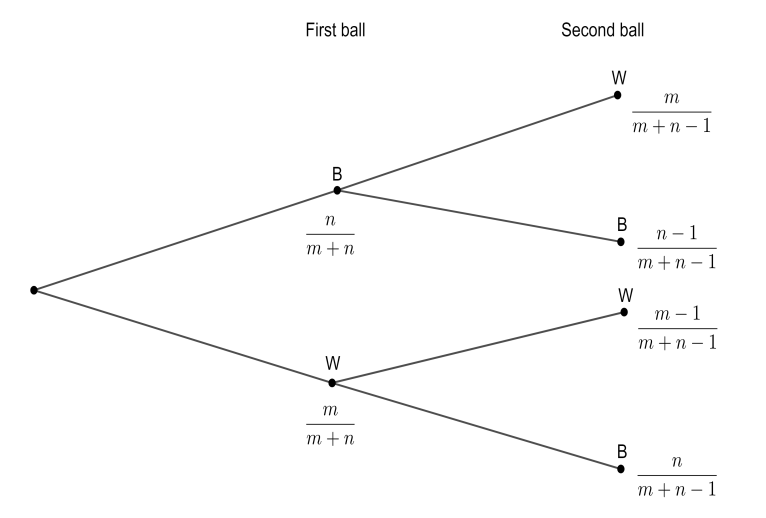
So, the probability that the second ball is white will be,
$P=P(BW)+P(WW)$
Substituting the values of $P(BW)$ and $P(WW)$, we get
$P=\left( \dfrac{n}{m+n}\times \dfrac{m}{m+n-1} \right)+\left( \dfrac{m}{m+n}\times \dfrac{m-1}{m+n-1} \right)$
Simplifying the above equation, we get the following
$\begin{align}
& P=\left( \dfrac{mn+m\left( m-1 \right)}{\left( m+n \right)\left( m+n-1 \right)} \right) \\
& =\dfrac{mn+{{m}^{2}}-m}{\left( m+n \right)\left( m+n-1 \right)} \\
& =\dfrac{m\left( n+m-1 \right)}{\left( m+n \right)\left( m+n-1 \right)} \\
& =\dfrac{m}{m+n}
\end{align}$
Hence, the probability that the second ball drawn is white is $\dfrac{m}{m+n}$.
So, the correct answer is “Option A”.
Note:
The key aspect of this question is multiplying the probability that the first ball is white or that it is black while calculating the probability that the second ball is white. Basically, we split the event of the second ball being white into two cases. Case 1 is BW, that is the first ball is black AND the second ball is white. Case 2 is WW, which means that the first ball is white AND the second ball is white.
Complete step by step answer:
Let us draw a diagram to understand the events.
Now, the probability that the first ball is white is $\dfrac{m}{m+n}$, since there are $m$ white balls and $m+n$ total balls in the urn. Similarly, the probability that the first ball is black is $\dfrac{n}{m+n}$, as there are $n$ white balls and $m+n$ total balls.
Next we will come to the second ball. The total number of balls left in the urn after drawing the first ball is $m+n-1$. Let us fix the first ball to be black. Now, the probability that the second ball is white is $P\left( BW \right)=\dfrac{n}{m+n}\times \dfrac{m}{m+n-1}$. The probability that the second ball is black is $P\left( BB \right)=\dfrac{n}{m+n}\times \dfrac{n-1}{m+n-1}$.
Now we will fix the first ball to be white. So, the probability that the second ball is white is $P\left( WW \right)=\dfrac{m}{m+n}\times \dfrac{m-1}{m+n-1}$. And the probability that the second ball is black is $P\left( WB \right)=\dfrac{m}{m+n}\times \dfrac{n}{m+n-1}$.
So, the probability that the second ball is white will be,
$P=P(BW)+P(WW)$
Substituting the values of $P(BW)$ and $P(WW)$, we get
$P=\left( \dfrac{n}{m+n}\times \dfrac{m}{m+n-1} \right)+\left( \dfrac{m}{m+n}\times \dfrac{m-1}{m+n-1} \right)$
Simplifying the above equation, we get the following
$\begin{align}
& P=\left( \dfrac{mn+m\left( m-1 \right)}{\left( m+n \right)\left( m+n-1 \right)} \right) \\
& =\dfrac{mn+{{m}^{2}}-m}{\left( m+n \right)\left( m+n-1 \right)} \\
& =\dfrac{m\left( n+m-1 \right)}{\left( m+n \right)\left( m+n-1 \right)} \\
& =\dfrac{m}{m+n}
\end{align}$
Hence, the probability that the second ball drawn is white is $\dfrac{m}{m+n}$.
So, the correct answer is “Option A”.
Note:
The key aspect of this question is multiplying the probability that the first ball is white or that it is black while calculating the probability that the second ball is white. Basically, we split the event of the second ball being white into two cases. Case 1 is BW, that is the first ball is black AND the second ball is white. Case 2 is WW, which means that the first ball is white AND the second ball is white.
Recently Updated Pages
Master Class 12 Economics: Engaging Questions & Answers for Success

Master Class 12 Physics: Engaging Questions & Answers for Success
Master Class 12 English: Engaging Questions & Answers for Success
Master Class 12 Social Science: Engaging Questions & Answers for Success
Master Class 12 Maths: Engaging Questions & Answers for Success
Master Class 12 Business Studies: Engaging Questions & Answers for Success
Trending doubts
Which are the Top 10 Largest Countries of the World?
What are the major means of transport Explain each class 12 social science CBSE
Draw a labelled sketch of the human eye class 12 physics CBSE
Why cannot DNA pass through cell membranes class 12 biology CBSE
Differentiate between insitu conservation and exsitu class 12 biology CBSE
Draw a neat and well labeled diagram of TS of ovary class 12 biology CBSE