




An organic compound \[X\] of molecular formula ${C_2}{H_4}{O_2}$ gives brisk effervescence with $NaHC{O_3}$ . Give the name of the formula of $X$
Answer
 Verified
609.3k+ views
Hint: We will first try to draw the structural formula of the organic compound. Also, we know Brisk effervescence means release of bubbles. Brisk effervescence is observed when there is a release of the gas called carbon dioxide. Since two atoms of oxygen are present, two structural isomers are possible namely a carboxylic acid or an ester.
Complete solution:
So, the two functional isomers formed are:
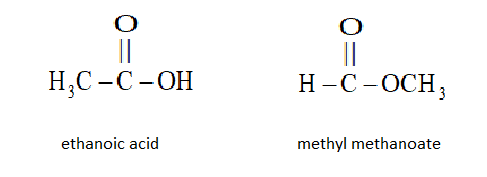
A carboxylic acid and an ester will be formed.
We know that esters do not react with $NaHC{O_3}$ while carboxylic acids will react with $NaHC{O_3}$ and to the brisk effervescence of carbon dioxide.
Ethanoic acid reacts with sodium bicarbonate to form sodium acetate and water with the release of carbon dioxide.
$2C{H_3}COOH + 2NaHC{O_3} \to 2C{H_3}COONa + C{O_2} + {H_2}O$
This is a very common test used for the identification of carboxylic acid in functional group analysis.
Let us have a look on how to write the IUPAC name of the compound:
Here we see that since two carbon atoms are present so the root word will be ‘eth’. And also, a single bond is present between carbon and hydrogen atoms so the root word will become ethane. It is an acid so, ‘oic’ will be used as the suffix. Hence the name of the acid is ethanoic acid.
Therefore, the compound \[X\] of molecular formula ${C_2}{H_4}{O_2}$ is ethanoic acid also known as acetic acid.
Note:We know that here the reaction is taking place between an acid and a base so the reaction will be named as the neutralization reaction. In neutralization reaction acid reacts with base to form salt and water. Hence in the above reaction the salt which is being formed is sodium acetate salt with the release of water and carbon dioxide.
Complete solution:
So, the two functional isomers formed are:
A carboxylic acid and an ester will be formed.
We know that esters do not react with $NaHC{O_3}$ while carboxylic acids will react with $NaHC{O_3}$ and to the brisk effervescence of carbon dioxide.
Ethanoic acid reacts with sodium bicarbonate to form sodium acetate and water with the release of carbon dioxide.
$2C{H_3}COOH + 2NaHC{O_3} \to 2C{H_3}COONa + C{O_2} + {H_2}O$
This is a very common test used for the identification of carboxylic acid in functional group analysis.
Let us have a look on how to write the IUPAC name of the compound:
Here we see that since two carbon atoms are present so the root word will be ‘eth’. And also, a single bond is present between carbon and hydrogen atoms so the root word will become ethane. It is an acid so, ‘oic’ will be used as the suffix. Hence the name of the acid is ethanoic acid.
Therefore, the compound \[X\] of molecular formula ${C_2}{H_4}{O_2}$ is ethanoic acid also known as acetic acid.
Note:We know that here the reaction is taking place between an acid and a base so the reaction will be named as the neutralization reaction. In neutralization reaction acid reacts with base to form salt and water. Hence in the above reaction the salt which is being formed is sodium acetate salt with the release of water and carbon dioxide.
Recently Updated Pages
Match columnI with columnII and choose the correct class 12 biology NEET_UG

Match columnI with columnII and choose the correct class 12 biology NEET_UG
Match columnI with columnII and choose the correct class 12 biology NEET_UG
Which plant will lose its economic value if its fruits class 12 biology NEET_UG
Human insulin is being commercially produced from a class 12 biology NEET_UG
Match columnI with columnII and choose the correct class 12 biology NEET_UG
Trending doubts
Which are the Top 10 Largest Countries of the World?
Draw a labelled sketch of the human eye class 12 physics CBSE
Why is the cell called the structural and functional class 12 biology CBSE
Draw ray diagrams each showing i myopic eye and ii class 12 physics CBSE
Differentiate between homogeneous and heterogeneous class 12 chemistry CBSE
Which is the correct genotypic ratio of mendel dihybrid class 12 biology CBSE