



An organic compound which is used as a refrigerant in refrigerators and air conditioners is:
(A) BHC
(B) $CC{l_4}$
(C) freon
(D) $CHC{l_3}$
Answer
 Verified
574.5k+ views
Hint: Refrigerant is a liquid which changes to vapour form when subjected to minute change in pressure. The freezing, refrigeration and air conditioning will not be possible without a refrigerant. The refrigerant has the ability to absorb heat from its surrounding which is used for providing cooling or refrigeration with the help of compressor and evaporator. It is pumped through a closed system through a coiled copper tube. The direct impact of refrigerants on the environment is ozone layer depletion caused by refrigerants leaked through air conditioners and refrigerators.
Complete step by step solution:
Freon is a type of chlorofluorocarbons (CFCs), halogen derivatives of methane and ethane. The nontoxic and non-flammable compounds containing carbon, chlorine and fluorine are referred to as chlorofluorocarbons (CFCs). The chemical formula of freon is $C{F_2}C{l_2}$ and its chemical name is dichlorodifluoromethane. It is also known as CFC-12 and R-22. It is a simple aliphatic organic compound containing two halogens.

The freon is a colourless, odourless and noncorrosive gas. Freons came into application as refrigerants in the 1930s. Along with its usage in air conditioners, it is also used in cold storage facilities and during food transportation.
Freons when released in the atmosphere, cause environmental pollution by depleting the ozone layer. It leads to exposure of organisms to the harmful UV radiations.
Therefore, option (C) freon is a correct option.
Note:
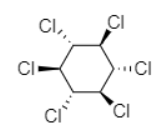
Freon is a CFC compound. Students may get confused between the term’s CFC and BHC. Remember that BHC stands for benzene hexachloride, also known as lindane. It contains carbon, hydrogen and chlorine.
The $CC{l_4}$, carbon tetrachloride and $CHC{l_3}$, trichloromethane are carbon-halogen compounds but cannot be categorised as CFCs as they do not contain fluorine.
Complete step by step solution:
Freon is a type of chlorofluorocarbons (CFCs), halogen derivatives of methane and ethane. The nontoxic and non-flammable compounds containing carbon, chlorine and fluorine are referred to as chlorofluorocarbons (CFCs). The chemical formula of freon is $C{F_2}C{l_2}$ and its chemical name is dichlorodifluoromethane. It is also known as CFC-12 and R-22. It is a simple aliphatic organic compound containing two halogens.
The freon is a colourless, odourless and noncorrosive gas. Freons came into application as refrigerants in the 1930s. Along with its usage in air conditioners, it is also used in cold storage facilities and during food transportation.
Freons when released in the atmosphere, cause environmental pollution by depleting the ozone layer. It leads to exposure of organisms to the harmful UV radiations.
Therefore, option (C) freon is a correct option.
Note:
Freon is a CFC compound. Students may get confused between the term’s CFC and BHC. Remember that BHC stands for benzene hexachloride, also known as lindane. It contains carbon, hydrogen and chlorine.
The $CC{l_4}$, carbon tetrachloride and $CHC{l_3}$, trichloromethane are carbon-halogen compounds but cannot be categorised as CFCs as they do not contain fluorine.
Recently Updated Pages
Master Class 12 Economics: Engaging Questions & Answers for Success

Master Class 12 Physics: Engaging Questions & Answers for Success
Master Class 12 English: Engaging Questions & Answers for Success
Master Class 12 Social Science: Engaging Questions & Answers for Success
Master Class 12 Maths: Engaging Questions & Answers for Success
Master Class 12 Business Studies: Engaging Questions & Answers for Success
Trending doubts
Which are the Top 10 Largest Countries of the World?
What are the major means of transport Explain each class 12 social science CBSE
Draw a labelled sketch of the human eye class 12 physics CBSE
Why cannot DNA pass through cell membranes class 12 biology CBSE
Differentiate between insitu conservation and exsitu class 12 biology CBSE
Draw a neat and well labeled diagram of TS of ovary class 12 biology CBSE