



An organic compound contains $69.77%$ carbon, $11.63%$ hydrogen and rest oxygen. The molecular mass of the compound is 86. It does not reduce Tollens reagent but forms an additional compound with sodium hydrogen sulphite and gives positive iodoform test. On vigorous oxidation, it gives ethanoic and propanoic acid. Write the possible structure of the compound.
Answer
 Verified
609.6k+ views
Hint The percentage composition will provide the ratio in which the atoms in the compound are present, giving the empirical formula. This is further related to the molecular formula by the n-factor.
Complete step by step answer:
The percentage composition of the components is given as follows:
Percentage of carbon $=69.77%$
Percentage of hydrogen $=11.63%$
Percentage of oxygen $=(100-69.77-11.63)=18.6%$
So, the molar ratio of carbon, hydrogen and oxygen in the compound is given by:
$C:H:O=\dfrac{69.77}{12}:\dfrac{11.63}{1}:\dfrac{18.6}{16}$
Then, on simplifying, we get, $C:H:O=5:10:1$
So, the empirical formula for the compound will now be ${{C}_{5}}{{H}_{10}}O$and the empirical formula mass will be $(5\times 12+10\times 1+1\times 16)=86g$.
The molecular mass also given equal to $86g$. So, the n-factor $\text{=}\dfrac{\text{molecular}\,\text{mass}}{\text{empirical formula mass}}=\dfrac{86}{86}=1$ .
Therefore, the molecular formula of the compound is ${{C}_{5}}{{H}_{10}}O$.
Now, the structure of the compound can be detrained, following through the tests it satisfies, which are as follows:
- Firstly, the Tollens test, will distinguish between the aldehydes and ketones. As the Tollens reagent is not reduced by the compound, so it will not be an aldehyde. We thus get a ketone.
- Further, the compound reacts with sodium hydrogen sulphite giving a positive iodoform test. Thus, the ketone compound is rather a methyl ketone compound.
- This methyl ketone on vigorous oxidation gives ethanoic and propanoic acid.so, the compound will be $\text{Pentan-2-one}$.
Reaction as follows: \[\underset{\text{Pentan-2-one}}{\mathop{C{{H}_{3}}COC{{H}_{2}}C{{H}_{2}}C{{H}_{3}}}}\,\to \underset{\text{Ethanoic acid}}{\mathop{C{{H}_{3}}COOH}}\,+\underset{\text{Propanoic acid}}{\mathop{C{{H}_{3}}C{{H}_{2}}COOH}}\,\]
Therefore, the possible structure of $\text{Pentan-2-one}$ is shown below:
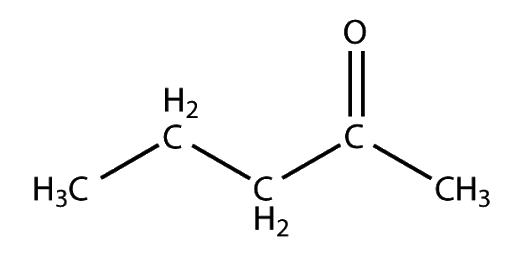
Note: The n-factor gives the ratio of the atoms in the molecular formula as an integer multiple of the atoms in the empirical formula, which helps to obtain the actual molecular formula of the compound.
Complete step by step answer:
The percentage composition of the components is given as follows:
Percentage of carbon $=69.77%$
Percentage of hydrogen $=11.63%$
Percentage of oxygen $=(100-69.77-11.63)=18.6%$
So, the molar ratio of carbon, hydrogen and oxygen in the compound is given by:
$C:H:O=\dfrac{69.77}{12}:\dfrac{11.63}{1}:\dfrac{18.6}{16}$
Then, on simplifying, we get, $C:H:O=5:10:1$
So, the empirical formula for the compound will now be ${{C}_{5}}{{H}_{10}}O$and the empirical formula mass will be $(5\times 12+10\times 1+1\times 16)=86g$.
The molecular mass also given equal to $86g$. So, the n-factor $\text{=}\dfrac{\text{molecular}\,\text{mass}}{\text{empirical formula mass}}=\dfrac{86}{86}=1$ .
Therefore, the molecular formula of the compound is ${{C}_{5}}{{H}_{10}}O$.
Now, the structure of the compound can be detrained, following through the tests it satisfies, which are as follows:
- Firstly, the Tollens test, will distinguish between the aldehydes and ketones. As the Tollens reagent is not reduced by the compound, so it will not be an aldehyde. We thus get a ketone.
- Further, the compound reacts with sodium hydrogen sulphite giving a positive iodoform test. Thus, the ketone compound is rather a methyl ketone compound.
- This methyl ketone on vigorous oxidation gives ethanoic and propanoic acid.so, the compound will be $\text{Pentan-2-one}$.
Reaction as follows: \[\underset{\text{Pentan-2-one}}{\mathop{C{{H}_{3}}COC{{H}_{2}}C{{H}_{2}}C{{H}_{3}}}}\,\to \underset{\text{Ethanoic acid}}{\mathop{C{{H}_{3}}COOH}}\,+\underset{\text{Propanoic acid}}{\mathop{C{{H}_{3}}C{{H}_{2}}COOH}}\,\]
Therefore, the possible structure of $\text{Pentan-2-one}$ is shown below:
Note: The n-factor gives the ratio of the atoms in the molecular formula as an integer multiple of the atoms in the empirical formula, which helps to obtain the actual molecular formula of the compound.
Recently Updated Pages
Master Class 12 Economics: Engaging Questions & Answers for Success

Master Class 12 Biology: Engaging Questions & Answers for Success
Master Class 11 English: Engaging Questions & Answers for Success
Master Class 11 Physics: Engaging Questions & Answers for Success
Master Class 11 Computer Science: Engaging Questions & Answers for Success
Master Class 11 Chemistry: Engaging Questions & Answers for Success
Trending doubts
Draw a labelled sketch of the human eye class 12 physics CBSE
Why is the cell called the structural and functional class 12 biology CBSE
Draw ray diagrams each showing i myopic eye and ii class 12 physics CBSE
Which are the Top 10 Largest Countries of the World?
Differentiate between homogeneous and heterogeneous class 12 chemistry CBSE
Which is the correct genotypic ratio of mendel dihybrid class 12 biology CBSE