




An object shaped as ‘L’ is placed between two parallel plane mirrors. In the first seven closest images that are formed, how many laterally inverted images are formed?
A. 1
B. 2
C. 3
D. 4
Answer
 Verified
614.7k+ views
Hint: When an object is placed in front of a mirror, it will be automatically inverted laterally. For example small b will appear as small d. This laterally inverted image acts as objects for the next images to form the original image.
Complete step by step answer:
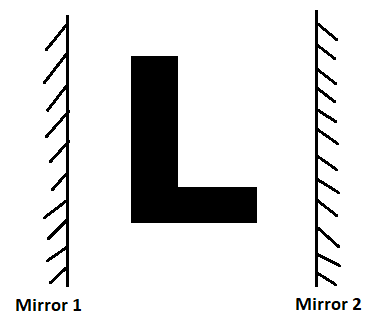
We are given an object shaped as ‘L’ is placed between two parallel plane mirrors.
We have to find how many laterally inverted images are formed in the first seven closest images that are formed.
Because of object L, there will be two laterally images ${I_1},{I_2}$ formed in mirrors 1 and 2 respectively in the first two closest images.
${I_1}$ acts as an object for mirror 2 and ${I_2}$ acts as an object for mirror 1.
These objects result in two L shaped images ${I_3},{I_4}$ formed in mirrors 1 and 2 respectively.
These images ${I_3},{I_4}$ acts as objects for the next two images to form two laterally images ${I_5},{I_6}$ formed in mirrors 1 and 2 respectively in the first two closest images.
${I_5},{I_6}$ acts as objects for the next two images to form L shaped images ${I_7},{I_8}$.
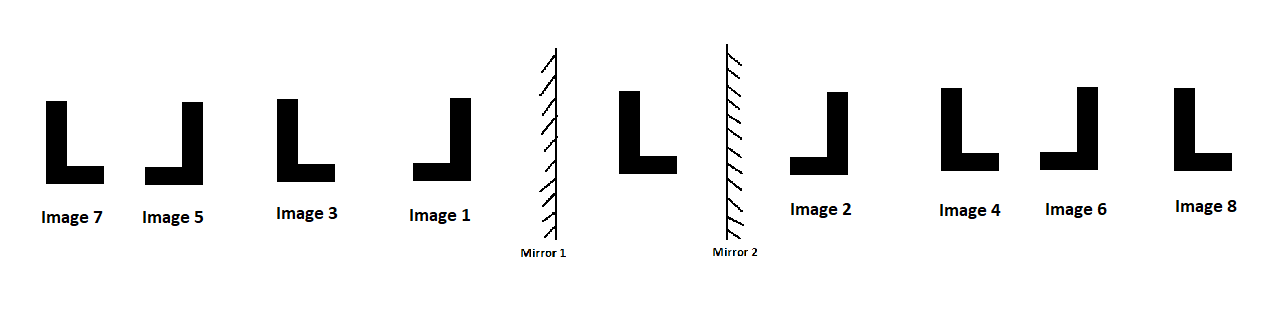
Therefore, in the first seven closest images that are formed by ‘L’ shape, there are 4 laterally inverted images.
The correct answer is Option D, which is 4.
Note:A mirror is a reflective surface in which light does not pass through it, but bounces off of it and this produces an image. Mirrors are made by putting a thin layer of silver nitrate or aluminum behind a flat piece of glass. When you place an object in front of a mirror, you see the same object in the mirror but with lateral inversion.
Complete step by step answer:
We are given an object shaped as ‘L’ is placed between two parallel plane mirrors.
We have to find how many laterally inverted images are formed in the first seven closest images that are formed.
Because of object L, there will be two laterally images ${I_1},{I_2}$ formed in mirrors 1 and 2 respectively in the first two closest images.
${I_1}$ acts as an object for mirror 2 and ${I_2}$ acts as an object for mirror 1.
These objects result in two L shaped images ${I_3},{I_4}$ formed in mirrors 1 and 2 respectively.
These images ${I_3},{I_4}$ acts as objects for the next two images to form two laterally images ${I_5},{I_6}$ formed in mirrors 1 and 2 respectively in the first two closest images.
${I_5},{I_6}$ acts as objects for the next two images to form L shaped images ${I_7},{I_8}$.
Therefore, in the first seven closest images that are formed by ‘L’ shape, there are 4 laterally inverted images.
The correct answer is Option D, which is 4.
Note:A mirror is a reflective surface in which light does not pass through it, but bounces off of it and this produces an image. Mirrors are made by putting a thin layer of silver nitrate or aluminum behind a flat piece of glass. When you place an object in front of a mirror, you see the same object in the mirror but with lateral inversion.
Recently Updated Pages
Master Class 12 Economics: Engaging Questions & Answers for Success

Master Class 12 English: Engaging Questions & Answers for Success
Master Class 12 Social Science: Engaging Questions & Answers for Success
Master Class 12 Maths: Engaging Questions & Answers for Success
Master Class 12 Physics: Engaging Questions & Answers for Success
Master Class 12 Business Studies: Engaging Questions & Answers for Success
Trending doubts
Which are the Top 10 Largest Countries of the World?
Draw a labelled sketch of the human eye class 12 physics CBSE
Differentiate between homogeneous and heterogeneous class 12 chemistry CBSE
Why is the cell called the structural and functional class 12 biology CBSE
Draw ray diagrams each showing i myopic eye and ii class 12 physics CBSE
Which is the correct genotypic ratio of mendel dihybrid class 12 biology CBSE