




An object is situated at $8\;cm$ from a convex lens of focal length $10\;cm$. Find the position and the nature of the image. Draw a ray diagram to illustrate the formation of the image-
(A) $ - 40\;$
(B) $50\;$
(C) $60\;$
(D) $ - 20\;$
Answer
 Verified
562.8k+ views
Hint: The image formed by a convex lens can have different features, it can be enlarged or diminished, real or virtual, upright or inverted, the nature of the image formed depends on the position of the object relative to the lens.
Complete step by step solution:
It is given that,
The object is kept at a distance of $u = 8\;cm$ from the lens’ optical centre.
The focal length of the given lens is, $f = 10\;cm$
It is observed that the distance of the object is less than the focal length of the object.
For a convex lens, if the object is kept within the focal length of the lens, then the rays from the same point in the object (say, from the point$A$ ) diverge after the refraction from the lens. This creates a virtual image of the object and the image is situated behind the lens and is enlarged.
The ray diagram for the illustration of the formation of this image is drawn below-
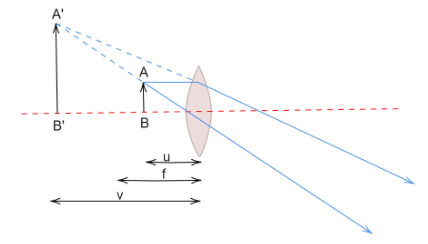
Let the distance of the image from the optical centre of the lens be $v$.
We can find the position of the image by using the lens formula-
$\dfrac{1}{f} = \dfrac{1}{v} - \dfrac{1}{u}$
We can rearrange this,
$\dfrac{1}{v} = \dfrac{1}{f} + \dfrac{1}{u}$
According to the sign convention, we have,
$u = - 8cm$
The focal length of a convex lens is taken as positive, therefore-
$f = 10cm$
Keeping these values in the lens formula-
$\dfrac{1}{v} = \dfrac{1}{{10}} + \left( { - \dfrac{1}{8}} \right)$
$ \Rightarrow \dfrac{1}{v} = \dfrac{1}{{10}} - \left( {\dfrac{1}{8}} \right)$
Cross multiplying,
$ \Rightarrow \dfrac{1}{v} = \dfrac{{8 - 10}}{{80}}$
$ \Rightarrow \dfrac{1}{v} = \dfrac{{ - 2}}{{80}}$
Reciprocating,
$v = - 40$
The image is formed at a distance of $ - 40cm$ from the optical centre of the lens. The negative sign signifies that the image is formed behind the lens.
Note:
The sign convention should be kept in mind while using the lens formula or the mirror formula in optics. For the position of an image, the sign tells whether the image is situated behind or above the lens. The terms behind or above are defined relative to the direction of travel of light.
Complete step by step solution:
It is given that,
The object is kept at a distance of $u = 8\;cm$ from the lens’ optical centre.
The focal length of the given lens is, $f = 10\;cm$
It is observed that the distance of the object is less than the focal length of the object.
For a convex lens, if the object is kept within the focal length of the lens, then the rays from the same point in the object (say, from the point$A$ ) diverge after the refraction from the lens. This creates a virtual image of the object and the image is situated behind the lens and is enlarged.
The ray diagram for the illustration of the formation of this image is drawn below-
Let the distance of the image from the optical centre of the lens be $v$.
We can find the position of the image by using the lens formula-
$\dfrac{1}{f} = \dfrac{1}{v} - \dfrac{1}{u}$
We can rearrange this,
$\dfrac{1}{v} = \dfrac{1}{f} + \dfrac{1}{u}$
According to the sign convention, we have,
$u = - 8cm$
The focal length of a convex lens is taken as positive, therefore-
$f = 10cm$
Keeping these values in the lens formula-
$\dfrac{1}{v} = \dfrac{1}{{10}} + \left( { - \dfrac{1}{8}} \right)$
$ \Rightarrow \dfrac{1}{v} = \dfrac{1}{{10}} - \left( {\dfrac{1}{8}} \right)$
Cross multiplying,
$ \Rightarrow \dfrac{1}{v} = \dfrac{{8 - 10}}{{80}}$
$ \Rightarrow \dfrac{1}{v} = \dfrac{{ - 2}}{{80}}$
Reciprocating,
$v = - 40$
The image is formed at a distance of $ - 40cm$ from the optical centre of the lens. The negative sign signifies that the image is formed behind the lens.
Note:
The sign convention should be kept in mind while using the lens formula or the mirror formula in optics. For the position of an image, the sign tells whether the image is situated behind or above the lens. The terms behind or above are defined relative to the direction of travel of light.
Recently Updated Pages
Master Class 12 Economics: Engaging Questions & Answers for Success

Master Class 12 Physics: Engaging Questions & Answers for Success
Master Class 12 English: Engaging Questions & Answers for Success
Master Class 12 Social Science: Engaging Questions & Answers for Success
Master Class 12 Maths: Engaging Questions & Answers for Success
Master Class 12 Business Studies: Engaging Questions & Answers for Success
Trending doubts
Which are the Top 10 Largest Countries of the World?
What are the major means of transport Explain each class 12 social science CBSE
Draw a labelled sketch of the human eye class 12 physics CBSE
Why cannot DNA pass through cell membranes class 12 biology CBSE
Differentiate between insitu conservation and exsitu class 12 biology CBSE
Draw a neat and well labeled diagram of TS of ovary class 12 biology CBSE