




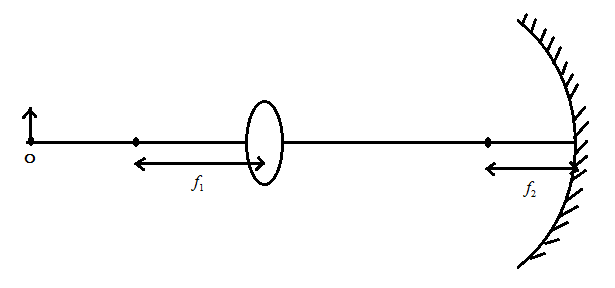
An object is placed in front of a converging lens at a distance equal to twice the focal length $ {f_1} $ of the lens. On the other side of the lens is a concave mirror of focal length $ {f_2} $ separated from the lens by a distance $ 2({f_1} + {f_2}) $ . Light from the object passes rightward through the lens, and forms a final image of the object.
(A) The distance between the lens and the final image is equal to $ 2{f_1} $
(B) The distance between the lens and the final image is equal to $ 2({f_1} + {f_2}) $
(C) The final image is real, inverted and the same size as that of the object.
(D) The final image is real, erect and of the same size as that of the object.
Answer
 Verified
552.9k+ views
Hint :Here, the lens is in between the object and the concave mirror, use the ray diagram concepts used to draw the image forming from lenses and mirrors. The image formed by the lens is real if the object is placed at the distance more than that of the focal length. Also image formed by the concave mirror virtual and inverted image if the object is placed in front of the focal point.
Complete Step By Step Answer:
The distance between the lens and the object is given by $ 2{f_1} $ since it is placed at the distance of twice the focal length. The lens is placed at the length of $ 2({f_1} + {f_2}) $ . So we have to draw the ray diagram using the concept of formation of images by the lens and the mirror as:
Image formed by lens is real and inverted is $ {I_1} $
$ {I_1} $ acts as the object for the concave mirror and the image formed by the concave mirror is $ {I_2} $ real and inverted.
$ {I_3} $ is the image formed by the lens at length $ 2{f_1} $ is due to the image $ {I_2} $ . It is real, inverted and of the same size as that of the object.
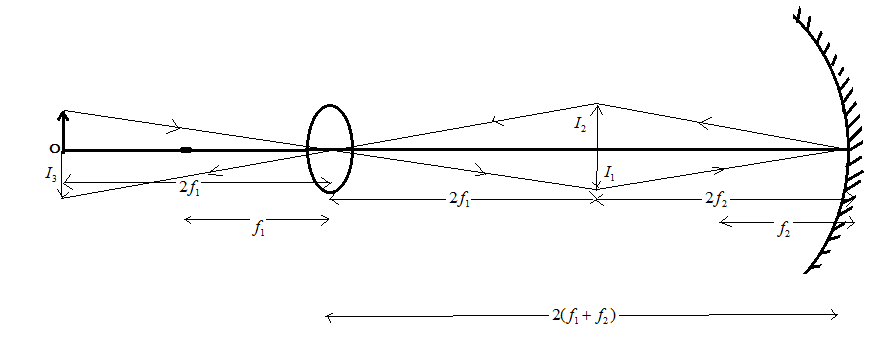
Thus, we observed in the above figure that the image formed by lens for the first time is real inverted and of same size at distance $ 2{f_1} $ also the last image formed is real, inverted and of same size that of the object also at distance $ 2{f_1} $ .
The correct answer is option A and B.
Note :
We have drawn the ray diagram of the image formation of the lens and the concave mirror but still we have to study the options given and match those statements with the images we obtained that comparison will lead us to the correct answer. We must understand the laws of forming the ray diagram to obtain images.
Complete Step By Step Answer:
The distance between the lens and the object is given by $ 2{f_1} $ since it is placed at the distance of twice the focal length. The lens is placed at the length of $ 2({f_1} + {f_2}) $ . So we have to draw the ray diagram using the concept of formation of images by the lens and the mirror as:
Image formed by lens is real and inverted is $ {I_1} $
$ {I_1} $ acts as the object for the concave mirror and the image formed by the concave mirror is $ {I_2} $ real and inverted.
$ {I_3} $ is the image formed by the lens at length $ 2{f_1} $ is due to the image $ {I_2} $ . It is real, inverted and of the same size as that of the object.
Thus, we observed in the above figure that the image formed by lens for the first time is real inverted and of same size at distance $ 2{f_1} $ also the last image formed is real, inverted and of same size that of the object also at distance $ 2{f_1} $ .
The correct answer is option A and B.
Note :
We have drawn the ray diagram of the image formation of the lens and the concave mirror but still we have to study the options given and match those statements with the images we obtained that comparison will lead us to the correct answer. We must understand the laws of forming the ray diagram to obtain images.
Recently Updated Pages
Master Class 10 Computer Science: Engaging Questions & Answers for Success

Master Class 10 General Knowledge: Engaging Questions & Answers for Success
Master Class 10 English: Engaging Questions & Answers for Success
Master Class 10 Social Science: Engaging Questions & Answers for Success
Master Class 10 Maths: Engaging Questions & Answers for Success
Master Class 10 Science: Engaging Questions & Answers for Success
Trending doubts
Which are the Top 10 Largest Countries of the World?
Draw a labelled sketch of the human eye class 12 physics CBSE
Differentiate between homogeneous and heterogeneous class 12 chemistry CBSE
What are the major means of transport Explain each class 12 social science CBSE
Sulphuric acid is known as the king of acids State class 12 chemistry CBSE
Why should a magnesium ribbon be cleaned before burning class 12 chemistry CBSE