




An object is placed in front of a concave mirror of radius of curvature 15 cm, at a distance of 10cm. The position and nature of the image is formed
A. +30cm, virtual and erect
B. +30cm, real and inverted
C. -30cm, virtual and erect
D. -30cm, real and inverted
Answer
 Verified
637.5k+ views
Hint: We use here mirror formula for a concave mirror. Concave mirror in which the inner depressed surface is reflecting and the outer surface is painted. It can produce both real and virtual images. The images can be enlarged, diminished, and the same size as the object.
Complete step by step answer:
Here the object is placed in the front of the concave mirror,
Radius of curvature (R) = -15cm
Object distance (u) = -10cm
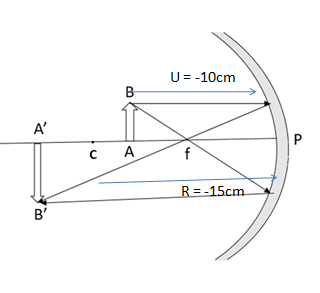
(Here we take negative signs by applying a new Cartesian sign convention.)
First we find the focal length of the concave mirror, ${\rm{f = }}\dfrac{{{\rm{ - R}}}}{2} = \dfrac{{ - 15}}{2}{\rm{cm}}$
Now by using mirror formula $\dfrac{1}{{\rm{u}}} + \dfrac{1}{{\rm{v}}} = \dfrac{1}{{\rm{f}}}$ we get,
$\dfrac{1}{{\rm{v}}} = \dfrac{1}{{\rm{f}}} - \dfrac{1}{{\rm{u}}}$
$ \Rightarrow - \dfrac{2}{{15}} - \dfrac{1}{{({\rm{ - 10)}}}} = - \dfrac{2}{{15}} + \dfrac{1}{{10}} = - \dfrac{1}{{30}}$
$\dfrac{1}{{\rm{v}}} = - \dfrac{1}{{30}}$
$\Rightarrow {\rm{v = - 30cm}}$
Here $v$ is the image of an object and the image formed by the concave mirror is at 30cm in front of it.
Therefore the image is real and inverted. Thus correct option is (D).
Note:
A concave mirror is a converging mirror, which has a reflecting surface inwards. The concave mirror reflects light inward to one focal point. They are used to focus light—the concave mirror used as car headlights. The mirror formula is the same for a convex and concave mirror. Concave mirrors and plane mirrors are always used inside mirrors of automobiles. The image formed in the concave mirror is diminished, and it is typical to find precisely how far and closer away from the objects.
Complete step by step answer:
Here the object is placed in the front of the concave mirror,
Radius of curvature (R) = -15cm
Object distance (u) = -10cm
(Here we take negative signs by applying a new Cartesian sign convention.)
First we find the focal length of the concave mirror, ${\rm{f = }}\dfrac{{{\rm{ - R}}}}{2} = \dfrac{{ - 15}}{2}{\rm{cm}}$
Now by using mirror formula $\dfrac{1}{{\rm{u}}} + \dfrac{1}{{\rm{v}}} = \dfrac{1}{{\rm{f}}}$ we get,
$\dfrac{1}{{\rm{v}}} = \dfrac{1}{{\rm{f}}} - \dfrac{1}{{\rm{u}}}$
$ \Rightarrow - \dfrac{2}{{15}} - \dfrac{1}{{({\rm{ - 10)}}}} = - \dfrac{2}{{15}} + \dfrac{1}{{10}} = - \dfrac{1}{{30}}$
$\dfrac{1}{{\rm{v}}} = - \dfrac{1}{{30}}$
$\Rightarrow {\rm{v = - 30cm}}$
Here $v$ is the image of an object and the image formed by the concave mirror is at 30cm in front of it.
Therefore the image is real and inverted. Thus correct option is (D).
Note:
A concave mirror is a converging mirror, which has a reflecting surface inwards. The concave mirror reflects light inward to one focal point. They are used to focus light—the concave mirror used as car headlights. The mirror formula is the same for a convex and concave mirror. Concave mirrors and plane mirrors are always used inside mirrors of automobiles. The image formed in the concave mirror is diminished, and it is typical to find precisely how far and closer away from the objects.
Recently Updated Pages
Basicity of sulphurous acid and sulphuric acid are

Master Class 12 Economics: Engaging Questions & Answers for Success
Master Class 12 Biology: Engaging Questions & Answers for Success
Master Class 11 English: Engaging Questions & Answers for Success
Master Class 11 Physics: Engaging Questions & Answers for Success
Master Class 11 Computer Science: Engaging Questions & Answers for Success
Trending doubts
Draw a labelled sketch of the human eye class 12 physics CBSE
The chemical formula of tear gas is A CO Cl 2 B C 10 class 12 chemistry CBSE
Draw ray diagrams each showing i myopic eye and ii class 12 physics CBSE
Which are the Top 10 Largest Countries of the World?
Differentiate between homogeneous and heterogeneous class 12 chemistry CBSE
Which is the correct genotypic ratio of mendel dihybrid class 12 biology CBSE