




An object is placed at a distance of $30\,cm$ in front of a convex mirror of focal length $15\,cm$ . Find the nature and the position of the image.
Answer
 Verified
522.9k+ views
Hint: In this question, we will first calculate the image distance from the given object distance and focal length of the mirror using the mirror formula given as $\dfrac{1}{v} + \dfrac{1}{u} = \dfrac{1}{f}$ where v is the image distance, u is the object distance and f is the focal length of the mirror.
Complete step by step answer:
Then, we shall calculate the magnification of the image formed and then from the sign of the image distance and the magnification, we will tell the nature and position of the image.
Complete step by step answer: The mirror formula is given by
$\dfrac{1}{v} + \dfrac{1}{u} = \dfrac{1}{f}$ where v is the image distance, u is the object distance and f is the focal length of the mirror.
According to the question, we can say that,
$u = 30\,cm$ and $f = 15\,cm$
Substituting in the mirror formula we have,
$\dfrac{1}{v} + \dfrac{1}{{ - 30}} = \dfrac{1}{{15}}$
Rearranging the terms, we get,
$\dfrac{1}{v} = \dfrac{1}{{15}} + \dfrac{1}{{30}}$
Further solving the equation, we get,
$\dfrac{1}{v} = \dfrac{{30 + 15}}{{30 \times 15}}$
$ \Rightarrow \dfrac{1}{v} = \dfrac{{45}}{{450}}$
$ \Rightarrow \dfrac{1}{v} = \dfrac{1}{{10}}$
Taking reciprocal both sides, we get,
$v = 10\,cm$
Magnification is defined as the ratio of the image distance and the object distance. Mathematically it is expressed as $m = -\dfrac{v}{u}$ where m is the magnification, v is the image distance and u is the object distance.
In the given situation,
$u = -30\,cm$ and $v = 10\,cm$
Substituting the values we get,
$m = -\dfrac{{10}}{{-30}}$
$ \Rightarrow m = \dfrac{1}{3}$
Magnification can also be defined as a ratio of the image size and the object size. This is expressed as
$m = \dfrac{h^{'}}{h}$ where $h^{'}$ is the image size and h is the object size.
In this situation we calculated the magnification to be one.
Substituting in the formula, we get,
$\dfrac{1}{3} = \dfrac{h^{'}}{h}$
$ \Rightarrow h = 3h^{'}$
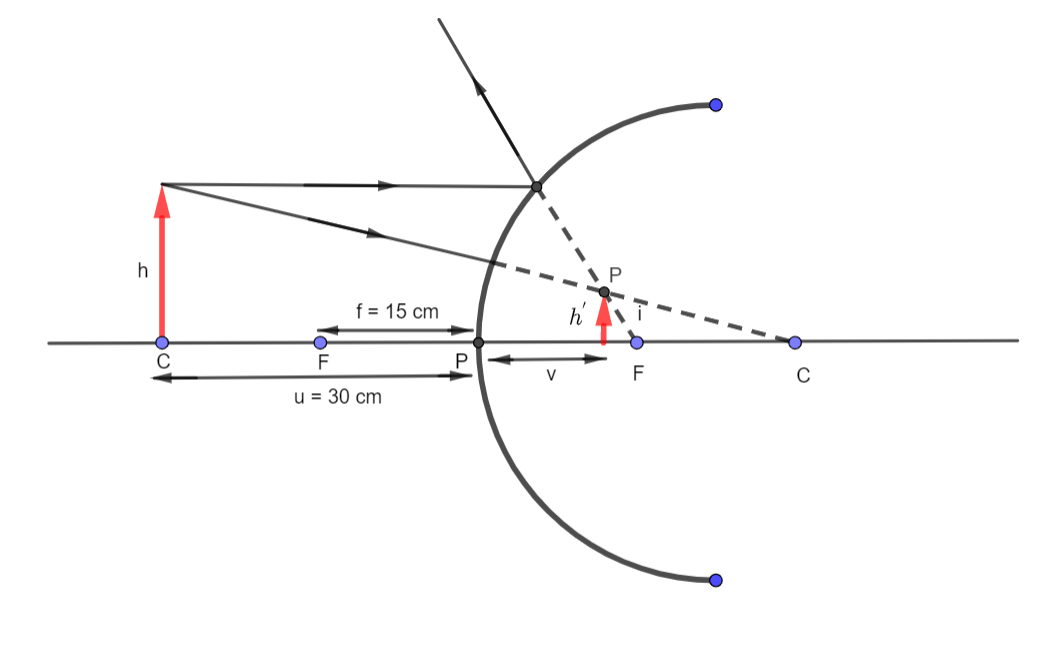
Hence, the characteristics of the image formed are:
1) Position: Since the focal length is $15\,cm$ and the image distance is $10\,cm$ , we can say that the image is formed between the pole and the focus of the mirror.
2) Nature: Since the sign of v came out to be positive, we can say that the image formed is virtual and erect.
3) Magnification: Since the magnification is less than one, we can say that the image is diminished.
The image formation as depicted by a ray diagram in this case would be
Note:
We adopt a standard convention that the object is always kept at the left of the mirror and hence the light rays are incident on the left of the mirror. Here we took $u = - 30\,cm$ because the object is located at the left side of the mirror. The sign convention demands that the distances measured to the left of the pole of the mirror are to be taken negative. Following proper sign conventions would give the correct answer.
Complete step by step answer:
Then, we shall calculate the magnification of the image formed and then from the sign of the image distance and the magnification, we will tell the nature and position of the image.
Complete step by step answer: The mirror formula is given by
$\dfrac{1}{v} + \dfrac{1}{u} = \dfrac{1}{f}$ where v is the image distance, u is the object distance and f is the focal length of the mirror.
According to the question, we can say that,
$u = 30\,cm$ and $f = 15\,cm$
Substituting in the mirror formula we have,
$\dfrac{1}{v} + \dfrac{1}{{ - 30}} = \dfrac{1}{{15}}$
Rearranging the terms, we get,
$\dfrac{1}{v} = \dfrac{1}{{15}} + \dfrac{1}{{30}}$
Further solving the equation, we get,
$\dfrac{1}{v} = \dfrac{{30 + 15}}{{30 \times 15}}$
$ \Rightarrow \dfrac{1}{v} = \dfrac{{45}}{{450}}$
$ \Rightarrow \dfrac{1}{v} = \dfrac{1}{{10}}$
Taking reciprocal both sides, we get,
$v = 10\,cm$
Magnification is defined as the ratio of the image distance and the object distance. Mathematically it is expressed as $m = -\dfrac{v}{u}$ where m is the magnification, v is the image distance and u is the object distance.
In the given situation,
$u = -30\,cm$ and $v = 10\,cm$
Substituting the values we get,
$m = -\dfrac{{10}}{{-30}}$
$ \Rightarrow m = \dfrac{1}{3}$
Magnification can also be defined as a ratio of the image size and the object size. This is expressed as
$m = \dfrac{h^{'}}{h}$ where $h^{'}$ is the image size and h is the object size.
In this situation we calculated the magnification to be one.
Substituting in the formula, we get,
$\dfrac{1}{3} = \dfrac{h^{'}}{h}$
$ \Rightarrow h = 3h^{'}$
Hence, the characteristics of the image formed are:
1) Position: Since the focal length is $15\,cm$ and the image distance is $10\,cm$ , we can say that the image is formed between the pole and the focus of the mirror.
2) Nature: Since the sign of v came out to be positive, we can say that the image formed is virtual and erect.
3) Magnification: Since the magnification is less than one, we can say that the image is diminished.
The image formation as depicted by a ray diagram in this case would be
Note:
We adopt a standard convention that the object is always kept at the left of the mirror and hence the light rays are incident on the left of the mirror. Here we took $u = - 30\,cm$ because the object is located at the left side of the mirror. The sign convention demands that the distances measured to the left of the pole of the mirror are to be taken negative. Following proper sign conventions would give the correct answer.
Recently Updated Pages
Master Class 12 Economics: Engaging Questions & Answers for Success

Master Class 12 English: Engaging Questions & Answers for Success
Master Class 12 Social Science: Engaging Questions & Answers for Success
Master Class 12 Maths: Engaging Questions & Answers for Success
Master Class 12 Physics: Engaging Questions & Answers for Success
Master Class 9 General Knowledge: Engaging Questions & Answers for Success
Trending doubts
Which are the Top 10 Largest Countries of the World?
Draw a labelled sketch of the human eye class 12 physics CBSE
Differentiate between homogeneous and heterogeneous class 12 chemistry CBSE
Why is the cell called the structural and functional class 12 biology CBSE
Draw ray diagrams each showing i myopic eye and ii class 12 physics CBSE
Which is the correct genotypic ratio of mendel dihybrid class 12 biology CBSE