




An object $50\,cm$ tall is placed on the principal axis of a convex lens, its $20\,cm$ tall image is formed on the screen placed at a distance of $10\,cm$ from the lens. Calculate the focal length of the lens.
Answer
 Verified
543.3k+ views
Hint: In the question, we have given the value of the distance of the image from the lens, the height of the object, and its image. We are required to find the focal length of the lens and to find that we will use the formula of magnification and lens.
Complete answer:
Given:
Height of object (h) $=\,50\,cm$
Height of image (h’) $=\,-20\,cm$(real and inverted as shown in the diagram below)
Distance of image from the lens (v) $=10\,cm$
Distance of object from the lens (u) $=?$
Focal length of the lens (f) $=?$
Diagram:
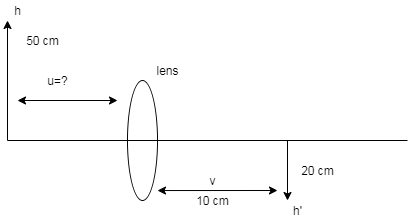
We know that magnification (m) of the lens is given by:
$m=\dfrac{v}{u}=\dfrac{h'}{h}\,\,\,\,.....(1)$
Where, magnification (m) is the process of enlarging the apparent size, not physical size, of something. This enlargement is quantified by a calculated number also called "magnification". When this number is less than one, it refers to a reduction in size, sometimes called de-magnification.
Thus, substituting the values of h, h’ and v in equation (1), we get:
$\dfrac{10}{u}=\dfrac{-20}{50}$
$u=\dfrac{-50}{20}\times 10$
Therefore,
$u=-25\,cm$
Now, using the lens formula:
$\dfrac{1}{v}-\dfrac{1}{u}=\dfrac{1}{f}\,\,\,\,.....(2)$
Thus, substituting the values of v and in equation (2), we get:
$\Rightarrow $$\dfrac{1}{10}-\dfrac{1}{-25}=\dfrac{1}{f}$
$\Rightarrow $ $\dfrac{1}{10}+\dfrac{1}{25}=\dfrac{1}{f}$
$\Rightarrow $$\dfrac{5+2}{5}=\dfrac{1}{f}$
Therefore,
$f=\dfrac{50}{7}$
Or
$f=7.14\,cm$
Hence the focal length of the lens $=\,7.14\,cm.$
Note:
To solve this kind of question we should have knowledge about ray optics. The focal length of an optical system is a measure of how strongly the system converges or diverges light; it is the inverse of the system's optical power. A positive focal length indicates that a system converges light, while a negative focal length indicates that the system diverges light. For better understanding, the solution is explained with the help of a diagram.
Complete answer:
Given:
Height of object (h) $=\,50\,cm$
Height of image (h’) $=\,-20\,cm$(real and inverted as shown in the diagram below)
Distance of image from the lens (v) $=10\,cm$
Distance of object from the lens (u) $=?$
Focal length of the lens (f) $=?$
Diagram:
We know that magnification (m) of the lens is given by:
$m=\dfrac{v}{u}=\dfrac{h'}{h}\,\,\,\,.....(1)$
Where, magnification (m) is the process of enlarging the apparent size, not physical size, of something. This enlargement is quantified by a calculated number also called "magnification". When this number is less than one, it refers to a reduction in size, sometimes called de-magnification.
Thus, substituting the values of h, h’ and v in equation (1), we get:
$\dfrac{10}{u}=\dfrac{-20}{50}$
$u=\dfrac{-50}{20}\times 10$
Therefore,
$u=-25\,cm$
Now, using the lens formula:
$\dfrac{1}{v}-\dfrac{1}{u}=\dfrac{1}{f}\,\,\,\,.....(2)$
Thus, substituting the values of v and in equation (2), we get:
$\Rightarrow $$\dfrac{1}{10}-\dfrac{1}{-25}=\dfrac{1}{f}$
$\Rightarrow $ $\dfrac{1}{10}+\dfrac{1}{25}=\dfrac{1}{f}$
$\Rightarrow $$\dfrac{5+2}{5}=\dfrac{1}{f}$
Therefore,
$f=\dfrac{50}{7}$
Or
$f=7.14\,cm$
Hence the focal length of the lens $=\,7.14\,cm.$
Note:
To solve this kind of question we should have knowledge about ray optics. The focal length of an optical system is a measure of how strongly the system converges or diverges light; it is the inverse of the system's optical power. A positive focal length indicates that a system converges light, while a negative focal length indicates that the system diverges light. For better understanding, the solution is explained with the help of a diagram.
Recently Updated Pages
Master Class 12 Economics: Engaging Questions & Answers for Success

Master Class 12 Physics: Engaging Questions & Answers for Success
Master Class 12 English: Engaging Questions & Answers for Success
Master Class 12 Social Science: Engaging Questions & Answers for Success
Master Class 12 Maths: Engaging Questions & Answers for Success
Master Class 12 Business Studies: Engaging Questions & Answers for Success
Trending doubts
Which are the Top 10 Largest Countries of the World?
What are the major means of transport Explain each class 12 social science CBSE
Draw a labelled sketch of the human eye class 12 physics CBSE
Why cannot DNA pass through cell membranes class 12 biology CBSE
Differentiate between insitu conservation and exsitu class 12 biology CBSE
Draw a neat and well labeled diagram of TS of ovary class 12 biology CBSE