




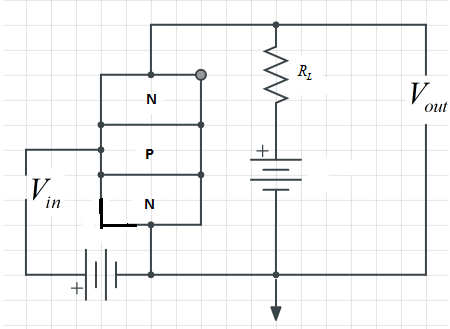
An n-p-n transistor circuit is arranged as shown in the figure. It is common:
A. Base amplifier circuit
B. Emitter amplifier circuit
C. Collector amplifier circuit
D. None of these
Answer
 Verified
574.2k+ views
Hint: A junction transistor is formed by sandwiching a thin layer of a p-type semiconductor between two layers of n-type semiconductor or by sandwiching a thin layer of an n-type semiconductor between two layers of p-type semiconductor. N-P-N transistor has three terminal-emitter, collector, and base. In the N-P-N circuit, the emitter is always forward biased while the base and collector are reversed biased.
Complete step-by-step solution
We know that the transistor in which two N-type semiconductor materials are separated by a thin layer of P-type semiconductors they are called an N-P-N transistor, As the N-P-N transistor, has three terminal- emitter-collector and base in this type of transistor the majority carriers are the electrons.
Now, in N-P-N transistor circuits the direction of movement of electrons is from the emitter to the collector region which forms the current flow in the transistor because we know that the movement of electrons generates the current in the circuit.
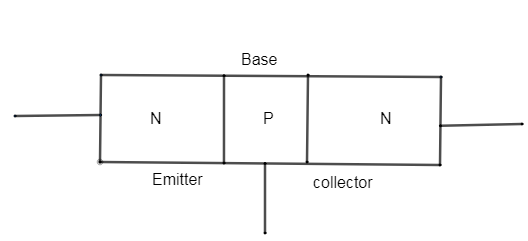
As shown in the diagram which is given in the question, the N-P-N transistor circuit is arranged in the figure. It is a common emitter amplifier circuit because emitter (N) is common to both the base (P) and collector (N) therefore; it is a common emitter amplifier circuit because the emitter is common in a given circuit. So the correct option is (B).
Note: The middle section of the N-P-N circuit is lightly doped, that is the base while the emitter is moderately doped and the collector is heavily doped. These N-P-N transistors are mostly used in circuits for amplifying and switching signals. Because their majority charge carriers are electrons.
Complete step-by-step solution
We know that the transistor in which two N-type semiconductor materials are separated by a thin layer of P-type semiconductors they are called an N-P-N transistor, As the N-P-N transistor, has three terminal- emitter-collector and base in this type of transistor the majority carriers are the electrons.
Now, in N-P-N transistor circuits the direction of movement of electrons is from the emitter to the collector region which forms the current flow in the transistor because we know that the movement of electrons generates the current in the circuit.
As shown in the diagram which is given in the question, the N-P-N transistor circuit is arranged in the figure. It is a common emitter amplifier circuit because emitter (N) is common to both the base (P) and collector (N) therefore; it is a common emitter amplifier circuit because the emitter is common in a given circuit. So the correct option is (B).
Note: The middle section of the N-P-N circuit is lightly doped, that is the base while the emitter is moderately doped and the collector is heavily doped. These N-P-N transistors are mostly used in circuits for amplifying and switching signals. Because their majority charge carriers are electrons.
Recently Updated Pages
Master Class 12 Economics: Engaging Questions & Answers for Success

Master Class 12 Physics: Engaging Questions & Answers for Success
Master Class 12 English: Engaging Questions & Answers for Success
Master Class 12 Social Science: Engaging Questions & Answers for Success
Master Class 12 Maths: Engaging Questions & Answers for Success
Master Class 12 Business Studies: Engaging Questions & Answers for Success
Trending doubts
Which are the Top 10 Largest Countries of the World?
What are the major means of transport Explain each class 12 social science CBSE
Draw a labelled sketch of the human eye class 12 physics CBSE
Why cannot DNA pass through cell membranes class 12 biology CBSE
Differentiate between insitu conservation and exsitu class 12 biology CBSE
Draw a neat and well labeled diagram of TS of ovary class 12 biology CBSE