




An LR series circuit has $L=1H$ and $R=1\Omega$. It is connected across an emf of $\;2V$.
A.The maximum rate at which energy is stored in the magnetic field is $1\;W$
B.The maximum rate at which energy is stored in the magnetic field is $2\;W$
C.The current at that instant is $1\;A$
D.The current at that instant is $2\;A$
Answer
 Verified
567.3k+ views
Hint: Recall the expressions for the instantaneous current flowing through a series LR circuit as well as the energy stored in a magnetic field by virtue of the inductor. You will see that you need to find the instant of time$\;t$ at which the maximum rate of energy storage is achieved and subsequently arrive at the current flowing through the circuit at this instant. Note that the maximum rate of energy storage is achieved under the steady state condition where the power remains constant over time.
Formula Used:
Instantaneous current: $I = I_0 \left(1-e^{-\dfrac{t}{\tau}}\right)$
Energy stores in magnetic field: $E = \dfrac{1}{2}LI^2$
Complete answer:
We are given a series LR circuit with inductance $L=1H$, resistance $R = 1\Omega$ and emf $\epsilon = 2V$.
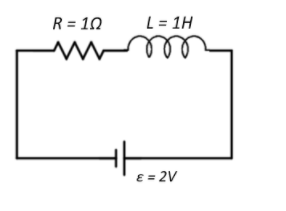
Now, the peak or steady state current following through this circuit can be given as:
$I_0 = \dfrac{\epsilon}{R} = \dfrac{2}{1} = 2\;A$
For an LR series circuit, the time constant $\tau$ is a quantity defined as the ratio of inductance to resistance and is indicative of the time taken by the current to reach its maximum steady state value, i.e.,
$\tau = \dfrac{L}{R} = \dfrac{1}{1} = 1$
Let$\;t$ be any instant of time.
The instantaneous current through this circuit can thus be given as:
$I = I_0 \left(1-e^{-\dfrac{t}{\tau}}\right) = 2\left(1-e^{-\dfrac{t}{1}}\right) =2\left(1-e^{-t}\right)$
Now, when electric current flows through the inductor, magnetic energy gets stores in the field in and around the inductor. This magnetic energy stored by virtue of the inductor is given as:
$E = \dfrac{1}{2}LI^2 = \dfrac{1}{2} \times 1 \times \left(2\left(1-e^{-t}\right)\right)^2 = \dfrac{1}{2} \times 4 \times \left(1-e^{-t}\right)^2 = 2(1+e^{-2t} – 2e^{-t})$
The rate at which this magnetic energy is stored is nothing but the power, i.e.,
$P = \dfrac{dE}{dt} = \dfrac{d}{dt}\left(2(1+e^{-2t} – 2e^{-t})\right)$
$\Rightarrow P = 2\left(0-2e^{-2t}+2e^{-t}\right) = -4e^{-2t} + 4e^{-t}$
Now, suppose that the circuit takes time$\;t$ to reach maximum power and maintain steady state, i.e., when,
$\dfrac{dP}{dt} = 0$
$ \Rightarrow \dfrac{d}{dt}\left(-4e^{-2t} + 4e^{-t}\right) = 0$
$\Rightarrow 8e^{-2t} – 4e^{-t} = 0 \Rightarrow \dfrac{8}{4}= \dfrac{e^{-t}}{e^{-2t}}$
$\Rightarrow 2 = e^{-t+2t}$
$\Rightarrow 2 = e^{t}$
Taking logarithm on both sides we get:
$ln\;2 = t$
The maximum rate at which energy is stores is attained at $t = ln\;2\;s$
Plugging this into the power equation we get:
$P =-4e^{-2t} + 4e^{-t} = -4e^{-2\;ln\;2} + 4e^{-\;ln\;2} = -4e^{-ln2^2} + 4e^{-ln2}$
$\Rightarrow P = -4\times \dfrac{1}{4} + 4\times \dfrac{1}{2} = -1 + 2 = 1\;W$
The current at $t=ln\;2\;s$ will be:
$I = 2\left(1-e^{-t}\right) = 2\left(1-e^{-ln2}\right) = 2\left(1-\dfrac{1}{2}\right) = 2 \times \dfrac{1}{2} = 1\;A$
Therefore, the correct choices would be: A. The maximum rate at which energy is stored in the magnetic field is $1\;W$, and C. The current at that instant is $1\;A$
Note:
It is important to understand that the time constant varies with different types of circuits and their constituent components. For the series LR circuit we’ve already seen that the time constant is given as $\tau = \dfrac{L}{R}$. Similarly, for a series RC circuit, the time constant is given as $\tau = RC$, where C is the capacitance of the capacitor component.
Thus, the time constant basically describes how rapidly an exponential function decays, which in our case, is the decay of current. If $t=\tau$, then
$I = I_0\left(1 – e^{-1}\right) = I_0\left(1-\dfrac{1}{e}\right) \approx 0.63I_{0}$
Which means that it takes $\tau\;s$ for the current in the circuit to increase from zero to $63\%$ of the peak current value, and this quantity remains constant for a given circuit. Higher the value of decay constant, lower will be the rate of change of current and vice versa.
Formula Used:
Instantaneous current: $I = I_0 \left(1-e^{-\dfrac{t}{\tau}}\right)$
Energy stores in magnetic field: $E = \dfrac{1}{2}LI^2$
Complete answer:
We are given a series LR circuit with inductance $L=1H$, resistance $R = 1\Omega$ and emf $\epsilon = 2V$.
Now, the peak or steady state current following through this circuit can be given as:
$I_0 = \dfrac{\epsilon}{R} = \dfrac{2}{1} = 2\;A$
For an LR series circuit, the time constant $\tau$ is a quantity defined as the ratio of inductance to resistance and is indicative of the time taken by the current to reach its maximum steady state value, i.e.,
$\tau = \dfrac{L}{R} = \dfrac{1}{1} = 1$
Let$\;t$ be any instant of time.
The instantaneous current through this circuit can thus be given as:
$I = I_0 \left(1-e^{-\dfrac{t}{\tau}}\right) = 2\left(1-e^{-\dfrac{t}{1}}\right) =2\left(1-e^{-t}\right)$
Now, when electric current flows through the inductor, magnetic energy gets stores in the field in and around the inductor. This magnetic energy stored by virtue of the inductor is given as:
$E = \dfrac{1}{2}LI^2 = \dfrac{1}{2} \times 1 \times \left(2\left(1-e^{-t}\right)\right)^2 = \dfrac{1}{2} \times 4 \times \left(1-e^{-t}\right)^2 = 2(1+e^{-2t} – 2e^{-t})$
The rate at which this magnetic energy is stored is nothing but the power, i.e.,
$P = \dfrac{dE}{dt} = \dfrac{d}{dt}\left(2(1+e^{-2t} – 2e^{-t})\right)$
$\Rightarrow P = 2\left(0-2e^{-2t}+2e^{-t}\right) = -4e^{-2t} + 4e^{-t}$
Now, suppose that the circuit takes time$\;t$ to reach maximum power and maintain steady state, i.e., when,
$\dfrac{dP}{dt} = 0$
$ \Rightarrow \dfrac{d}{dt}\left(-4e^{-2t} + 4e^{-t}\right) = 0$
$\Rightarrow 8e^{-2t} – 4e^{-t} = 0 \Rightarrow \dfrac{8}{4}= \dfrac{e^{-t}}{e^{-2t}}$
$\Rightarrow 2 = e^{-t+2t}$
$\Rightarrow 2 = e^{t}$
Taking logarithm on both sides we get:
$ln\;2 = t$
The maximum rate at which energy is stores is attained at $t = ln\;2\;s$
Plugging this into the power equation we get:
$P =-4e^{-2t} + 4e^{-t} = -4e^{-2\;ln\;2} + 4e^{-\;ln\;2} = -4e^{-ln2^2} + 4e^{-ln2}$
$\Rightarrow P = -4\times \dfrac{1}{4} + 4\times \dfrac{1}{2} = -1 + 2 = 1\;W$
The current at $t=ln\;2\;s$ will be:
$I = 2\left(1-e^{-t}\right) = 2\left(1-e^{-ln2}\right) = 2\left(1-\dfrac{1}{2}\right) = 2 \times \dfrac{1}{2} = 1\;A$
Therefore, the correct choices would be: A. The maximum rate at which energy is stored in the magnetic field is $1\;W$, and C. The current at that instant is $1\;A$
Note:
It is important to understand that the time constant varies with different types of circuits and their constituent components. For the series LR circuit we’ve already seen that the time constant is given as $\tau = \dfrac{L}{R}$. Similarly, for a series RC circuit, the time constant is given as $\tau = RC$, where C is the capacitance of the capacitor component.
Thus, the time constant basically describes how rapidly an exponential function decays, which in our case, is the decay of current. If $t=\tau$, then
$I = I_0\left(1 – e^{-1}\right) = I_0\left(1-\dfrac{1}{e}\right) \approx 0.63I_{0}$
Which means that it takes $\tau\;s$ for the current in the circuit to increase from zero to $63\%$ of the peak current value, and this quantity remains constant for a given circuit. Higher the value of decay constant, lower will be the rate of change of current and vice versa.
Recently Updated Pages
Master Class 12 Business Studies: Engaging Questions & Answers for Success

Master Class 12 Biology: Engaging Questions & Answers for Success
Master Class 12 Chemistry: Engaging Questions & Answers for Success
Class 12 Question and Answer - Your Ultimate Solutions Guide
Master Class 11 Social Science: Engaging Questions & Answers for Success
Master Class 11 English: Engaging Questions & Answers for Success
Trending doubts
Which is more stable and why class 12 chemistry CBSE
What are the major means of transport Explain each class 12 social science CBSE
Give 10 examples of unisexual and bisexual flowers
Which one is the sweetest sugar a Glucose b Fructose class 12 biology CBSE
The first microscope was invented by A Leeuwenhoek class 12 biology CBSE
What is the Full Form of 1.DPT 2.DDT 3.BCG