




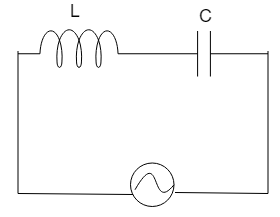
An L-C circuit consists of an inductor with $ L = 0.0900H $ and a capacitor of $ C = 4 \times {10^{ - 4}}F $ . The initial charge on the capacitor is $ 5.00\mu C $ , and the initial current in the inductor is zero. When the current in the inductor has half its maximum value, what is the charge on the capacitor?
$ (A)1.33 \times {10^6}C $
$ (B)9.33 \times {10^{ - 6}}C $
$ (C)4.33 \times {10^{ - 6}}C $
$ (D)7.33 \times {10^6}C $
Answer
 Verified
513.6k+ views
Hint: This question will be solved by using the expression of charge which is stored in a capacitor in terms of time. On putting the given value of current, we will find the value of the sine trigonometric function. Then we will find the value of the cosine trigonometric function and with the help of it we will find the required value.
Complete Step By Step Answer:
Given,
Inductor which has inductance $ L = 0.0900H $
Capacitor of capacitance $ C = 4 \times {10^{ - 4}}F $ .
The initial charge which is present on the capacitor is $ 5.00\mu C $
On converting the initial charge in $ C $ , we get,
The initial charge which is present on the capacitor is $ 5 \times {10^{ - 6}}C $
We also know that the charge which is stored in a capacitor in terms of time is,
$ Q = {Q_i}\cos \omega t $
Similarly, the current as a function of time is,
$ I = {I_o}\sin \omega t $
Now, we have to find the charge on a capacitor, when the current in the inductor has half its maximum value. So,
$ I = \dfrac{{{I_o}}}{2} $
On putting the above value in the equation for the current, we get,
$ \dfrac{{{I_o}}}{2} = {I_o}\sin \omega t $
On cancelling the same terms on both the sides, we get,
$ \sin \omega t = \dfrac{1}{2} $
$ \sin \omega t = 0.5 $
According to the trigonometric functions,
$ \cos \omega t = \sqrt {1 - {{\sin }^2}\omega t} $
On putting the value of $ \sin \omega t = 0.5 $ in the above equation,
$ \cos \omega t = \sqrt {1 - {{0.5}^2}} $
On further solving, we get,
$ \cos \omega t = \sqrt {1 - 0.25} $
$ \cos \omega t = \sqrt {0.75} $
On solving the square root,
$ \cos \omega t = 0.866 $
On putting the above value in the charge which is stored in a capacitor in terms of time,
$ Q = 5 \times {10^{ - 6}} \times 0.866 $
$ Q = 4.33 \times {10^{ - 6}}C $
So, the charge on the capacitor is $ Q = 4.33 \times {10^{ - 6}}C $ .
Note:
LC circuit is defined as a closed loop which consists of just two elements: a capacitor and an inductor. It also has a special resonance property like mechanical systems like a pendulum or even a mass on a spring. There is also a particular frequency at which it likes to oscillate at, and therefore it responds strongly to it.
Complete Step By Step Answer:
Given,
Inductor which has inductance $ L = 0.0900H $
Capacitor of capacitance $ C = 4 \times {10^{ - 4}}F $ .
The initial charge which is present on the capacitor is $ 5.00\mu C $
On converting the initial charge in $ C $ , we get,
The initial charge which is present on the capacitor is $ 5 \times {10^{ - 6}}C $
We also know that the charge which is stored in a capacitor in terms of time is,
$ Q = {Q_i}\cos \omega t $
Similarly, the current as a function of time is,
$ I = {I_o}\sin \omega t $
Now, we have to find the charge on a capacitor, when the current in the inductor has half its maximum value. So,
$ I = \dfrac{{{I_o}}}{2} $
On putting the above value in the equation for the current, we get,
$ \dfrac{{{I_o}}}{2} = {I_o}\sin \omega t $
On cancelling the same terms on both the sides, we get,
$ \sin \omega t = \dfrac{1}{2} $
$ \sin \omega t = 0.5 $
According to the trigonometric functions,
$ \cos \omega t = \sqrt {1 - {{\sin }^2}\omega t} $
On putting the value of $ \sin \omega t = 0.5 $ in the above equation,
$ \cos \omega t = \sqrt {1 - {{0.5}^2}} $
On further solving, we get,
$ \cos \omega t = \sqrt {1 - 0.25} $
$ \cos \omega t = \sqrt {0.75} $
On solving the square root,
$ \cos \omega t = 0.866 $
On putting the above value in the charge which is stored in a capacitor in terms of time,
$ Q = 5 \times {10^{ - 6}} \times 0.866 $
$ Q = 4.33 \times {10^{ - 6}}C $
So, the charge on the capacitor is $ Q = 4.33 \times {10^{ - 6}}C $ .
Note:
LC circuit is defined as a closed loop which consists of just two elements: a capacitor and an inductor. It also has a special resonance property like mechanical systems like a pendulum or even a mass on a spring. There is also a particular frequency at which it likes to oscillate at, and therefore it responds strongly to it.
Recently Updated Pages
Master Class 12 Business Studies: Engaging Questions & Answers for Success

Master Class 12 Biology: Engaging Questions & Answers for Success
Master Class 12 Chemistry: Engaging Questions & Answers for Success
Class 12 Question and Answer - Your Ultimate Solutions Guide
Master Class 11 Social Science: Engaging Questions & Answers for Success
Master Class 11 English: Engaging Questions & Answers for Success
Trending doubts
Which are the Top 10 Largest Countries of the World?
Draw a labelled sketch of the human eye class 12 physics CBSE
Differentiate between homogeneous and heterogeneous class 12 chemistry CBSE
Sulphuric acid is known as the king of acids State class 12 chemistry CBSE
Why is the cell called the structural and functional class 12 biology CBSE
Which is the correct genotypic ratio of mendel dihybrid class 12 biology CBSE