




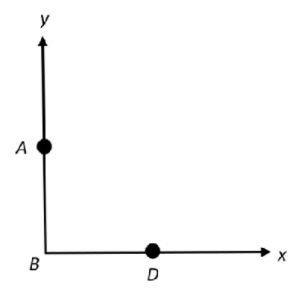
An interference is observed due to two coherent sources ‘A’&’B’ separated by a distance of $\text{4 }\lambda$ along the y-axis where $\lambda$ is the wavelength of the
source. A detector D is moved on the positive x-axis. The number of points on the x-axis excluding the points, x=0 & x=$\infty $ at which maximum will be observed is
A. Three
B. Four
C. Two
D. Infinite
Answer
 Verified
548.4k+ views
Hint: To know at which point maxima will be observed, we need to find all the points. Now, to find the points we will construct a diagram or figure which can elaborate the question for better clarity. After constructing the diagram, we can find all the points of maxima, and then remove those points which are given in question.
Complete step-by-step solution:
First of all let us construct a rough figure to get an idea for proceeding further,
Now, in the diagram,
AB=$\text{4 }\lambda$ (Given in the question)
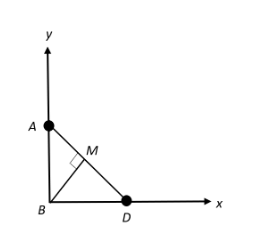
Now, let us consider a triangle ABD,
$\Rightarrow {{\left( \text{AD} \right)}^{\text{2}}}\text{=}{{\left( \text{AB}
\right)}^{\text{2}}}\text{+}{{\left( \text{BD} \right)}^{\text{2}}}$
$\Rightarrow {{\left( \text{AM+MD} \right)}^{\text{2}}}\text{=}{{\left( \text{AB}
\right)}^{\text{2}}}\text{+}{{\left( \text{BD} \right)}^{\text{2}}}$ -----equation(1)
Here, AM is the path difference,
Therefore, AM=BD=${{\text{x}}_{\text{n}}}$
Now, let us put the values in equation (1),
$\Rightarrow {{\left( \text{n }\lambda\text{ +}{{\text{x}}_{\text{n}}}
\right)}^{\text{2}}}\text{=}{{\left( \text{4 }\lambda \right)}^{\text{2}}}\text{+}{{\left(
{{\text{x}}_{\text{n}}} \right)}^{\text{2}}}$
$\Rightarrow {{\text{x}}_{\text{n}}}\text{=}\dfrac{\text{16}{{\lambda}^{\text{2}}}\text{-
}{{\text{n}}^{\text{2}}}{{\lambda}^{\text{2}}}}{\text{2n }\lambda}$ - ------equation (2)
Now, we will put the value of $n$ as, $n=1,2,3,4$.. in the above equation (2).
$\Rightarrow {{\text{x}}_{\text{1}}}\text{=}\dfrac{\text{16}{{\lambda}^{\text{2}}}\text{-
}{{\lambda}^{\text{2}}}}{\text{2 }\lambda}=7.5\lambda$
$\Rightarrow {{\text{x}}_{2}}\text{=}\dfrac{\text{16}{{\lambda}^{\text{2}}}\text{-
4}{{\lambda}^{\text{2}}}}{\text{4 }\lambda}=3\lambda$
$\Rightarrow {{\text{x}}_{3}}\text{=}\dfrac{\text{16}{{\lambda}^{\text{2}}}\text{-
9}{{\lambda}^{\text{2}}}}{\text{6 }\lambda}=\dfrac{7}{6}\lambda$
$\Rightarrow {{\text{x}}_{4}}=0$
Hence, the number of points where maxima is observed is 3. Therefore, we conclude that the final answer is option A.), which is A. three
Note: There is no particular formula for this question, applying which we can get the answer, so we will be required to construct the figure and label it accordingly and then only proceed further to get the answer of this question. At last, after getting all the maxima points, don’t forget to remove the point where it is zero and infinity, as given in the question.
Complete step-by-step solution:
First of all let us construct a rough figure to get an idea for proceeding further,
Now, in the diagram,
AB=$\text{4 }\lambda$ (Given in the question)
Now, let us consider a triangle ABD,
$\Rightarrow {{\left( \text{AD} \right)}^{\text{2}}}\text{=}{{\left( \text{AB}
\right)}^{\text{2}}}\text{+}{{\left( \text{BD} \right)}^{\text{2}}}$
$\Rightarrow {{\left( \text{AM+MD} \right)}^{\text{2}}}\text{=}{{\left( \text{AB}
\right)}^{\text{2}}}\text{+}{{\left( \text{BD} \right)}^{\text{2}}}$ -----equation(1)
Here, AM is the path difference,
Therefore, AM=BD=${{\text{x}}_{\text{n}}}$
Now, let us put the values in equation (1),
$\Rightarrow {{\left( \text{n }\lambda\text{ +}{{\text{x}}_{\text{n}}}
\right)}^{\text{2}}}\text{=}{{\left( \text{4 }\lambda \right)}^{\text{2}}}\text{+}{{\left(
{{\text{x}}_{\text{n}}} \right)}^{\text{2}}}$
$\Rightarrow {{\text{x}}_{\text{n}}}\text{=}\dfrac{\text{16}{{\lambda}^{\text{2}}}\text{-
}{{\text{n}}^{\text{2}}}{{\lambda}^{\text{2}}}}{\text{2n }\lambda}$ - ------equation (2)
Now, we will put the value of $n$ as, $n=1,2,3,4$.. in the above equation (2).
$\Rightarrow {{\text{x}}_{\text{1}}}\text{=}\dfrac{\text{16}{{\lambda}^{\text{2}}}\text{-
}{{\lambda}^{\text{2}}}}{\text{2 }\lambda}=7.5\lambda$
$\Rightarrow {{\text{x}}_{2}}\text{=}\dfrac{\text{16}{{\lambda}^{\text{2}}}\text{-
4}{{\lambda}^{\text{2}}}}{\text{4 }\lambda}=3\lambda$
$\Rightarrow {{\text{x}}_{3}}\text{=}\dfrac{\text{16}{{\lambda}^{\text{2}}}\text{-
9}{{\lambda}^{\text{2}}}}{\text{6 }\lambda}=\dfrac{7}{6}\lambda$
$\Rightarrow {{\text{x}}_{4}}=0$
Hence, the number of points where maxima is observed is 3. Therefore, we conclude that the final answer is option A.), which is A. three
Note: There is no particular formula for this question, applying which we can get the answer, so we will be required to construct the figure and label it accordingly and then only proceed further to get the answer of this question. At last, after getting all the maxima points, don’t forget to remove the point where it is zero and infinity, as given in the question.
Recently Updated Pages
Master Class 12 Economics: Engaging Questions & Answers for Success

Master Class 12 Physics: Engaging Questions & Answers for Success
Master Class 12 English: Engaging Questions & Answers for Success
Master Class 12 Social Science: Engaging Questions & Answers for Success
Master Class 12 Maths: Engaging Questions & Answers for Success
Master Class 12 Business Studies: Engaging Questions & Answers for Success
Trending doubts
Which are the Top 10 Largest Countries of the World?
What are the major means of transport Explain each class 12 social science CBSE
Draw a labelled sketch of the human eye class 12 physics CBSE
Why cannot DNA pass through cell membranes class 12 biology CBSE
Differentiate between insitu conservation and exsitu class 12 biology CBSE
Draw a neat and well labeled diagram of TS of ovary class 12 biology CBSE