




An infinitely long cylinder is kept parallel to a uniform magnetic field \[B\] directed along the positive z-axis. The direction of induced current on the surface of the cylinder as seen from the z-axis will be
A. Clockwise of the positive z-axis
B. Anticlockwise of the positive z-axis
C. Zero
D. Along the magnetic field
Answer
 Verified
555.3k+ views
Hint: When a compass is brought near the current-carrying conductor, the compass needle started deflecting because of the electricity. This statement shows that electric current produces a magnetic field. In a uniform magnetic field, the net velocity of the electron will be zero.
Formula used
From Maxwell equation: $\dfrac{{d\overrightarrow B }}{{dt}} = - \nabla E$
Complete step by step solution:
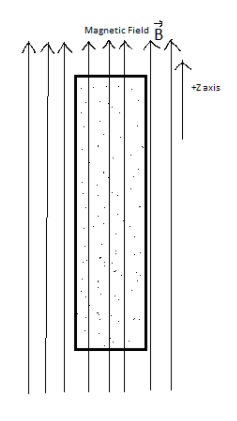
In question, it is given that we have a uniform magnetic field around the z-direction
From Maxwell equation $\dfrac{{d\overrightarrow B }}{{dt}} = - \nabla E$
We can say that changing the magnetic field generates an electric field and that will produce an electric current. But when the magnetic field is uniform then the velocity of the electron will be zero and there will be no electric field so
$I = 0$
Therefore, The direction of induced current on the surface of the cylinder as seen from the z-axis will be zero. So, option (C) is correct .
Note:
In the early days, scientists believed that electricity and magnetism were two separate forces. But, after the discovery of the Maxwell equation by James Clerk Maxwell, these forces are treated as interrelated forces.
By the property of electromagnetism, the light wave can travel through a vacuum.
Machines like a fan, washing machine, refrigerator, television all work due to electricity. When current passes through the current-carrying conductor or coil, a magnetic field gets produced around that conductor or coil.
The spinning and orbiting of the nucleus of an atom produce a magnetic field similar to electrical current flowing through a wire. The direction of the spin and orbit decide the direction of the magnetic field.
Formula used
From Maxwell equation: $\dfrac{{d\overrightarrow B }}{{dt}} = - \nabla E$
Complete step by step solution:
In question, it is given that we have a uniform magnetic field around the z-direction
From Maxwell equation $\dfrac{{d\overrightarrow B }}{{dt}} = - \nabla E$
We can say that changing the magnetic field generates an electric field and that will produce an electric current. But when the magnetic field is uniform then the velocity of the electron will be zero and there will be no electric field so
$I = 0$
Therefore, The direction of induced current on the surface of the cylinder as seen from the z-axis will be zero. So, option (C) is correct .
Note:
In the early days, scientists believed that electricity and magnetism were two separate forces. But, after the discovery of the Maxwell equation by James Clerk Maxwell, these forces are treated as interrelated forces.
By the property of electromagnetism, the light wave can travel through a vacuum.
Machines like a fan, washing machine, refrigerator, television all work due to electricity. When current passes through the current-carrying conductor or coil, a magnetic field gets produced around that conductor or coil.
The spinning and orbiting of the nucleus of an atom produce a magnetic field similar to electrical current flowing through a wire. The direction of the spin and orbit decide the direction of the magnetic field.
Recently Updated Pages
Explain the structure of megasporangium class 12 biology CBSE

Why is chloroform kept in dark coloured bottles class 12 chemistry CBSE
Derive the balancing condition of a Wheatstone bri class 12 physics CBSE
Draw VI characteristics of a pn junction diode Explain class 12 physics CBSE
Is it possible to carry pride in ones language too class 12 english CBSE
In a population at Hardy Weinberg equilibrium the allele class 12 biology CBSE
Trending doubts
Draw a labelled sketch of the human eye class 12 physics CBSE
Which are the Top 10 Largest Countries of the World?
Draw ray diagrams each showing i myopic eye and ii class 12 physics CBSE
Which is the correct genotypic ratio of mendel dihybrid class 12 biology CBSE
Differentiate between homogeneous and heterogeneous class 12 chemistry CBSE
Which animal never drinks water in its entire life class 12 biology CBSE