




An infinitely large thin plane sheet has an uniform surface charge density $+\sigma$. Obtain the expression for the amount of work done in bringing a point charge q from infinity to a point, distant r, in front of the plane charged sheet.
Answer
 Verified
620.1k+ views
Hint: Knowledge of gauss law in electrostatics is necessary to solve this problem. Further, how the gauss law is used in different conditions, such as gauss law in the case of linear charge density, surface charge density and lastly in the case of volume charge density will be helpful too.
Complete step-by-step answer:
Let’s start by making a diagram for this problem.
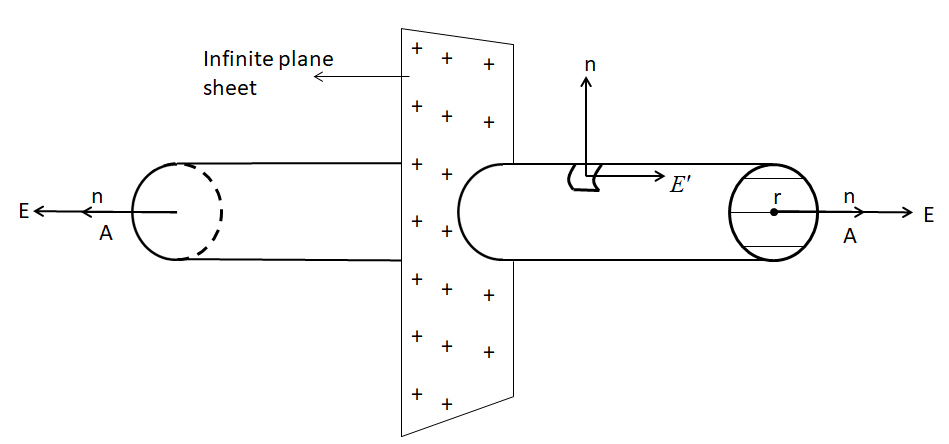
We have an infinitely large thin plane sheet having an uniform charge density $+\sigma $ throughout the surface. A charge is brought from infinity to a point at a distance r from the sheet. We will make a Gaussian surface as a cylinder of twice the same length from the sheet to the point passing through the sheet at the center of the cylinder.
The cross sectional area of the cylinder will be A.
Now let’s find out the Flux $'\phi '$ through the cylinder.
We know from gauss law: $\phi =\int{E.dS}$
Here, we have three surface area components. The 2 cross sectional area components, at the 2 opposite ends and the curved surface area components.
${{\phi }_{total}}={{\phi }_{cross\sec tion-1}}+{{\phi }_{cross\sec tion-2}}+{{\phi }_{curvedsurface}}$
Since, both the Electric field component and the area components will have the direction of outward normal. Hence, ${{\phi }_{cross\sec tion-1}}=\int{E.dA}$ and ${{\phi }_{cross\sec tion-2}}=\int{(-E).d{A}'}=\int{(-E).(-dA})=\int{E.dA}$
That is, the flux coming out of both the cross sectional areas are equal. Hence, when we calculate the net flux, they will add up.
Therefore, the net flux coming out of the cylinder will be, ${{\phi }_{total}}=2EA\cos {{0}^{0}}+EA\cos {{90}^{0}}$
\[\Rightarrow {{\phi }_{total}}=2EA\]
We also know that flux is equal to the net charge contained in the Gaussian surface. That is,$\phi =\dfrac{{{Q}_{enclosed}}}{{{\in }_{0}}}$
Since, we already have $\sigma$ surface charge density, hence, here the charge will be $\sigma .Area.$
Therefore, ${{\phi }_{total}}=\dfrac{{{Q}_{enclosed}}}{{{\in }_{0}}}\Rightarrow {{\phi }_{total}}=\dfrac{\sigma A}{{{\in }_{0}}}=2EA$
This implies, $E=\dfrac{\sigma }{2{{\in }_{0}}}$
Amount of work done ‘W’ to move a charge from infinity to a point is given by force ‘F’ times the displacement.
That is, $F=qE.$
Hence, the work done is, $dW=F.dr\Rightarrow W=-\int\limits_{\infty }^{r}{Fdr}$
\[\therefore W=-\int\limits_{\infty }^{r}{\dfrac{\sigma q}{2{{\in }_{0}}}dr=}-\dfrac{\sigma q}{2{{\in }_{0}}}[r]_{\infty }^{r}=-\dfrac{\sigma qr}{2{{\in }_{0}}}\]
However, the negative sign can be removed as it only states the direction of the work done.
Hence, the work done is, \[W=\dfrac{\sigma qr}{2{{\in }_{0}}}\]
Note: The reason why the Work done is negative is that $W=-\int\limits_{\infty }^{r}{F.dr}$, since the charge is initially brought from infinity to a point r. The distance is being reduced from the initial point to the final point. Hence, the negative sign is added. You may also say that displacement and force, both of which are vector quantities, are along the opposite directions.
In these kinds of vector quantities, negative signs only mean the direction with respect to another vector quantity.
Complete step-by-step answer:
Let’s start by making a diagram for this problem.
We have an infinitely large thin plane sheet having an uniform charge density $+\sigma $ throughout the surface. A charge is brought from infinity to a point at a distance r from the sheet. We will make a Gaussian surface as a cylinder of twice the same length from the sheet to the point passing through the sheet at the center of the cylinder.
The cross sectional area of the cylinder will be A.
Now let’s find out the Flux $'\phi '$ through the cylinder.
We know from gauss law: $\phi =\int{E.dS}$
Here, we have three surface area components. The 2 cross sectional area components, at the 2 opposite ends and the curved surface area components.
${{\phi }_{total}}={{\phi }_{cross\sec tion-1}}+{{\phi }_{cross\sec tion-2}}+{{\phi }_{curvedsurface}}$
Since, both the Electric field component and the area components will have the direction of outward normal. Hence, ${{\phi }_{cross\sec tion-1}}=\int{E.dA}$ and ${{\phi }_{cross\sec tion-2}}=\int{(-E).d{A}'}=\int{(-E).(-dA})=\int{E.dA}$
That is, the flux coming out of both the cross sectional areas are equal. Hence, when we calculate the net flux, they will add up.
Therefore, the net flux coming out of the cylinder will be, ${{\phi }_{total}}=2EA\cos {{0}^{0}}+EA\cos {{90}^{0}}$
\[\Rightarrow {{\phi }_{total}}=2EA\]
We also know that flux is equal to the net charge contained in the Gaussian surface. That is,$\phi =\dfrac{{{Q}_{enclosed}}}{{{\in }_{0}}}$
Since, we already have $\sigma$ surface charge density, hence, here the charge will be $\sigma .Area.$
Therefore, ${{\phi }_{total}}=\dfrac{{{Q}_{enclosed}}}{{{\in }_{0}}}\Rightarrow {{\phi }_{total}}=\dfrac{\sigma A}{{{\in }_{0}}}=2EA$
This implies, $E=\dfrac{\sigma }{2{{\in }_{0}}}$
Amount of work done ‘W’ to move a charge from infinity to a point is given by force ‘F’ times the displacement.
That is, $F=qE.$
Hence, the work done is, $dW=F.dr\Rightarrow W=-\int\limits_{\infty }^{r}{Fdr}$
\[\therefore W=-\int\limits_{\infty }^{r}{\dfrac{\sigma q}{2{{\in }_{0}}}dr=}-\dfrac{\sigma q}{2{{\in }_{0}}}[r]_{\infty }^{r}=-\dfrac{\sigma qr}{2{{\in }_{0}}}\]
However, the negative sign can be removed as it only states the direction of the work done.
Hence, the work done is, \[W=\dfrac{\sigma qr}{2{{\in }_{0}}}\]
Note: The reason why the Work done is negative is that $W=-\int\limits_{\infty }^{r}{F.dr}$, since the charge is initially brought from infinity to a point r. The distance is being reduced from the initial point to the final point. Hence, the negative sign is added. You may also say that displacement and force, both of which are vector quantities, are along the opposite directions.
In these kinds of vector quantities, negative signs only mean the direction with respect to another vector quantity.
Recently Updated Pages
Three beakers labelled as A B and C each containing 25 mL of water were taken A small amount of NaOH anhydrous CuSO4 and NaCl were added to the beakers A B and C respectively It was observed that there was an increase in the temperature of the solutions contained in beakers A and B whereas in case of beaker C the temperature of the solution falls Which one of the following statements isarecorrect i In beakers A and B exothermic process has occurred ii In beakers A and B endothermic process has occurred iii In beaker C exothermic process has occurred iv In beaker C endothermic process has occurred

Master Class 12 Social Science: Engaging Questions & Answers for Success
Master Class 12 Physics: Engaging Questions & Answers for Success
Master Class 12 Maths: Engaging Questions & Answers for Success
Master Class 12 Economics: Engaging Questions & Answers for Success
Master Class 12 Chemistry: Engaging Questions & Answers for Success
Three beakers labelled as A B and C each containing 25 mL of water were taken A small amount of NaOH anhydrous CuSO4 and NaCl were added to the beakers A B and C respectively It was observed that there was an increase in the temperature of the solutions contained in beakers A and B whereas in case of beaker C the temperature of the solution falls Which one of the following statements isarecorrect i In beakers A and B exothermic process has occurred ii In beakers A and B endothermic process has occurred iii In beaker C exothermic process has occurred iv In beaker C endothermic process has occurred
Master Class 12 Social Science: Engaging Questions & Answers for Success
Master Class 12 Physics: Engaging Questions & Answers for Success
Trending doubts
Which are the Top 10 Largest Countries of the World?
Draw a labelled sketch of the human eye class 12 physics CBSE
What are the major means of transport Explain each class 12 social science CBSE
Differentiate between homogeneous and heterogeneous class 12 chemistry CBSE
Sulphuric acid is known as the king of acids State class 12 chemistry CBSE
Why should a magnesium ribbon be cleaned before burning class 12 chemistry CBSE