




An infinite line charge produces a field of \[{\text{9}} \times {\text{1}}{{\text{0}}^4} N/ C \] at a distance of ${\text{2cm}}$. Calculate the linear charge density.
Answer
 Verified
632.4k+ views
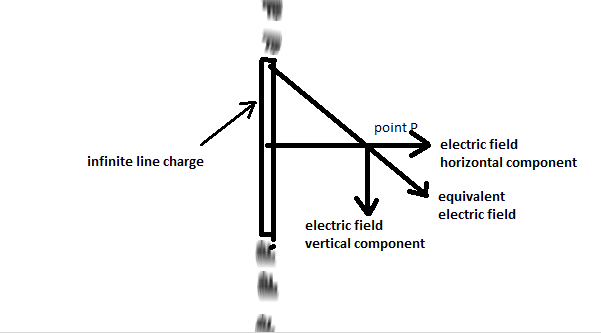
Hint: An infinite line charge is an arrangement of the charges in the form of a line which is extending to the infinity. The line charge is also producing a magnetic field like a current carrying wire of finite length. So we will approach this problem with the help of the formula for the magnetic field produced by an infinite line charge.
Complete step-by-step solution -
Now firstly we will write the given quantities in the problem,
Magnetic field produced = \[{\text{9}} \times {\text{1}}{{\text{0}}^4} N/ C \]
And the distance of a point from the infinite line charge where we are considering the effect of magnetic field=${\text{d = 2cm}}$$ = 0.02m$
So as we know the formula for the magnetic field produced by a infinite line charge is as follows,
${\text{E = }}\dfrac{\lambda }{{2\pi { \in _0}{\text{d}}}}$-----equation (1)
where $\lambda $=charge density
and ${\text{E}}$= electric field produced
and $d$=distance of the point from the infinite line charge
${ \in _0}$=permittivity of free space
Also we know that $\dfrac{1}{{4\pi { \in _0}}} = 9 \times {10^9}N{m^2}{C^{ - 2}}$
So, $\pi { \in _0} = \dfrac{1}{{4 \times 9 \times {{10}^9}}}$
Now we will be using this value in place of the combination of two terms $\pi $and $ \in $.
now from the equation (1) we can derive the equation for the charge density as follows
So, $\lambda = 2\pi { \in _0}{\text{d}} \times {\text{E}}$------equation (2)
Now on putting the values of the quantities from the given quantities in the equation (2)
$\lambda = 2 \times \dfrac{1}{{4 \times 9 \times {{10}^9}}} \times 0.02 \times {\text{9}} \times {\text{1}}{{\text{0}}^4}$
$\lambda = {10^{ - 7}}{C/ m}$
Hence now we have line charge density, $\lambda = {10^{ - 7}}{C/m}$ for the above given problem.
Note: Here we have seen the use of ${ \in _0}$which is called the vacuum permittivity or the permittivity of the free space. Other names of this quantity are electric constant or the distributed capacitance of the vacuum. It is an ideal physical constant. It is the value of the absolute dielectric permittivity of vacuum.
Complete step-by-step solution -
Now firstly we will write the given quantities in the problem,
Magnetic field produced = \[{\text{9}} \times {\text{1}}{{\text{0}}^4} N/ C \]
And the distance of a point from the infinite line charge where we are considering the effect of magnetic field=${\text{d = 2cm}}$$ = 0.02m$
So as we know the formula for the magnetic field produced by a infinite line charge is as follows,
${\text{E = }}\dfrac{\lambda }{{2\pi { \in _0}{\text{d}}}}$-----equation (1)
where $\lambda $=charge density
and ${\text{E}}$= electric field produced
and $d$=distance of the point from the infinite line charge
${ \in _0}$=permittivity of free space
Also we know that $\dfrac{1}{{4\pi { \in _0}}} = 9 \times {10^9}N{m^2}{C^{ - 2}}$
So, $\pi { \in _0} = \dfrac{1}{{4 \times 9 \times {{10}^9}}}$
Now we will be using this value in place of the combination of two terms $\pi $and $ \in $.
now from the equation (1) we can derive the equation for the charge density as follows
So, $\lambda = 2\pi { \in _0}{\text{d}} \times {\text{E}}$------equation (2)
Now on putting the values of the quantities from the given quantities in the equation (2)
$\lambda = 2 \times \dfrac{1}{{4 \times 9 \times {{10}^9}}} \times 0.02 \times {\text{9}} \times {\text{1}}{{\text{0}}^4}$
$\lambda = {10^{ - 7}}{C/ m}$
Hence now we have line charge density, $\lambda = {10^{ - 7}}{C/m}$ for the above given problem.
Note: Here we have seen the use of ${ \in _0}$which is called the vacuum permittivity or the permittivity of the free space. Other names of this quantity are electric constant or the distributed capacitance of the vacuum. It is an ideal physical constant. It is the value of the absolute dielectric permittivity of vacuum.
Recently Updated Pages
Master Class 12 Economics: Engaging Questions & Answers for Success

Master Class 12 English: Engaging Questions & Answers for Success
Master Class 12 Social Science: Engaging Questions & Answers for Success
Master Class 12 Maths: Engaging Questions & Answers for Success
Master Class 12 Physics: Engaging Questions & Answers for Success
Master Class 9 General Knowledge: Engaging Questions & Answers for Success
Trending doubts
Which are the Top 10 Largest Countries of the World?
Draw a labelled sketch of the human eye class 12 physics CBSE
Differentiate between homogeneous and heterogeneous class 12 chemistry CBSE
Sulphuric acid is known as the king of acids State class 12 chemistry CBSE
Why is the cell called the structural and functional class 12 biology CBSE
Draw ray diagrams each showing i myopic eye and ii class 12 physics CBSE