




An inductance $L$ and a resistance $R$ are connected to a battery. After some time, the battery is removed but $L$ and $R$ remain connected in the closed circuit. The value of current will reduce to \[37\% \] of its maximum value in
A. $RL{\text{ second}}$
B. $\dfrac{R}{L}{\text{ second}}$
C. $\dfrac{L}{R}{\text{ second}}$
D. $\dfrac{1}{{LR}}{\text{ second}}$
Answer
 Verified
490.2k+ views
Hint:To solve this type of question we will use the concept of decay of current.If a circuit containing a pure inductor L and a resistor R in series with a battery and a key is opened then the current starts to flow from the charge capacitor. After this there will be mathematical terms and we will get our required answer.
Formula used:
\[i = {i_0}({e^{ - \dfrac{{RT}}{L}}})\]
Where, $i$ is the current, ${i_0}$ is the initial current, $R$ is the resistance, $T$ is the time and $L$ is the inductance.
Complete step by step answer:
According to the question we can understand that after removal of the battery there is a reduction in current value of $37\% $.
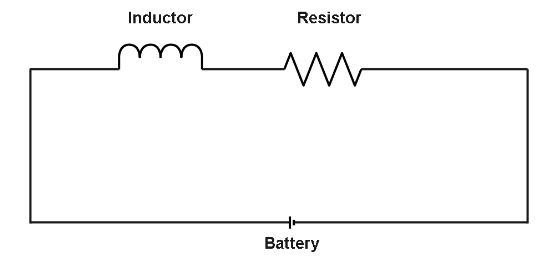
So, we can say that rate of decay of current is,
\[i = {i_0}({e^{ - \dfrac{{RT}}{L}}})\]
Now, putting the values in above equation,
\[0.37{i_0} = {i_0}({e^{ - \dfrac{{RT}}{L}}}) \\
\Rightarrow 0.37 = {e^{ - \dfrac{{RT}}{L}}} \\ \]
And we know that $0.37$ is approximately equivalent to $\dfrac{1}{e}$. Therefore,
$\dfrac{1}{e} = {e^{ - \dfrac{{RT}}{L}}}$
We know that,
$\log {e^{ - 1}} = \log {e^{\dfrac{{ - RT}}{L}}}$
Therefore,
$- 1 = \dfrac{{ - RT}}{L} \\
\therefore T = \dfrac{L}{R} \\ $
Hence the correct option is C.
Note:We must know that the time constant in the LR circuit is used to describe the speed of the current attaining its maximum steady value. Hence the time constant is used to measure the speed of the LR circuit.
Formula used:
\[i = {i_0}({e^{ - \dfrac{{RT}}{L}}})\]
Where, $i$ is the current, ${i_0}$ is the initial current, $R$ is the resistance, $T$ is the time and $L$ is the inductance.
Complete step by step answer:
According to the question we can understand that after removal of the battery there is a reduction in current value of $37\% $.
So, we can say that rate of decay of current is,
\[i = {i_0}({e^{ - \dfrac{{RT}}{L}}})\]
Now, putting the values in above equation,
\[0.37{i_0} = {i_0}({e^{ - \dfrac{{RT}}{L}}}) \\
\Rightarrow 0.37 = {e^{ - \dfrac{{RT}}{L}}} \\ \]
And we know that $0.37$ is approximately equivalent to $\dfrac{1}{e}$. Therefore,
$\dfrac{1}{e} = {e^{ - \dfrac{{RT}}{L}}}$
We know that,
$\log {e^{ - 1}} = \log {e^{\dfrac{{ - RT}}{L}}}$
Therefore,
$- 1 = \dfrac{{ - RT}}{L} \\
\therefore T = \dfrac{L}{R} \\ $
Hence the correct option is C.
Note:We must know that the time constant in the LR circuit is used to describe the speed of the current attaining its maximum steady value. Hence the time constant is used to measure the speed of the LR circuit.
Recently Updated Pages
Master Class 12 Economics: Engaging Questions & Answers for Success

Master Class 12 Physics: Engaging Questions & Answers for Success
Master Class 12 English: Engaging Questions & Answers for Success
Master Class 12 Social Science: Engaging Questions & Answers for Success
Master Class 12 Maths: Engaging Questions & Answers for Success
Master Class 12 Business Studies: Engaging Questions & Answers for Success
Trending doubts
Which are the Top 10 Largest Countries of the World?
What are the major means of transport Explain each class 12 social science CBSE
Draw a labelled sketch of the human eye class 12 physics CBSE
Why cannot DNA pass through cell membranes class 12 biology CBSE
Differentiate between insitu conservation and exsitu class 12 biology CBSE
Draw a neat and well labeled diagram of TS of ovary class 12 biology CBSE