




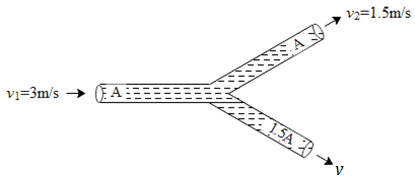
An incompressible liquid flows through a horizontal tube as shown in the following figure. Then velocity v of the fluid is
Answer
 Verified
562.1k+ views
Hint: Assume that the liquid is non viscous and flows steadily. In the above diagram we can see that the liquid flows from one tube and splits into two. Since the mass of the liquid flowing from the initial tube to the other two tubes in unit time remains the same, we can use the equation of continuity to determine the velocity of the liquid across the cross sectional area i.e. 1.5A.
Formula used:
$A{{v}_{1}}=A{{v}_{2}}+(1.5)Av$
Complete step-by-step answer:
If we see the above diagram, we can see that the liquid flows from one tube and then divides into two different tubes. Whatever mass flows across the single tube in unit time the same will get divided into the two other tubes. Hence we will use the equation of continuity to determine the velocity ‘v’ across the cross section 1.5A. Let us say that a liquid flows from a cross section ‘A’ with velocity ‘v’ to another cross section ‘a’ with velocity V. Hence the equation of continuity is given by,
$Av=aV$
If the same liquid splits into n tubes having the different cross sectional areas than the above equation becomes,
$\begin{align}
& Av={{a}_{1}}{{V}_{1}}+{{a}_{2}}{{V}_{2}}....{{a}_{n}}{{V}_{n}} \\
& \Rightarrow Av=\sum\limits_{i=1}^{n}{{{a}_{i}}{{V}_{i}}} \\
\end{align}$
Applying the above equation to the Y shaped tube in the above diagram we get,
$\begin{align}
& A{{v}_{1}}=A{{v}_{2}}+1.5Av \\
& \Rightarrow A{{v}_{1}}=A({{v}_{2}}+1.5v) \\
& \Rightarrow 3m{{s}^{-1}}=1.5m{{s}^{-1}}+1.5v \\
& \Rightarrow 1.5=1.5v \\
& \Rightarrow v=1m{{s}^{-1}} \\
\end{align}$
Hence the velocity of the liquid flowing across the tube of cross sectional area 1.5A is equal to 1m/s.
Note: The equation of continuity is the special case of law of conservation of mass. The equation shows that velocity of the liquid is inversely proportional to the cross sectional area of the tube or the pipe. If the liquid is viscous and does not flow steadily than the above equation is no longer valid.
Formula used:
$A{{v}_{1}}=A{{v}_{2}}+(1.5)Av$
Complete step-by-step answer:
If we see the above diagram, we can see that the liquid flows from one tube and then divides into two different tubes. Whatever mass flows across the single tube in unit time the same will get divided into the two other tubes. Hence we will use the equation of continuity to determine the velocity ‘v’ across the cross section 1.5A. Let us say that a liquid flows from a cross section ‘A’ with velocity ‘v’ to another cross section ‘a’ with velocity V. Hence the equation of continuity is given by,
$Av=aV$
If the same liquid splits into n tubes having the different cross sectional areas than the above equation becomes,
$\begin{align}
& Av={{a}_{1}}{{V}_{1}}+{{a}_{2}}{{V}_{2}}....{{a}_{n}}{{V}_{n}} \\
& \Rightarrow Av=\sum\limits_{i=1}^{n}{{{a}_{i}}{{V}_{i}}} \\
\end{align}$
Applying the above equation to the Y shaped tube in the above diagram we get,
$\begin{align}
& A{{v}_{1}}=A{{v}_{2}}+1.5Av \\
& \Rightarrow A{{v}_{1}}=A({{v}_{2}}+1.5v) \\
& \Rightarrow 3m{{s}^{-1}}=1.5m{{s}^{-1}}+1.5v \\
& \Rightarrow 1.5=1.5v \\
& \Rightarrow v=1m{{s}^{-1}} \\
\end{align}$
Hence the velocity of the liquid flowing across the tube of cross sectional area 1.5A is equal to 1m/s.
Note: The equation of continuity is the special case of law of conservation of mass. The equation shows that velocity of the liquid is inversely proportional to the cross sectional area of the tube or the pipe. If the liquid is viscous and does not flow steadily than the above equation is no longer valid.
Recently Updated Pages
Master Class 12 Business Studies: Engaging Questions & Answers for Success

Master Class 12 Chemistry: Engaging Questions & Answers for Success
Master Class 12 Biology: Engaging Questions & Answers for Success
Class 12 Question and Answer - Your Ultimate Solutions Guide
Master Class 11 English: Engaging Questions & Answers for Success
Master Class 11 Social Science: Engaging Questions & Answers for Success
Trending doubts
Which are the Top 10 Largest Countries of the World?
Draw a labelled sketch of the human eye class 12 physics CBSE
Differentiate between homogeneous and heterogeneous class 12 chemistry CBSE
Differentiate between Pyramid of energy and pyramid class 12 biology CBSE
Why is the cell called the structural and functional class 12 biology CBSE
Draw the diagram of the pyramid of energy Explain In class 12 biology CBSE