




An Ideal voltmeter has
A. Low Resistance
B. High Resistance
C. Infinite Resistance
D. Zero resistance
Answer
 Verified
655.8k+ views
Hint: An ideal voltmeter is one which has infinite resistance. When the resistance is infinite, the voltmeter draws no current and hence, gives accurate readings of voltage. And the internal resistance of an ideal ammeter is zero.
Complete step-by-step answer:
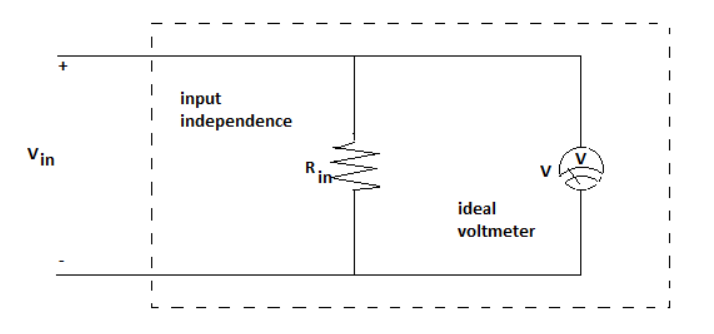
Resistance: Resistance is a measure of the opposition of current flow in an electric circuit. Resistance is measured in ohms, symbolized by the Greek letter omega$\Omega $.
A voltmeter is an instrument used for measuring electric potential difference between two points in an electric circuit. The main principle of voltmeter is that it must be connected in parallel in which we want to measure the voltage.
Parallel connection is used because a voltmeter is constructed in such a way that it has a way that it has a very high value of resistance.
An ideal voltmeter has infinite impedance, no capacitance, whatever and makes perfect readings of voltage.
Properties of an ideal voltmeter:
1. Infinite impedance
2. High Sensitivity
3. High Accuracy
4. No zero error
5. No temperature dependence
6. Fast response time
7. Good resolution
Since Voltmeter is connected in parallel with the element whose voltage is going to be measured, for an ideal voltmeter no current should flow through it, all current should pass through the connected resistance so that its voltage can be accurately measured by voltmeter. For no flow of current through voltmeter, we need infinite resistance.
Note: Ammeter is connected in series and voltmeter is connected in parallel with the electric appliance. Today’s lab voltmeters and even handheld DVM or DMMs come very close to ideal with very high impedances. The DC meters can be had with 5.5 6.5 digits and more resolution.
Complete step-by-step answer:
Resistance: Resistance is a measure of the opposition of current flow in an electric circuit. Resistance is measured in ohms, symbolized by the Greek letter omega$\Omega $.
A voltmeter is an instrument used for measuring electric potential difference between two points in an electric circuit. The main principle of voltmeter is that it must be connected in parallel in which we want to measure the voltage.
Parallel connection is used because a voltmeter is constructed in such a way that it has a way that it has a very high value of resistance.
An ideal voltmeter has infinite impedance, no capacitance, whatever and makes perfect readings of voltage.
Properties of an ideal voltmeter:
1. Infinite impedance
2. High Sensitivity
3. High Accuracy
4. No zero error
5. No temperature dependence
6. Fast response time
7. Good resolution
Since Voltmeter is connected in parallel with the element whose voltage is going to be measured, for an ideal voltmeter no current should flow through it, all current should pass through the connected resistance so that its voltage can be accurately measured by voltmeter. For no flow of current through voltmeter, we need infinite resistance.
Note: Ammeter is connected in series and voltmeter is connected in parallel with the electric appliance. Today’s lab voltmeters and even handheld DVM or DMMs come very close to ideal with very high impedances. The DC meters can be had with 5.5 6.5 digits and more resolution.
Recently Updated Pages
Onehalf of a convex lens is covered with a black paper class 12 physics CBSE

Differentiate between lanthanoids and actinoids class 12 chemistry CBSE
An object 5 cm in length is held 25 cm away from a class 12 physics CBSE
Name the following halides according to the IUPAC system class 12 chemistry CBSE
An infinite ladder network of resistances is constructed class 12 physics CBSE
How will you bring about the following conversions class 12 chemistry CBSE
Trending doubts
Draw a labelled sketch of the human eye class 12 physics CBSE
Which are the Top 10 Largest Countries of the World?
Draw ray diagrams each showing i myopic eye and ii class 12 physics CBSE
Which is the correct genotypic ratio of mendel dihybrid class 12 biology CBSE
Differentiate between homogeneous and heterogeneous class 12 chemistry CBSE
What is the Full Form of PVC, PET, HDPE, LDPE, PP and PS ?