




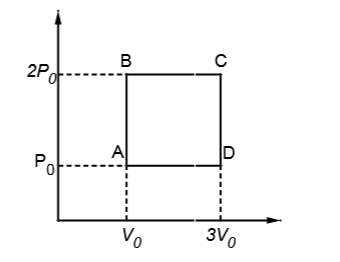
An ideal monoatomic gas is carried around the cycle ABCDA as shown in the figure. The efficiency of the gas cycle is
Answer
 Verified
629.4k+ views
Hint: Efficiency of gas is the ratio of work done by gas to the total heat given to gas multiplied by 100. We can calculate work by calculating the area under curve and heat can be calculated using the first law of thermodynamics for every process.
Complete Step By Step Solution:
The efficiency of gas going through a cyclic process is given by
$\eta =\dfrac{W}{{{H}_{in}}}\times 100$,
where $\eta $ is efficiency of gas, W is work done by gas and ${{H}_{in}}$ is the heat given to gas in the entire process.
For calculating work done by cyclic processes we can just calculate the area under P-V graph (because work done by gas in integral of P with respect to V i.e. area under P-V curve)
Work done for process AB=0, as the area under AB curve is zero
Work done for process BC=$3{{P}_{0}}{{V}_{0}}$ , as this is the area under BC curve (area between curve and x-axis)
Work done for process CD=0, as the area under AB curve is zero
Work done for process DA=$-{{P}_{0}}{{V}_{0}}$ , as this is the area under DA curve (area between curve and x-axis) and the minus sign shows that volume is decreasing.
So the total work done for
$AB+BC+CD+DA=0+3{{P}_{0}}{{V}_{0}}+0-{{P}_{0}}{{V}_{0}}=2{{P}_{0}}{{V}_{0}}$
Now we have to calculate heat given to the system. From the first law of thermodynamics we know that heat given to a gas is equal to the sum of change in its internal energy and the work done by it.
Change in internal energy is given by
$\dfrac{f}{2}\left( {{P}_{f}}{{V}_{f}}-{{P}_{i}}{{V}_{i}} \right)=\dfrac{f}{2}\left( \Delta PV \right)$ , where f is freedom of degree of gas.
For a monoatonic gas freedom of degree is 3
Heat given for process AB
$0+\dfrac{3}{2}\left( 3{{P}_{0}}{{V}_{0}}-{{P}_{0}}{{V}_{0}} \right)=\dfrac{3}{2}\times 2{{P}_{0}}{{V}_{0}}=3{{P}_{0}}{{V}_{0}}$
Heat given for process BC
$3{{P}_{0}}{{V}_{0}}+\dfrac{3}{2}\left( 3{{P}_{0}}\times 2{{V}_{0}}-3{{P}_{0}}{{V}_{0}} \right)=7.5{{P}_{0}}{{V}_{0}}$
Heat given for process CD
$0+\dfrac{3}{2}\left( {{P}_{0}}\times 2{{V}_{0}}-3{{P}_{0}}\times 2{{V}_{0}} \right)=-6{{P}_{0}}{{V}_{0}}$
Heat given for process DA
\[-{{P}_{0}}{{V}_{0}}+\dfrac{3}{2}\left( {{P}_{0}}{{V}_{0}}-{{P}_{0}}\times 2{{V}_{0}} \right)=-2.5{{P}_{0}}{{V}_{0}}\]
This negative sign indicates heat is released, but we have to calculate total heat given so we will calculate sum of positive heat given only
${{H}_{in}}=7.5{{P}_{0}}{{V}_{0}}+2{{P}_{0}}{{V}_{0}}=10.5{{P}_{0}}{{V}_{0}}$
So,
$\eta =\dfrac{2{{P}_{0}}{{V}_{0}}}{10.5{{P}_{0}}{{V}_{0}}}\times 100=19.05%$
Note: The negative sign for heat indicates that the heat is released. But this heat is often not utilized. It is the energy wasted. For efficiency of any gas to increase we need heat released to be as low as possible. We want all the heat given to get converted into work.
Complete Step By Step Solution:
The efficiency of gas going through a cyclic process is given by
$\eta =\dfrac{W}{{{H}_{in}}}\times 100$,
where $\eta $ is efficiency of gas, W is work done by gas and ${{H}_{in}}$ is the heat given to gas in the entire process.
For calculating work done by cyclic processes we can just calculate the area under P-V graph (because work done by gas in integral of P with respect to V i.e. area under P-V curve)
Work done for process AB=0, as the area under AB curve is zero
Work done for process BC=$3{{P}_{0}}{{V}_{0}}$ , as this is the area under BC curve (area between curve and x-axis)
Work done for process CD=0, as the area under AB curve is zero
Work done for process DA=$-{{P}_{0}}{{V}_{0}}$ , as this is the area under DA curve (area between curve and x-axis) and the minus sign shows that volume is decreasing.
So the total work done for
$AB+BC+CD+DA=0+3{{P}_{0}}{{V}_{0}}+0-{{P}_{0}}{{V}_{0}}=2{{P}_{0}}{{V}_{0}}$
Now we have to calculate heat given to the system. From the first law of thermodynamics we know that heat given to a gas is equal to the sum of change in its internal energy and the work done by it.
Change in internal energy is given by
$\dfrac{f}{2}\left( {{P}_{f}}{{V}_{f}}-{{P}_{i}}{{V}_{i}} \right)=\dfrac{f}{2}\left( \Delta PV \right)$ , where f is freedom of degree of gas.
For a monoatonic gas freedom of degree is 3
Heat given for process AB
$0+\dfrac{3}{2}\left( 3{{P}_{0}}{{V}_{0}}-{{P}_{0}}{{V}_{0}} \right)=\dfrac{3}{2}\times 2{{P}_{0}}{{V}_{0}}=3{{P}_{0}}{{V}_{0}}$
Heat given for process BC
$3{{P}_{0}}{{V}_{0}}+\dfrac{3}{2}\left( 3{{P}_{0}}\times 2{{V}_{0}}-3{{P}_{0}}{{V}_{0}} \right)=7.5{{P}_{0}}{{V}_{0}}$
Heat given for process CD
$0+\dfrac{3}{2}\left( {{P}_{0}}\times 2{{V}_{0}}-3{{P}_{0}}\times 2{{V}_{0}} \right)=-6{{P}_{0}}{{V}_{0}}$
Heat given for process DA
\[-{{P}_{0}}{{V}_{0}}+\dfrac{3}{2}\left( {{P}_{0}}{{V}_{0}}-{{P}_{0}}\times 2{{V}_{0}} \right)=-2.5{{P}_{0}}{{V}_{0}}\]
This negative sign indicates heat is released, but we have to calculate total heat given so we will calculate sum of positive heat given only
${{H}_{in}}=7.5{{P}_{0}}{{V}_{0}}+2{{P}_{0}}{{V}_{0}}=10.5{{P}_{0}}{{V}_{0}}$
So,
$\eta =\dfrac{2{{P}_{0}}{{V}_{0}}}{10.5{{P}_{0}}{{V}_{0}}}\times 100=19.05%$
Note: The negative sign for heat indicates that the heat is released. But this heat is often not utilized. It is the energy wasted. For efficiency of any gas to increase we need heat released to be as low as possible. We want all the heat given to get converted into work.
Recently Updated Pages
Master Class 12 Business Studies: Engaging Questions & Answers for Success

Master Class 12 Biology: Engaging Questions & Answers for Success
Master Class 12 Chemistry: Engaging Questions & Answers for Success
Class 12 Question and Answer - Your Ultimate Solutions Guide
Master Class 11 Social Science: Engaging Questions & Answers for Success
Master Class 11 English: Engaging Questions & Answers for Success
Trending doubts
Which is more stable and why class 12 chemistry CBSE
Which are the Top 10 Largest Countries of the World?
Draw a labelled sketch of the human eye class 12 physics CBSE
Differentiate between homogeneous and heterogeneous class 12 chemistry CBSE
What are the major means of transport Explain each class 12 social science CBSE
Sulphuric acid is known as the king of acids State class 12 chemistry CBSE